Tuesday, October 09, 2018

The “Ups and Downs” of Lower Extremity Edema

20180928_173817

1999I haven’t done a medical update in a while because the bottom line is not very exciting. I am recovering slowly, a little better each day, from the effects of the cancer, chemo and the stem cell transplant. According to my oncologist, the process takes about two years and I am approaching the one-year anniversary at the end of November. At that time I will have to get revaccinated and may go on a bit different recovery regimen. I am regaining strength. Joyce and I are up to about a 1/2 hour one mile daily walk and I am doing some other regular core strengthening exercises. In the meantime, I get to do a lot of reading and studying, which I enjoy very much, and am working on an “exegetical devotional” of the Gospel of Mark, which I have been posting from here on this blog. Comments are welcome on those posts.

The big issue for me is the “lower extremity edema” which is a result of the lymphoma which ravaged my lymph nodes in 2016-17. The cancer is gone but the damage done to the lymph nodes remains. I also had to have a lymph node removed from the right side of my pelvis which inhibits flow and removal a the lymph fluids from my body. This causes swelling in my pelvic area and legs. To manage it I go to a physical therapist, who gave me instruction for self-care which includes massage, exercises and the wearing of compression gear during the day. This will be something that I will have to manage the rest of my life. We are also hoping that I will qualify and be able to benefit from a machine that moves the lymph out of my lower body. It doesn’t work for everyone and it is not covered by any insurance. We are waiting for one to become available to try it out and see if it will work for me. We’d appreciate your prayers on that.

So, here are some “ups and downs” of having lower extremity edema….

The Downs

  1. It takes a long time to get up in the morning and to get ready for bed. First, there is the putting on or taking off the compression gear. That includes a jockstrap-like pad that goes on first followed by compression stockings and then compression shorts. At night they come off in the opposite order. Before I put them on and after I take them off I have a 20+ minute regimen of massage and exercise that I go through. It really helps in controlling the swelling, but I have also learned that bad results happen when I slack off on this regimen.
  2. It is uncomfortable. The pad is a little bulky and the compression gear can dry the skin. So some days the gear can cause a bit of chafing. Also the multi-layers of gear under the clothing can lead to a lot of sweating. This slows down the active life a little. As winter approaches though I am hoping the layers of gear will keep me warm and toasty, instead of just being hot like in the summer.
  3. My biggest concern when I go somewhere is how good are the bathrooms. Using one involves a bit of extra effort than in my pre-cancer days. (See above with gear off and on) I found that I loved attending a game at the Golden One Center but the Oakland Coliseum left a lot to be desired – managed it with a bit of bathroom gymnastics. Basically, it just requires a little extra time and effort.
  4. I need to watch my salt intake and make sure my body stays hydrated. Thankfully my diet restrictions aren’t much more stringent than that. I need to drink a lot of water, which seems counter-intuitive considering the problem seems to be retaining water. But what I am really retaining is lymph fluid and water moves it through my system.
  5. It hurts a little once in a while, but I am thankful the pain is pretty minimal. I have been on line and seen some cases far worse than what I have .

The Ups

  1. The regimen forces me to live one day at a time. God has made us physical, as well as spiritual, creatures and having physical needs reminds me of my daily dependence on God. That is easy to forget when you are healthy. The “chaos” is always hovering out there on the horizon and we should not forget that God is the only One who has defeated and will defeat that sin, death, sickness and evil chaos.
  2. It also reminds me of the daily spiritual care that is needed for living life. If I blow off days of massage and exercise I will see negative results. In the same way, if I blow off times of daily prayer and listening to the Spirit I will also see negative results that are just as real. This is how I can cooperate with God as he holds back the chaos.

This was supposed to be a short post so I’ll end it here. I am so thankful to God who has healed me from cancer and gives me daily strength to live day to day, no matter what we face.

Monday, October 08, 2018

Devotional: Right and Wrong at the Same Time Mark 8:22-9:1

Mark 8.23-9.1 outline

The rest of chapter completes the transition section to Jesus’ revelation to his disciples that, as Messiah, he would have to go to the cross, die and rise from the dead to open the way for the world to experience the blessings of God’s kingdom. This teaching was completely unexpected by the disciples who expected Jesus to defeat the enemies of their nation and bring in the glorious kingdom of God right away. Peter’s confession and subsequent rebuke by Jesus represented the view of all the disciples who recognized who Jesus was but failed to understand how the kingdom was to come and what their part in it would be. Thus, they needed further teaching and exposure to Jesus before they were ready to begin what would be their mission: the founding of the church community and taking the message of the gospel to the world. This teaching section (8:22-10:45) is bracketed by the healings of two blind men to show that the disciples’ blindness to Jesus and his mission needed to be fixed before they were ready for this mission.

The healing of the blind man at Bethsaida concludes the previous section (the revelation of Jesus as God’s Son) and begins this next teaching section. Jesus heals the blind man by spitting in his eye and laying his hands on him. The healing takes place in stages. After the healing Jesus tells the man to keep it quiet. The details seem strange, but they are a picture of what Jesus is about to do for the disciples. After the first stage of the healing the man says, “I see people, but they look like trees, walking” (Mark 8:24 ESV). This pictures the disciples’ understanding of Jesus.. They needed further experience of him and exposure to his teaching before they were ready to do what God had called them to do. At the end of this section, the healing of Bartimaeus (10:52) will be immediate and Jesus will command him to “go.”

Peter’s confession is like the blind man’s sight when he sees people as trees. He gets the label right, Messiah, but totally misunderstands what it means and what being part of God's kingdom is all about. Jesus rebukes Peter (he will strongly rebuke the disciples four times in this section) because he makes the same mistake as the Pharisees. He wants a Jesus who conforms to his own selfish agenda, “the things of man,” but Jesus will only bless on his terms. For the first time in Mark, Jesus reveals that the kingdom must go through the cross and resurrection and that His disciples must deny themselves and take up His cross of suffering to follow Him. He promises glory. but the cross and self-denial must come first. To teach anything else is to be a "satan."

Like Peter, and the rest of the disciples, we need regular exposure to the touch and word of Jesus to enable us to rise above our own selfish agendas and change our bad theology (wrong ideas about the character of God and the mission he calls us to do). The disciples listened, gave their lives and did their job and left us with a legacy and a body of faith to follow. We build on that foundation as we listen to the Spirit and apply Jesus’ word to our daily life and work. Jesus calls us to pick up his cross and follow his agenda for the day which may be difficult, but is only the only way to “glory” and “to gain the whole world.” The disciples were about to get a glimpse of that glory (9:1).

Saturday, October 06, 2018

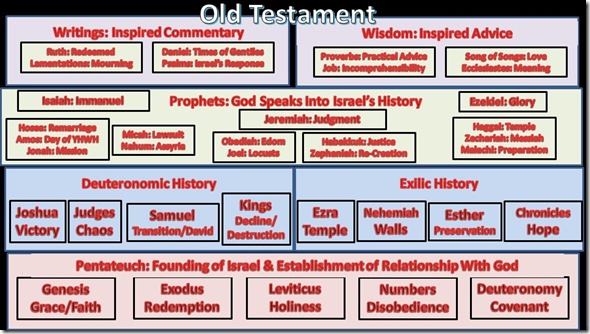
OT Message on One Page?

Old Testament One Page

The Old Testament records the story of God breaking back into His creation through the nation of Israel over a period of about 1000 years as he develops relationships with key people to teach the nations what He wants them to be and to do.

Friday, October 05, 2018

Devotional: The “Leaven” of Unbelief, Mark 8:11-21

Mark 8.11-22 outline

The next passage (8:11-21) is a critical hinge passage, along with 8:22-9:1, to conclude the previous section, in which Jesus provides the signs that the promised King and God’s Kingdom were then present, but also records the misunderstanding and rejection of these signs by the Jewish leadership and most of the people. It then introduces the next section of Mark (8:22-10:52) in which Jesus will explicitly reveal himself to the disciples as the Son of God and Messiah, but correct their misconceptions of what that means. The big point is that the Jewish leadership’s unbelief and lack of openness to what God is doing through Jesus will permeate their lives, like yeast in dough, and cause them to miss God’s blessing. He calls the disciples, and us, to really look at what Jesus has done, exercise discernment and follow him, even though, it will mean a cross, persecution and difficulty before resurrection, blessing and victory.

We see the “leaven of the Pharisees” in 8:11-13. They ask Jesus for a “sign from heaven” to prove who he was. You might be asking, “What else does he have to do?” This guy has already defeated demons, healed many kinds of disease, calmed the chaos of nature and raised the dead, but the Pharisees were looking for a sign that would have validated their own agenda for what a Messiah should do. They wanted God on their terms, not God’s terms. Thus, they repeated the sin of Eden, Babel, and that of the majority of Israelites throughout their rebellious history. With sadness, Jesus refused their request. They would get a great sign, the cross and resurrection, but God would not give them the kind of sign they wanted. At this point, Jesus “left them,” “gave them up (Romans 1.24, 26, 28), and left their country.

On the way across the lake, Jesus warns the disciples not to make the same mistake as the Pharisees. He calls them to watch carefully and discern what God is doing through him. They should not allow their preconceptions of who God is and what they thought he must do cloud their discernment about what Jesus is doing right in front of their eyes. The new greater than Moses was there revealing God’s Presence and offering life in a way that had never happened before. To understand God and what He was doing in the world would require ears that really hear what Jesus is saying and eyes that really see what Jesus is doing.

This is what Jesus calls us to do as we experience him in the Gospel of Mark. Look at what Jesus does. Listen to what Jesus says. Then let go of your own agenda. Let go of your own striving to please God in your own power. Trust him to provide the daily bread of life and follow him no matter where he leads.

Wednesday, October 03, 2018

Devotional: Jesus the Worldwide Messiah, Mark 7:24-8:10

Mark 7.24-8.10 outline

In 7:24, Mark moves the story back into Gentile territory, Tyre and Sidon, to continue Jesus’ teaching that the expectations of the Jewish leadership and the disciples of what their Messiah would be and the extent of His kingdom were too small. Jesus, by his words and actions, continues to show them that their view of what constitutes holiness is too shallow and their perspective on who is included in the people of God is too narrow. Jesus does three remarkable miracles in Canaanite territory for Gentiles to enlarge and widen the kingdom view of the disciples, and Mark’s readers, beyond their own people and desire for personal blessing, to include God’s concern for “blessing all the families of the earth” and preaching the gospel of Jesus “to the whole creation.”

In the first miracle (7:24-30) Jesus expels a demon from the daughter of a Syrophoenician woman. This miracle prefigures what Jesus will do in his death and resurrection to free the Gentile nations of the world from the domination of the demonic “principalities and powers” to which they have been enslaved since the tower of Babel. Thus, Jesus’ makes the point that this miracle “jumps the gun” a little on God’s plan to redeem the world. Nevertheless, because of her faithful response, he performs the miracle by a word, without even the need to be in the presence of the daughter. Jesus is truly the one who can free the nations from the bondage of darkness. The woman also provides a rebuke to the faithlessness and denseness of the Jewish leadership, and disciples, who have an invitation to sit at the kingdom banquet table but do not trust Jesus eagerly, like a little “puppy” who is “under the table eating the children’s crumbs.”  This woman’s faith should be a challenge and example to all of us.

The second miracle is the healing of a deaf man in Decapolis (7:31-37). Jesus takes him aside and heals his deafness and speech impediment by placing his fingers in his ears and touching his tongue. All of us need that kind of intimate connection with Jesus if we want to hear him and speak for him properly. Again we see Jesus “opening” what the powers of darkness had kept closed for thousands of years, and Jesus warns the man to “tell no one,” because the full realization of this freedom awaited his resurrection and ascension. Just like the deaf man, even the disciples (and us very often) were deaf to what He was saying and needed to humble themselves and receive what Jesus offered before their “speech impediment” could be removed and they could announce this “good news” message of God’s kingdom.

Finally, Jesus repeats the miracle of the feeding of a large crowd (8:1-10), this time with seven loaves and a few fish. The point should have been quite clear to the disciples: The God who provided bread for the Jewish nation to enter the promised land is now extending the offer of salvation, kingdom and blessing to the whole world. God has always had compassion for the needs of the whole world and the disciples are now being called to experience the intimate healing word and touch of the Messiah, the Son of God, and distribute its benefits to all of creation.

This is the lesson for us. We are to be as eager for the word and touch of Jesus as open-mouthed hungry puppies under a banquet table. And when we receive it, God calls us to pass it on to whoever is around us.

Tuesday, October 02, 2018

Principles on Forgiveness From the Life of Joseph (Genesis 37-50)

Principles on Forgiveness and Reconciliation from The Life of Joseph

  • Sometimes the means of the world’s salvation is your pain, betrayal and suffering
  • Forgiveness and Reconciliation are not the Same Thing
    • They are part of the same process but different parts of the process
    • Forgiveness must be given unilaterally but reconciliation requires the cooperation of both the victim and perpetrator

Principles of Internal Forgiveness

Definition: Internal forgiveness is a unilateral decision made within the heart of the victim to accept what has happened as part of the plan of God to bless him/her, and a commitment to be a conduit of God’s blessing to the offender. This does not mean that the victim condones the behavior of the perpetrator in any way. The behavior of the perpetrator must be faced and named for what it is, but the victim gives over the response to God and the proper authorities (state, church etc.) to hold the perpetrator accountable.

  • The victim must release the desire for revenge and retribution
  • The victim must see his/her suffering as something God can use to bring blessing to him/herself and to others
  • The basis for internal forgiveness is the character and plan of God
  • Internal forgiveness should be given quickly as possible, although deep pain may make this a long process
  • Forgiveness must be granted freely, permanently and unconditionally
  • Internal forgiveness must be given over and over despite what the offender does. The behavior of the perpetrator is not the responsibility of the victim
  • Forgiveness must be granted sacrificially
  • Forgiveness obligates one to seek reconciliation although it should be recognized that with some offenses reconciliation will never be possible

Principles of Interpersonal Forgiveness/Reconciliation

  • Full reconciliation must not be given until the offender has fully repented from the action and it is reasonable to believe that the victim or others will not be hurt by a repetition of the offense
  • Interpersonal forgiveness should be granted with the level of publicity at which the offense took place.
  • Reconciliation of relationships is an important means in God’s plan to bless the world.


Monday, October 01, 2018

Devotional: What Is Holiness? Mark 7.1-23

Mark 7.1-23 outline

The big question for all religions is, what is it that brings us into God’s presence?" What is it that God wants us to be and do? Jesus answers that question in a unique way in Mark 7.1-23 when the Pharisees question him about keeping their traditions that had been passed down over the years after Israel’s return from exile. Interestingly, Jesus does not really respond directly to their accusation, but questions their entire premise: their basis for holiness. The Pharisees had created many traditions that they thought placed a “fence” around the law and protected it and thus, identified the people of God by keeping ritual and rules. But Jesus rejected this means of identifying God’s people and granting them relationship with God. Instead, he taught that holiness does not come from external actions or traditions, which tend to separate us from one another and become a "who's in, who's out" criteria, but from inner attitudes of submission and love for God and for others that come out in our actions to one another. Relationship with God is only possible through a change of heart, (predicted by Moses, Jeremiah and Ezekiel in their new covenant prophecies) accomplished by Christ and implemented by the Holy Spirit, which then results in thoughts and actions that reflect the image of God.

In 7:1-13, Mark recounts Jesus’ dialog with the Pharisees about keeping rules and traditions. Jesus’ point is that reducing the commands of God to external human rules is just a way to avoid obeying the harder issues to which God calls His people: self-sacrificing love for God and for other people and attitudes and actions which reflect the character of God. Instead of loving God and serving people, these human rules put barriers between people that allow us to self-righteously condemn others and justify ourselves while we fail to allow God to deal with the sinful issues in our own lives. Jesus’ example is the Pharisaic rule of “Corban” which allowed a person to designate a future gift to God so that he did not have to use it to take care of one’s parents – something directly commanded by God. Rules allow people with hard hearts to keep a semblance of religion while denying its heart and soul.

Jesus then explains his point to the disciples in 7:14-23. Sin that causes people to separate themselves from God comes from the heart and out into the actions, not the other way around. The issue is the heart, not the outside. Rules about ritual and food do not make people acceptable to come into God’s presence. Thus, all foods, and associations with all people are clean. The problem is not external but an internal compulsion that expresses itself in a wide variety of evil actions. Jesus here is pointing out the need for a changed heart. And who can do that but the one who can heal all diseases, expel demons with a word and calm the chaotic sea? The issue is the heart and only connection to Jesus can fix that.