Monday, October 22, 2018

Devotional: Missing The Moment, Mark 11:13-26

Mark 11.12-26 outline

The next section (13-26) is an acted out judgment on the temple and nation of Israel. The two sections about the fig tree bracket Jesus’ disruption of the temple ministry. Like the fig tree, the temple and what it stood for was rejected for lack of “fruit.” Israel had been chosen to bless the nations by making God and his blessings accessible to them, but instead they proudly thought of themselves as better than the nations, selfishly used God’s blessing to enrich themselves and rejected God’s Messiah. So, Jesus symbolically condemns the sacrificial system, the corruption of its leadership, and the perversion of its purpose away from God's design for it. God had come through on his promise. Messiah, the glory of the incarnate Son of God,  had come to his temple (Haggai 2:7, Malachi 3:1) but his people were not ready.Their leaders rejected him because they were too busy taking care of their own business.

Jesus’ symbolic actions with the fig tree showed that the temple religious system had failed and was about to be replaced. The temple was supposed to be “a shining city on the hill” that would attract the nations to God and serve as a center of outreach to the poor and needy. But, as in the days of Jeremiah, it had become a den of thieves” (Jeremiah 7:4-12) that had allowed selfish, perverted people to think that they were insulated from God’s judgment. As in the days of Isaiah (56:7) the temple was not a “house of prayer for the nations,” but instead was a nationalistic shrine which separated and excluded foreigners and outcasts from salvation. With a few exceptions this had been the story of the history of Israel. Now, the Jerusalem mountain (11:23) was about to be removed. God was now doing something new in Jesus and that old system, like the fig tree, had been rejected from the roots up. The nation’s hope, like ours, was not to be in a building, a symbol, a program or a ritual but in “receiving” the LORD who had come to his temple and replaced it, and would now reside in his people.

The old way was done and the new way had begun, so Jesus closes this section by describing what his new way would require. Jesus’ kingdom would be all about “faith in God (22)” Prayer would be effective everywhere, not just Jerusalem, because the whole earth will be reclaimed by God. Prayer that trusts God and his promises for the impossible will accomplish its goal. Instead of excluding, the new way will be characterized by forgiveness which reconciles people to God and to one another. Jesus was there offering this new way of forgiveness, life and blessing. Sadly, the leaders missed their moment. Because of their fear (11:18) they tried to destroy him and, in doing that, destroyed themselves. Today, bearing fruit means a faithful witness to the nations in word and action, prayer that trusts God’s promises as the basis for life and a willingness to forgive as God has forgiven you.  This is the fruit Jesus is looking for today. May he find some on our trees.

Friday, October 19, 2018

Devotional: Be Ready for the King’s Arrival, Mark 11:1-11

Mark 11.1-11 outline

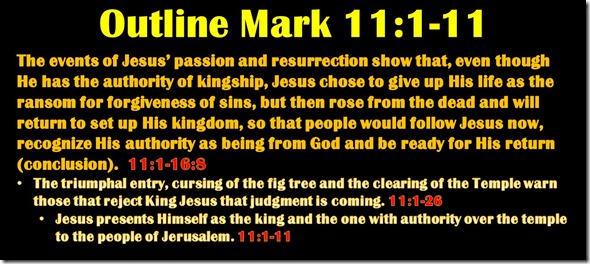
Chapter 11 begins the climactic section of the Gospel of Mark. Mark has been taking his readers on a journey with Jesus and the disciples to discover who Jesus is and what that means for the lives of those who come into contact with him. In this passage, Jesus, very deliberately, presents himself to the nation as the Messiah, the one to fulfill the prophecies about the great Son of David and the one who would bring in the age to come. The disciples and the people of Jerusalem recognized what Jesus was doing and rejoiced that the promised deliverer had come. But, just as Jesus had been cautioning in his teaching all along, he came in a way they did not expect. They were expecting a bloody, conquering messiah who would fulfill their personal and national hopes. But, as promised to Abraham and throughout the Old Testament, Jesus came to free everyone oppressed by evil and death and to be a blessing to all the families and nations of the earth. To do that he would not shed the blood of others but pour out his own blood as a “ransom” for the liberation of all humankind. The “Day of the LORD” had come and no one, including the disciples, was ready for it.

Jesus makes his entrance into Jerusalem when it was packed with people for the Passover celebration. Speculation would have been rampant about what this popular healer and teacher was about to do. He makes his entrance in a way that would have brought to mind well-known messianic prophecy (Genesis 49:10-11 and Zechariah 9:9). As king, he commandeers the donkey colt and it is given to him. The people recognize the statement the king is making. The problem is that the people, especially the disciples, have not been listening to what Jesus has been saying about his kingship. Their preconceived ideas and their own selfish desires have kept them from hearing the word of Jesus which leads to life and faith. Thus, when the events unfold exactly as Jesus said they would, everyone, again including the disciples, abandons him.

The section ends with Jesus arriving at the temple and  “looking around at everything.” On that first day of the passion week Jesus came to reveal himself as king but also to assess the nation for judgment. The revelation of Jesus as Messiah, King and Son of God calls for a faithful response. Sadly the people’s foolish expectations of their own glory led to a shallow response, that turned into rejection when those expectations were not met. Thus, they missed the blessing Jesus was coming to give. Let us make sure we listen to Jesus carefully, submit to his agenda and take up his cross and mission so that we do not make the same mistake.

Wednesday, October 17, 2018

Literary Structure of Mark 8:22-10:52

Structure of Mark 8.22-10.52

Devotional: The Way to Glory, Mark 10:32-52

Mark 10.32-52 outline

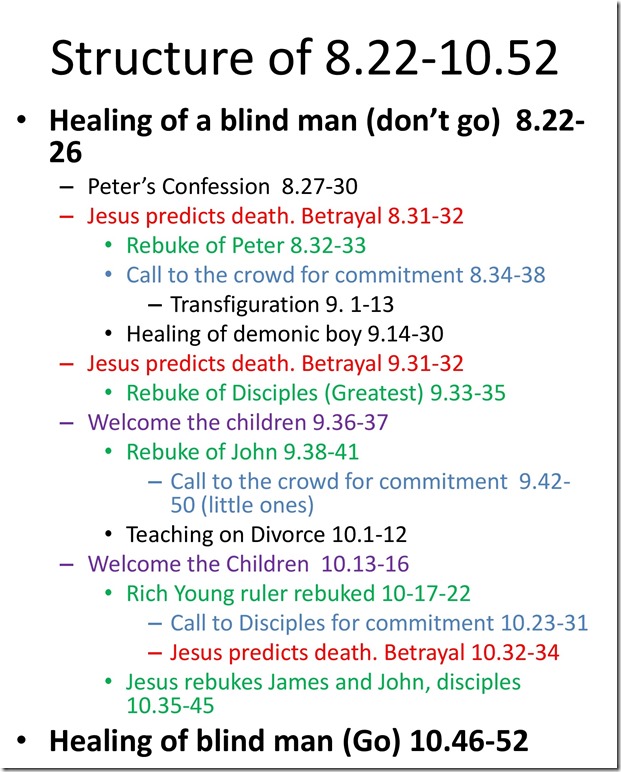
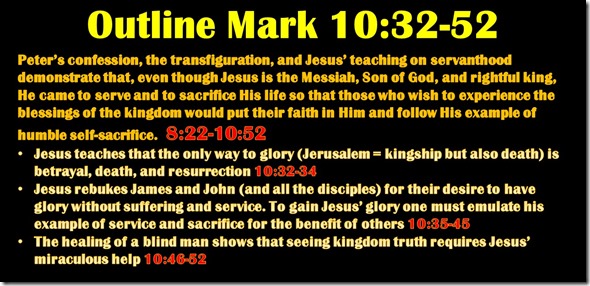
Mark closes his account of Jesus’ teaching and preparation of the disciples for his upcoming rejection and crucifixion in Jerusalem in 10:32-52. His teaching has scared and confused them so Jesus clarifies what is about to happen to him when they get to Jerusalem: he is going to be rejected, disrespected and killed, but will rise from the dead on the third day. However, John and James’ request for the prime places of authority in Jesus’ kingdom shows that they still don’t really get what he is saying. The way to real greatness and glory is not found by seizing power or manipulating others (the ways the world does it) but through service and giving one’s life to help and save others. This can only be appreciated by those who have experienced Jesus’ miraculous touch and had their eyes opened by him so that they are enabled to follow him. This is what the disciples needed and this is what we need every moment of our lives. 

Jesus now makes clear (10:32-34) that his road to glory and kingdom runs through Jerusalem where he faces betrayal, mocking, rejection, pain and death. Resurrection, ascension and glory will only come after this. For us to follow Jesus requires the same willingness to give up our own lives to serve and save others. Jesus explains that his life will be the “ransom” that sets free “many” to experience God’s forgiveness and freedom from sin, death and all its other consequences. Those that follow Jesus should expect to “drink the same cup” and for God to graciously work through their service to provide that same freedom to others.

John and James were not wrong to want to share Jesus’ glory. That is the goal of his incarnation. The problem was that they chose the wrong method. They tried to get in first (after all they were among the first disciples chosen) to get the best seats. Jesus was correcting their approach and method. The way to greatness is not through using people, seeking power, or pushing your own agenda. The way to real glory, power and authority is the way Jesus did it: through self-sacrifice and service to those who cry out (Bartimaeus) in need.

The section ends with the healing of blind Bartimaeus. He is a picture of what is required to follow Jesus to greatness. He acknowledges that he cannot see or help himself. He accepts the touch of Jesus and is healed. He then responds by leaving behind everything in his old life and following Jesus. With eyes opened by Jesus he is now ready to “go” and follow Jesus example. The reader should contrast the right response from the  unexpected person, blind Bartimaeus, with those who would have been expected to do the right things. The religious leaders try to manipulate God and the torah and trap God's Messiah. The disciples try to restrict access to Jesus and manipulate Him for personal ambition and power. The "good" man tries to reduce Jesus' demands to something he can handle on his own without following Jesus. We cannot save ourselves. Salvation requires a ransom (the life and death of Jesus). We need to meditate on what it means to follow someone who characterizes Himself as a ransom and servant.

Monday, October 15, 2018

Devotional: Too Difficult, But Really Easy, Mark 10:1-31

Mark 10.1-31 outline

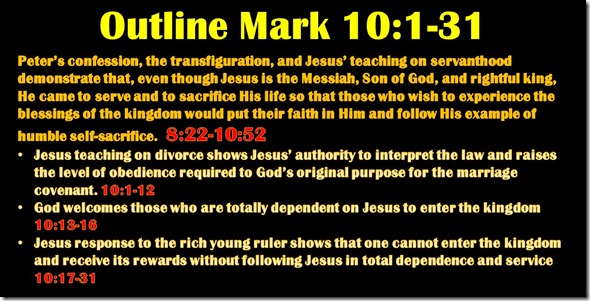
In chapter 10 Jesus continues teaching the disciples to correct their misunderstandings about who Jesus was, what he was doing and what his kingdom is like. In this section are two scenes (1-12 and 17-22) in which Jesus is asked to give a ruling about the law bracketing a short section (13-16) in which Jesus blesses and welcomes children and rebukes the disciples for trying to block them from his presence. Then Jesus drives his point home (23-31) as he explains the main point of the section: Salvation (entrance and living in God’s kingdom)  is very difficult, actually impossible, by human effort but easy for God to accomplish when we are totally dependent on him.

In the two law sections Jesus increases the requirements of the law in response to questioners who were looking to find loopholes that would make their commitment easier. Underlying the law is God’s design for relationships that requires one’s whole person to be focused on loving God, resulting in human relationships focused on loving and serving one another. Thus, marriage is not just a social transaction but is a lifetime relationship commitment, the breaking of which is always the result of sin (of at least one of the parties). Our possessions are not our own but, instead, they all belong to God and are to be used by us for advancing his kingdom and serving God’s people. Jesus raises the commitment requirement to be in his kingdom to such a high standard no human could possibly do it by his/her own effort.

The key is the middle section. Being part of Jesus’ kingdom does not happen through anything we do. It happens when we come to God like children, with total dependence on him and on what he has provided in Jesus Christ. Our efforts to make ourselves acceptable to God will always come up short. Goodness, access to God, and salvation only come as a gift from God through Jesus. In this way salvation, for us, is easy.

But salvation is also very difficult. Receiving the gift of God in Jesus requires us to deny ourselves, repent of our hope and trust in our own abilities and goodness, relinquish all of our possessions as belonging to us and there primarily for our use, and submit to God’s rule over every part of our life. Peter rashly responds, “we have left everything and followed you (ESV 10:28). Surprisingly, Peter gets no rebuke here. Instead he gets a grace-filled promise. Whatever, you give up for Jesus and the kingdom you will get back one hundred times as much “now in this time” and eternal life in the age to come. But even this will not be easy. It comes with persecution and difficulty as Jesus will demonstrate in his passion.

This is the paradox of salvation. It is easy because nothing is impossible for God to do and he has done everything needed in Christ to accomplish it. We receive it as a gift. Salvation is difficult because it calls us to give up everything we have to God. Salvation is easy because it comes with great blessing. Salvation is hard and painful because it come with persecution. But, overshadowing all of that is that salvation provides life forever in God’s presence.

Friday, October 12, 2018

Devotional: The Way to Greatness in the Kingdom, Mark 9:33-50

Mark 9.33-50 outline

The rest of chapter 9 begins a teaching section which goes through the end of chapter 10. Jesus rebukes the disciples’ use of worldly standards to define greatness and their desire for privilege which leads to the exclusion of others. This is the kind of attitude that leads to judgment and not blessing. Kingdom living is not about status, tribalism, or personal ambition, but it is about service, trust in God, connecting with those who are different from us, reaching out to the needy, and relinquishing personal pride and agendas. Jesus ends the chapter by exhorting the disciples that living in peace with one another, even with those who are not part of "our group," is one of the key indicators of real kingdom living. A relationship with Jesus connects us with God and should also connect us with the rest of God’s family throughout the world.

Jesus begins with a rebuke of the disciples (33-37) for their discussion about who was the “greatest.” I can imagine the disciples with their heads down, ashamed to look at each other as Jesus pointed out their selfish attitude. Instead of striving for privilege, honor, and status, to follow Jesus means to regard oneself with the status of a little child or a menial servant. There is nothing that carries more honor than serving the Lord of the universe and he regards serving the one with no status (a child) as serving him.

The next subject comes up as John (38-41), probably expecting an “attaboy” from Jesus, announces that he rebuked an exorcist for using Jesus’ name when he was not part of their group. Instead, he receives a sharp rebuke. We should not be so quick to condemn those who serve Jesus, but do it in a way different than we do. Other groups may worship in a different way, emphasize different things, and do things we don’t understand, but if they worship the same Lord Jesus Christ they are fellow-servants in Jesus’ house and we should be thankful for them. There are enough people who oppose us. We should be happy to have these allies.

This tendency to exclude others not like us is a very serious sin (42-50). Jesus says it that it would be better to drown in the sea than to exclude one of his children and it places one in danger of the fire of judgment. It would be better to lose body parts than to lose brothers and sisters in the body of Christ. The big issue is who “belongs to Christ.” (41). Our devotion to Christ is shown by reaching out to, including and serving those who belong to Jesus, despite their status or what they can give to us. That is how you become great in the kingdom.

Wednesday, October 10, 2018

Devotional: Glory, Suffering, and Faith, Mark 9:2-32

Mark 9.2-32 outline

In the previous chapter Jesus has unveiled the new and surprising information that the kingdom of the age to come will be brought in through his, and his disciples’, suffering, persecution and death. Does Jesus have the authority to introduce this major innovation into the hope that was prophesied and established in the covenants of the Hebrew scriptures? This is the issue Mark deals with as he presents Jesus, on the mountain and in the cloud of the presence of YHWH, as someone beyond Moses who brings a new and superior revelation. Jesus is the predicted beloved, pleasing Son of God. YHWH verifies Jesus’ authority and trustworthiness when he tells Peter, James and John to “listen to him.” Jesus, with the heroes of the Old Testament around him, corrects their view that the kingdom will come with immediate triumph, but instead will come through his suffering, death and resurrection. The disciples, and all subsequent followers of Jesus, will be called to share in his suffering before they share in his victory.

Jesus, thus gives Peter, James and John, a preview of Jesus’ glory so that they can be sure that the suffering they are called to do will certainly result in the promised glory. Both Peter, “we ourselves heard this very voice borne from heaven, for we were with him on the holy mountain” (2 Peter 1:18), and John, “we beheld his glory” John 1:14),  in their writings make reference to this event as being foundational to their faith. However, it will not be until after the resurrection, the coming of the Spirit and much reflection that they understand the full implications of what they experienced on the mountain. The curtain between heaven and earth is pulled back and Jesus' Divine glory is seen in the vision, but he reminds them, like with John the Baptist, it is also seen in Jesus' humility, obedience, suffering and sacrifice. This is the part the disciples refuse to accept and Jesus will need to respond with more teaching. The point here is that, as we trust the sure witness about the glory that is to come, we will have the God-given strength to endure the trials, persecution and suffering.

This is the point of Jesus’ teaching and actions in the next section as he expels the demon from the mute boy. Jesus is able to do it with just a word because of his great faithfulness, connection with, and trust in the Father. This powerful demon could not resist that kind of faith. The disciples, fresh off their successful preaching and miracle tour, had forgotten that this kind of power is a result of the faith and connectedness to God that is seen in a life of prayer. The prayer of the follower of Jesus must continue to be “I believe; help my unbelief!” (Mark 9.24). It is from this kind of practical dependence on God that all life and ministry must flow.

Jesus unveils the glory of God on earth even as he suffers and dies. We too, as we stay connected to him, can show his glory in both the good and difficult times we face. Faith grows as we pray and listen. Glory is certainly coming.