Friday, August 31, 2018

Reading Through The Revelation #1 (Chapters 1-3)

Revelation WrightThis read-through of Revelation will conclude (probably in 4-5 parts) this year’s devotional read through of the General Epistles of the New Testament, accompanied by The Early Christian Letters For Everyone by N.T. Wright. The book of Revelation is a single (it is not "Revelations") revelation of the resurrected Jesus Christ in glory at the right hand of the Father. The point is that Jesus will defeat Satan and all the world's evil systems and bring in His promised kingdom. Therefore, unbelievers should take warning that God's judgment is coming and seek redemption. Believers should take encouragement in coming victory and justice and prepare for God's kingdom by godly living now. I am posting from my reading in the New Testament accompanied by various commentaries on Monday, Wednesday and Friday and welcome comments and discussion on my Facebook page. I am using the Logos version of the book. As usual my comments are in black and quotes from the book are in blue.

The opening of the book prepares for the revelation of Jesus by explaining what the book is. It is a letter to the churches revealing Jesus in his glory. It opens up the heavens to the reader and connects Jesus who rules to those on earth and assures them of his upcoming victory. It provides a witness to God's people that their trials and persecutions are worth it because their oppressors will be judged, they will be vindicated and glorified as Jesus was in his resurrection. The big point is that this book is a revelation of the glorified Jesus. The rest of chapter recounts John's vision of the resurrected, ascended Jesus. The elements of this vision will keep showing up as we proceed through the book. The big point is that Jesus is the Son of Man of Daniel 7.13-14 who has the right to rule and judge. In the present, the churches (lampstands) bear the light of Christ and are held safely in his hands as they undergo persecution. Jesus shines with the glory of God and, through him, the church reflects that glory.

Revelation’ – the idea, and this book – are based on the ancient Jewish belief that God’s sphere of being and operation (‘heaven’) and our sphere (‘earth’) are not after all separated by a great gulf. They meet and merge and meld into one another in all kinds of ways...The early Christians believed that Jesus of Nazareth had become, in person, the place where heaven and earth met. Looking at him, and contemplating his death and resurrection in particular, they believed they could see right into God’s own world. They could then understand things about his purpose which nobody had imagined before. 3, Revelation 1.1-8

We are being asked to imagine: what would it look like if the curtain between heaven and earth were suddenly pulled up, revealing the Jesus who had been there all along but whom we had managed either to ignore or to cut down to our own size? This is the answer: a Jesus who is mind-blowing, dramatically powerful but also gentle and caring; a Jesus in and through whom we see his father, God the creator; a Jesus who has spoken, and still speaks, words which explain what is going on in the present, and warn of what will happen in the future. 9, Revelation 1.9-20

Chapters 2-3 contain the letters to the 7 churches. These churches represent all churches (the number seven) throughout the present age and emphasize their connection to the vision of Christ from chapter 1. They contain commendations, criticism, warnings, exhortations and promises. Ephesus represents churches with orthodoxy but who have lost their radical commitment to God and one another. They need to repent so that they can experience real life and maintain their place in the community. Smyrna represents the persecuted church. They are encouraged that persecution is temporary and, even if they die, they will not truly die because they will receive the crown of eternal life. Pergamum represents the steadfast church, but they are being tempted to compromise. They are urged to quit compromising with immorality, idolatry and heresy and they will experience real intimacy with Christ. Chapter 2 closes with the letter to Thyatira, the overly tolerant church. They are urged to resist compromise and hold on to the truth and commitment. Then they will avoid judgment and receive authority to rule with Christ.

Love’, in the early Christian sense, is something you do, giving hospitality and practical help to those in need, particularly to other Christians who are poor, sick or hungry. That was the chief mark of the early church. No other non-ethnic group had ever behaved like this. 13, Revelation 2.1-7

Do not be afraid to face the first death. Some of you will have to do that. To ‘conquer’ – to face that martyrdom in faithful patience – will mean that you will have nothing to fear from the ‘second death’. Be content to go with Jesus through the first death. He was dead, and came to life; and so will you. 18-19, Revelation 2.8-11

Jesus is promising to each faithful disciple, to each one who ‘conquers’, an intimate relationship with himself in which Jesus will use the secret name which, as with lovers, remains private to those involved. The challenge to avoid the false intimacy of sexual promiscuity is matched by the offer of a genuine intimacy of spiritual union with Jesus himself. 23, Revelation 2.12-17

Christian witness is meant to be a sign of the dawning of the day, the day in which love, faith, service and patience will have their fulfilment, in which idolatry and immorality will be seen as the snares and delusions they really are, and in which Jesus the Messiah will establish his glorious reign over the whole world. 28, Revelation 2.18-29

Chapter 3 continues the letters to the churches with letters directed to Sardis, Philadelphia and Laodicea. Sardis represents a church that is dead - has lost its viability. They are urged to "Wake Up," repent of complacency, remember God's Word and obey it or sudden unexpected judgment will come on them like the coming of a thief. Then they will have fellowship with Jesus and experience their eternal life. Philadelphia represents the persecuted church who is protected by Christ. They are encouraged to stay faithful because Christ is coming soon and they have an open door of service. In the end, even their persecutors will acknowledge that they are right. Finally Jesus addresses Laodicea, the hypocritical church. Jesus is faithful despite the fact that their hypocrisy, indifference and complacency had made them useless to Christ. They need to recognize their dependence on God for spiritual wealth, insight and righteousness and repent. If they do, Christ will come into their lives for fellowship and relationship and they will share in His victory and rule with Him. 

It’s a warning against presuming that belonging to the community of the people of God, irrespective of behaviour within it, is all that is required. To those who wake up, who stay unpolluted, and who conquer, Jesus finally reiterates another promise well known from the gospel tradition. He will ‘acknowledge their names’ before the father and his angels. To be acknowledged by Jesus himself will be amazing. To have him acknowledge us before his father will be the moment of all moments. Let’s wake up before it’s too late. 31-32, Revelation 3.1-6

(The Philadelphia Christians) are the ones, too, who carry the new name – now, the triple name of God, of the heavenly Jerusalem, and of Jesus himself, bearing his ‘new name’ of King and Lord. They are to be marked out publicly as God’s people, as Jesus’ people, as citizens of the city where heaven and earth will be joined for ever. No earthquakes there. Security, vindication, and the ultimate reward for patience. 35, Revelation 3.7-13

Jesus is a faithful friend, even if we are not – that he will tell them sharply and truly when they are in the wrong. Because he is not only a friend but their Lord, he will also punish them, not to devastate them but to bring them to their senses...As well as local colour, the letter to Laodicea carries the most striking descriptions of Jesus himself, and the most powerful promise. Strange, perhaps, that the one church that was in real trouble drew from the Lord the most intimate and loving promise. 39, Revelation 3.14-22

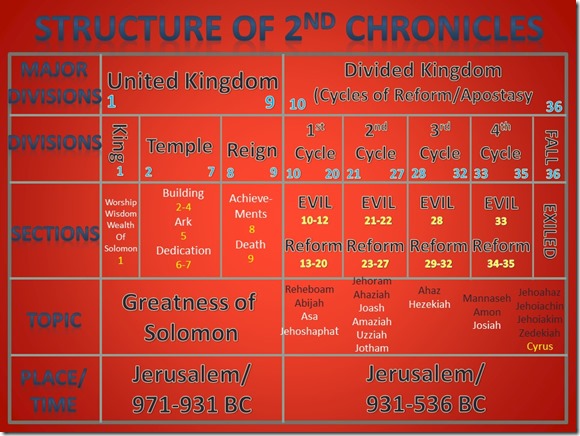
Thursday, August 30, 2018

Structure and Message of Second Chronicles

2 Chronicles Chart

Message of 2nd Chronicles

A response to God that is outward alone is useless, powerless and meaningless and brings judgment, but God’s love is always reaching out and working on the human heart to produce repentance and submission that comes from true, inward loyalty to God (Chesed). God never abandons his people.

Wednesday, August 29, 2018

Reading Through the Letter of Jude

ILetters Wright am continuing through the general epistles in this year’s devotional read through of the New Testament, in the Third Letter of John, accompanied by The Early Christian Letters For Everyone by N.T. Wright. Jude's letter is written to alert his readers to the danger of false teachers in the church. He reminds them that God knows how to judge those who reject the faith and how to preserve and protect those who hold on to the truth. Thus, his readers must recognize that there are people in the church who are trying to destroy the faith, and prepare themselves to rescue the church from them appropriately in God's strength. I am posting from my reading in the New Testament accompanied by various commentaries on Monday, Wednesday and Friday and welcome comments and discussion on my Facebook page. I am using the Logos version of the book. As usual my comments are in black and quotes from the book are in blue.

His greeting shows why defending the faith is so important. Believers are “slaves” of Jesus Christ, called into and kept in the faith by the love of God, and, thus, need the continuing work of God in their lives. His message is urgent because because false teachers have infiltrated the church to corrupt and destroy it. These teachers are ungodly, immoral people who deny the Deity and authority of Christ, despite pretending to believe. Good leaders must defend the faith because God has entrusted us with the special revelation of God contained in scripture and those who deny it will be condemned.

Find people who today are saying that God loves everyone exactly as they are, so everyone must stay exactly as they are, doing all the things they want to do, because God is so full of generosity that obviously he wants them to do that. Find such people, and you’ve found those of whom Judah is writing. 196, Jude 1-4

The main body of the letter presents examples of apostasy from the past as warnings of the danger of rejecting the truth. These rebels from the past lack submission to God and practice overreaching, abusive authority. They are seductive dangers that do not deliver what they promise and will be severely judged for their prideful words and deeds. Thus, Christians need to be able to recognize false teachers so that they can oppose them and avoid their judgment.

But the reality of false teaching, especially the rejection of authority, the denial of the uniqueness of Jesus, and the encouragement of sexual immorality, is with us today every bit as much as it was in the first century. We take a deep sigh for sorrow, and pray that Jesus the Messiah will indeed keep us safe. Part of the answer to that prayer will be that we have been alerted to the problem, so when it appears again, as it surely will, we will be able to recognize it for what it is. 202, Jude 5-16

This dark letter closes with a hopeful ending. Believers must remember that this was predicted and God is in control of the situation, and then take appropriate action to defend God's people from false teachers. Church leaders must take preemptive action to keep people in the faith by building each other up, praying, and focusing on the hope of the return of Christ. They must help those being deceived by mercifully confronting them with their errors and leading them back to the truth in a way that exposes the error but loves the deceived person. We can be hopeful, because God is the one who will ultimately preserve the truth, grow believers into maturity and keep believers safe in judgment. Thus, we can confidently fulfill our responsibility to preserve the truth of the Word and pass it on to the next generation.

The letter has had much to say about defilement, and the whole tone has been gloomy as a result. Looking into the murky pit of human wickedness is always like that. The alternative to the licentious and Jesus-denying teaching of the infiltrators isn’t, though, a gloomy, kill-joy religion. The very opposite! It is about glory, about purity, about glad and thrilling celebration. This, after all, is what we were made for. 206, Jude 17-25

Tuesday, August 28, 2018

Reading Through Third John

Letters WrightI am continuing through the general epistles in this year’s devotional read through of the New Testament, in the Third Letter of John, accompanied by The Early Christian Letters For Everyone by N.T. Wright. 3rd John emphasizes that faithfulness to the truth is seen practically in loving actions that promote the spread of the Gospel. I am posting from my reading in the New Testament accompanied by various commentaries on Monday, Wednesday and Friday and welcome comments and discussion on my Facebook page. I am using the Logos version of the book. As usual my comments are in black and quotes from the book are in blue.

Again, John gets right to the point in this letter. Faithfulness is shown by daily practical actions based on God's truth. Gaius provides a good example by supporting the ministries of apostolic teachers and providing hospitality to God's people. Christian ministry should be supported from within the church, not from outside it. Those who support Christian ministry become partners in the ministry, share in its reward, show what they really believe by where they put their time, effort and resources.  

The cheerful courage and faith both of such first-century missionaries and of those who gave them hospitality (perhaps arousing suspicious questions from neighbours) ought to remind us that following Jesus is expected to be an adventure. New things will happen. New people will come into our lives, and even though they were strangers a moment before, suddenly we realize we are part of the same family (verse 5). 186, 3 John 1-8

In verse 8 John moves to the bad example of Diotrephes. False leaders reject the apostolic authority of the scriptures, abuse their authority, and reveal a lack of truthful living by their love of control and power and with their loveless words and actions. Instead, John urges that believers, especially leaders, must continue to love God's people, respect God's word and promote the Gospel despite the opposition of false leadership.

(3 John) speaks, as in the closing verse, of ‘peace’: not the easy peace that comes from ignoring the problems, but the deeper peace that comes from confronting them in the knowledge that truth and love are the two arms with which God in Jesus now enfolds both church and world in one embrace. 190, 3 John 9-15

Jesus, The Ultimate Revelation of God…

Jesus ultimate expression of God

When we talk about God we tend to try to describe God in abstract terms like those above. Instead the Bible describes God in terms that emphasize personhood, actions, and relationship. It is not that the abstract terms are necessarily false, but they are inadequate to describe the God of the universe. Instead, God, the Trinity, chose to reveal himself incarnationally, ultimately in Jesus Christ. Hebrews 2,2-3 says “in these last days he has spoken to us by his Son, whom he appointed heir of all things, and through whom also he made the universe. The Son is the radiance of God’s glory and the exact representation of his being, sustaining all things by his powerful word. If we want to know what the Father is like we must look at the Son." As Jesus said to Philip, “Anyone who has seen me has seen the Father. How can you say, ‘Show us the Father’? Don’t you believe that I am in the Father, and that the Father is in me?” When we  explain what God is like, we must follow the Bible’s way and explain God by looking at Jesus. The character of the Father is the same as the character of Jesus.

Monday, August 27, 2018

Structure and Message of 2nd Peter

2 Peter Chart

Message of 2nd Peter

God is the gracious supplier of everything we need to live so we must diligently apply God's resources and trust his promises so that we will grow in godly character and purity, resist false teachers, and be ready for the day of the LORD.

Reading Through Second John

Letters WrightI am continuing through the general epistles in this year’s devotional read through of the New Testament, in the Second Letter of John, accompanied by The Early Christian Letters For Everyone by N.T. Wright. The main point of 2nd John is that love and truth must go together. The truth of the gospel defines what real love is. I am posting from my reading in the New Testament accompanied by various commentaries on Monday, Wednesday and Friday and welcome comments and discussion on my Facebook page. I am using the Logos version of the book. As usual my comments are in black and quotes from the book are in blue.

After a brief greeting John jumps right into the main theme of his letter. When the truth of God lives in us, the true love of God will come out in our words and actions. Love must be based on the truth of God, committed to the truth of the Gospel and always expressed with self-giving service. Love must be directed by the commands of God and and motivated by the desire to obey and please God. Daily life is directed by God's truth as we love in a way that obeys God's commands and follows Jesus' loving example. Truth and error  are recognized correctly as you build your life around the word of God and listen to His Spirit. Then you will know that you have relationship with the right Jesus. 

Truth, for John, is something that goes down deep and spreads out wide. It is what happens when humans, redeemed in the Messiah and renewed by the spirit, think, speak and act in a way which corresponds to God’s plan to renew the whole creation – and, indeed, which sets that renewal forward in whatever way they are called to do. 175, 2 John 1-6

Because faithfulness to the truth of the gospel is so important, love resists and exposes false teachers who deny and oppose Christ. There are many false teachers in the world who deny the truth and present a false Jesus and deny the full humanity of Christ. So, believers must be discerning to recognize and oppose false teaching. In fact, anyone who supports, encourages or in any way helps spread false teaching becomes a partner in its evil. Integrating truth and love will ultimately result in the true joy of fellowship.

God’s love in the flesh, in Jesus, is the source and framework for God’s love coming in human flesh in those who follow Jesus. That is how the two halves of this little letter belong so closely together. Anything that waters down this truth is not to be ‘tolerated’. 178-179, 2 John 7-13