Tuesday, May 08, 2018

Chart, Message and Outline of Malachi

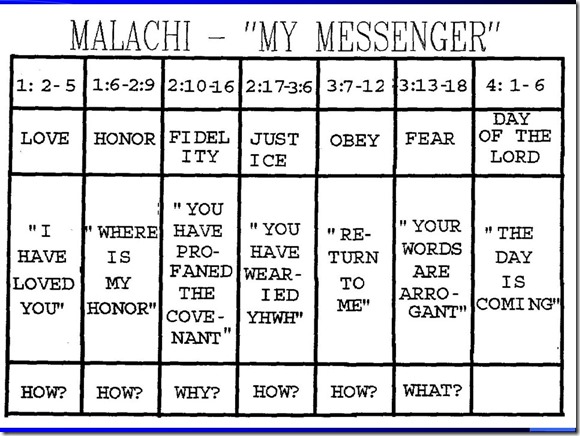
Malachi Chart

Message of Malachi

Repent NOW from your spiritual apathy and show your commitment to God with your words and actions because the Messiah is coming soon to judge and bless.

Preaching/Theological Outline of Malachi

The message is URGENT because God’s soon arrival means judgment is coming soon.

  • The message is a “burden.” Something is wrong and needs to be fixed. 1:1
  • God will separate the wicked for judgment and the righteous for blessing when He comes. 4:1-4
    God’s messenger will give a final opportunity to repent before judgment. 4:5-6

LOVE: God reaches out to you in love so respond to His love. 1:2-5

  • Charge: God reached out in love to Israel with covenant and promises and they have not responded.
  • Proof: God chose them to be His special people and gave them a wonderful inheritance. 
  • God has given the church special blessing and privilege (Ephesians 1:3-5). Our response should be loving, passionate commitment.

HONOR: Give God the respect He deserves. 1:6-2:9

  • Charge: God is not getting the respect He deserves as Father and Master  1:6
  • Evidence:
    • Sloppy half-hearted worship; giving their “leftovers.”  1:7-10
    • They gave less than their best, as little as possible. Worship was a tiresome duty 11-12
    • The priests despised the privilege of service. 2:1-9
  • We need to serve God in a way fitting to His character and to the Kingdom privileges He gives us.

FAITHFULNESS: Keep covenant with God if you want to experience blessing. 2:10-16

  • Charge: Israel was treacherous and had broken the covenant. 2:10
  • Evidence:
    • Idolatry: Their idolatrous marriages were a compromise with sin.   11-12
      • Those who compromise with sin shouldn’t expect to experience God’s blessing 13
    • Divorce: Divorce is treachery against a spouse and against God who is the witness. 14
      • God views divorce as violence; It makes Him sick 15-16
  • Solution: Guard faithfulness in all your relationships. Keep your commitments.  16b

HOPE: Trust God for the future. His character guarantees His promises. 2:17-3:6

  • Charge: God is tired of people acting and talking like He doesn’t keep His promises. 2:17
  • Warning: God is coming to His temple to purge out sin completely. 3:1-6
    • God will send warnings but His coming will be sudden (Be ready!!)
    • The character of  “God with us” guarantees salvation but also guarantees purging of sin.  5-6

OBEDIENCE: Our obedient use of money is a good measure of our commitment. 3:7-12

  • Charge: The people have not turned to God and in fact, are robbing God. 7-8
  • Evidence: The people were not paying the tithe commanded in the Mosaic Covenant. 8
  • Solution: Bring the whole tithe. Complete obedience will yield complete blessing. 10-12
  • Application: Our use of money is a good measure of our commitment under the new covenant

REVERENCE: God wants heartfelt worship that leads to committed service. 3:13-18

  • Charge: Arrogance against God 13
  • Evidence: The way the people talk to each other.  14-15  They say....
    • “It is useless to serve God” - There are no absolutes.
    • “No reward for obedience” - Self centered
    • “arrogant blessed” - Wrong, present oriented, value system.
  • Solution: Encourage one another that God has a “book of remembrance” and He will never forget faithful sacrificial service. Christians should act in the now and be motivated by the future

Do your words and actions show that you are ready for Messiah to come suddenly?

Monday, May 07, 2018

Chart, Message and Outline of Zechariah

Zechariah Chart

Message of Zechariah

Repent and obey because God is working out His purpose now and in the future God’s King is coming to rule over His people

Outline of Zechariah

Learn from the past (Repent!). Previous judgment on the nation happened just like God said it would. 1:1-6

  • Repentance must come before experience of relationship with God 1:3
  • God is very serious about dealing with sin and evil in His people. The past proves it

Be confident. Obey God. Repent of sin. Do the work God has called you to do (rebuild the Temple) because God is in control, He judges and removes sin, He gives His people power and He is preparing Messiah to come to rule and provide for His people. (God is at work now.1.7-6.15

  • Angelic Patrol: God knows what is happening and will punish sin and bless faithfulness. 1:7-17
  • 4 Horns/Craftsmen:God raises and destroys nations to work out His plan for His people. 1:18-21
  • Measuring Line: Our present worship has eternal value because of God guarantees His purpose to live eternally with His people and bless them.  2:1-13
  • Cleaning of the High Priest: Messiah (Branch) is coming to bring peace and forgiveness. Obey now and you will rule with Him. 3:1-10
  • Lamp stand & Olive Trees: God’s anointed, empowered by God’s Spirit accomplish great things. 4
  • Flying Scroll: Repent, because persistent sin will be judged according to God’s covenant. 5:1-4
  • Woman in a Basket: God will remove evil from His people and send it away for judgment. 5:5-11
  • 4 Chariots: Powerful judgment is coming on the world. God’s wrath will be appeased. 6:1-8
  • Crowning of Joshua: Messiah is coming to finish the work and be our priest and king. 6:9-15

God expects character change & obedience now to prepare for the coming of His Kingdom 7-8

  • Rebuke: Hypocritical ritual is of no interest to God 7:1-7
  • Reminder: True worship is expressed in justice, mercy and compassion to others 7:8-14
  • Restoration: The faithful few can expect full restoration of every promised blessing 8:1-17
  • Return: We sacrifice (fast) now so we will feast when the LORD returns 8:18-23

God is coming to His people. He will be rejected by them leading to great hardship and destruction. Later His people will welcome Him, repent and be saved even though every nation will be against them. 9-14

  • God is coming to shepherd His people. All who reject the true shepherd will be slaughtered 9-11
    • The king will come with judgment and salvation and in humility and power. 9:1-10
    • God will come offering blessing, deliverance, victory, compassion and regathering. 9:11-10:12
    • Most of the nation will reject the true shepherd and follow a false shepherd. 11:1-17
  • The nation will repent of their earlier rejection of God's Messiah and He will save them from the nations gathered against them, He will make them holy and rule over them as king. 12-14
    • An attack by all nations against Jerusalem will signal the end of the old age and beginning of the new. 12:1-9
    • Israel will repent, receive the Spirit and be saved. 12:10-13
    • Israel will be cleansed and made holy by their wounded shepherd. 13:1-9
    • The final battle of the Day of the LORD battle and its results are described 14:1-21
      • God will gather all nations to Jerusalem for a final battle 1-2
      • The battle will end when Messiah touches down on the Mount of Olives (3-6) and destroys His enemies  (12-15)
      • The Messiah will rule over a blessed, fertile, secure kingdom 9-11
      • God’s people will celebrate and worship. 16-19
      • Even the most common parts of life will be holy to the LORD. (Everything will be “Holy of Holies” 20-21

Reading Through the Letter to the Romans #2 (5.12-8.39)

Romans KeenerThis post continues my reading through Paul’s letter to the Romans accompanied by Romans, New Covenant Commentary Series, by Craig S. Keener. In this section Paul focuses on the supernatural nature of the Christian life. The believer is joined to God and enabled to live out God’s righteousness by the Spirit. I am posting from my reading in the New Testament accompanied by various commentaries on Monday, Wednesday and Friday and welcome comments and discussion on my Facebook page. I am using the Logos version of the book. As usual my comments are in black and quotes from the book are in blue.

In 5.12 Paul transitions from talking about entrance into the family of God and into righteousness, to how a righteous life is lived within the family of God. This new life of righteousness is a gift from God, based on Jesus' righteous life and death and confirmed through his resurrection. It is bestowed on the believer through the indwelling Holy Spirit. Thus, the believer no longer is a slave to sin, but to righteousness, and is enabled from within to choose to serve God and practice righteousness. Believers must recognize (reckon) and live within this new identity in Christ. The believer is now obligated to Christ rather than the law. Rather than being controlled from the outside by the law, which was insufficient to produce God's righteousness, we are now transformed from within by the Spirit. Thus, as the believer trusts in what Christ has done and yields to the Spirit and is connected to the whole body of Christ, God's righteousness is produced.

Paul elsewhere defines Jesus’s obedience in terms of humbling himself to the point of shameful execution on a cross, perhaps in contrast to Adam seeking divinity. Adam, by seeking greater life, brought death, whereas Jesus by dying brought life. Just as Adam introduced sin, Jesus now introduces true righteousness (5:19) that stems from solidarity with his obedience. Paul’s understanding is not that Jesus merely reverses Adam’s punishment (although his accomplishment includes that), but that Jesus came to form a new basis for humanity, enabling people to serve God fully from the heart. Romans 5.12-21, 77

For Paul identity is determined by being in Christ, but the believer must still choose to believe the eschatological reality sufficiently to live accordingly. Through faith one receives a new identity, and through faith one must also continue to embrace and live in that new identity, so that obedient works become expressions of living faith. Romans 6, 82

For Paul, the law is good (7:12, 14); the problem is not the law but flesh, which law was designed to control, not transform (8:3). Nevertheless, the regulations of the law pointed God’s people to his righteousness. When approached the right way, as God’s message and witness rather than a standard to achieve, the law supported the truth of the gospel (3:31; 10:6–8). Thus the law must be approached by faith rather than works. Its content must be inscribed on the heart by the Spirit rather than depending on efforts of the flesh (8:2–4). Romans 7, 88

Paul sums up his argument by contrasting the life lived by the external motivation of the law with the internal transformation of the life lived by reliance on the indwelling Spirit. The life that can live out the revelation of God's character in the Torah is a supernatural life produced by the indwelling Spirit, who connects the believer relationally to the Trinity, enables the believer to be involved in God's mission and goals, and works in the believer, through the external circumstances (especially suffering), to prepare believers for glory. The Spirit, who has intimate knowledge of God's will, prays for and with the believer to accomplish God's purpose. Therefore, the believer can be confident that nothing in all creation can stop the accomplishment of God's plan for the renewal of creation and completion of God's glorious image in humanity.

Western Christendom today has imbibed the radical Enlightenment’s skepticism of the supernatural, suspicious of miracles and other divine interventions. For Paul, however, the genuine Christian life is “supernatural” (i.e., divinely empowered) from start to finish, a life by God’s own Spirit. Apart from acknowledging and embracing the Spirit, the best imitations of Pauline religion are just “flesh.”  Romans 8.1-12, 104

Whatever the other benefits of the Spirit’s intercession (8:26–27), the Spirit works within believers during their sufferings to prepare them for conformity with the image of the crucified and resurrected Christ (8:28–29), i.e., to share his glory (8:30)...Believers never have to worry about the efficacy of this intercession, because it is born from God’s own presence within them (8:27), working to bring about his purpose (8:28). Romans 8.13-30, 107–108

Paul in 8:37 declares that believers “prevail completely” (BDAG ὑπερνικάω), experiencing utter victory. This is because even the harshest circumstances cannot dislodge believers from God’s love and the incomparably greater hope of glory that awaits them (8:18; hope made firm through affliction, 5:3–4). They are special to God; he is with them and has a purpose for them, working even their sufferings for eternal glory (8:28). Romans 8.31-39, 112

Friday, May 04, 2018

Chart, Message and Outline of Haggai

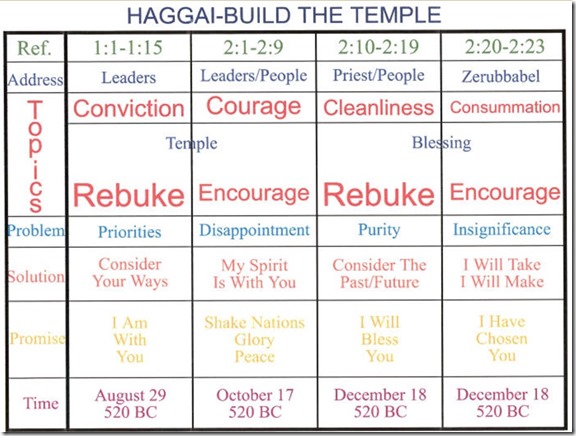
Haggai Chart

Message of Haggai

If you make your relationship with God, commitment to God’s work, and pursuit of God's Holiness, your highest priority, God will come to you, encourage you, fill your work with glory, and give you blessing.

Theological Outline of Haggai

Renew your commitment to God and to His work.   (Rebuild the Temple!) 1:1-15

  • The people’s problem was that they valued their own interests above God’s. 1:2-3, 9b
    • Your actions and the way you spend your time show what you really love.
  • God disciplined them by removing what was coming between them and God (prosperity) 6a, 9-11
  • We need to constantly evaluate our lives and actions to see if they are pleasing God. 1:5,7
    • “Set your heart” Give careful consideration to your priorities and actions.
    • You should do everything you do to please and honor God.  7
  • God desires complete and active obedience.  12, 14-15
    • Basis: They feared God. They had respect and honor for God and His Word.
    • They heard the Word, respected and then acted quickly and actively. James 1:22-25
  • God responded to their commitment by coming to them and stirring them up for action 14 
  • We are God’s temple. We rebuild the temple today when we renew commitment to worship and serve God. We need to build our own relationship with God and help others to build their own relationships with God.

Renew your courage by focusing on God’s promises, not present circumstances. 2:1-9

  • The people are disappointed and discouraged as they look at themselves and what they have done. 3
    • “Remnant” They are an insignificant people under the thumb of the mighty Persian empire.  2
    • The temple they have built is small and ugly compared to Solomon’s.
  • We become courageous when we honestly face our problems, but draw our strength from God. 4-9
    • God’s presence with us guarantees our success and blessing. 4
    • God’s promises and Spirit guarantee deliverance and salvation. 5
    • God is going to judge and destroy the powers and problems we fear. 6
  • God’s presence in our lives fills our insignificant works with power, meaning and glory.
    • Their insignificant temple would be the one that Messiah was to enter and minister in.
    • God evaluates our works on a different standard (Faithfulness, not results) 8
    • The purpose of everything we have is that it be used to bring glory to God. 8
    • God gives seemingly insignificant acts eternal glory and significance.
  • Courage comes from knowing God and gaining the Divine perspective.

Renew your cleanliness. Service must come from clean heart.  2:10-19

  • Holy work does not make an unclean person clean.  12
  • An unclean person makes a holy work unclean. 13
  • God does not accept work or sacrifice that comes from impure people.  14
  • Solution:  Holiness only can be gained from relationship with God. 15-19
    • He brings discipline to alert us to sin in our lives. 15-17
    • God offers forgiveness and blessing when we commit to relationship with Him.
  • Our holiness never comes from a person or act. It can only be given by God.

Renew your Confidence. God is in control of the future.  2:20-23

  • God is in control of nature and will use it for His purposes. 21
  • God is in control of nations and will use them to bring about his purposes. 22
  • When we become “God’s servant” the power of God is behind us. 23
    • Zerubbabel will be the signet ring. He was a Son of David and God will fulfil all his promises to David through Zerubbabel, overcome the curse (Jeremiah 22:24-25) and rule together forever.
    • Imagine what you could do as a “ring on God’s hand.”

Thursday, May 03, 2018

Reading Through the Letter to the Romans #1 (1.1-5.11)

Romans KeenerThis post begins my reading through Paul’s letter to the Romans accompanied by Romans, New Covenant Commentary Series, by Craig S. Keener. In Romans Paul focuses on God’s righteousness as it is seen in the gospel which includes Jews and Gentiles in the family of God, by grace through faith without partiality. I am posting from my reading in the New Testament accompanied by various commentaries on Monday, Wednesday and Friday and welcome comments and discussion on my Facebook page. I am using the Logos version of the book. As usual my comments are in black and quotes from the book are in blue.

The introduction to Romans follows the pattern of ancient letters. In it Paul greets the Roman church and talks about his plans. This makes us aware that even Romans needs to be understood in its immediate cultural context and is dealing with issues faced by people in a certain time and place as we gain the timeless and authoritative principles it teaches. Keener sees several ways of stating the main theme- gospel, God's righteousness, the "obedience of faith" - all of which point to the same idea. Paul is sharing the good news that the righteousness of God is available to all from Christ, as a gift which is received through faith (trust, "dependence," and "loyalty") in Christ. This restores and transforms believers into what God created him/her to be: the image of God and incorporates them into the worldwide kingdom of God.

In Romans, righteousness is a transforming gift. It is a divine gift rather than human achievement (Rom 5:17, 21), but God’s gift also enables obedience (cf. 1:5; 2:8; 5:19; 15:18), i.e., right living (6:16–18; 8:2–4; 13:14). In theological terms, justification is inseparable from regeneration. 29

The first part of the book argues that all people, Jew and Gentile, are equal before God and come into God's kingdom in the same way - faith in Christ. The Gentile should have been able to see God in creation, but instead remade God in the image of creation and debased themselves with the natural results of their worship. You become like what you worship. The Jew had the law and should have known better, but failed to live as God instructed. They would be judged by a higher standard based on superior knowledge. What God wants is heartfelt devotion to His covenant, relationship with God based on trust. Without that all outward religious observance is hypocritical. Thus, everyone enters into God's kingdom in the same way, through faith, and all are in equal in their need for grace and faith and in their status within God's people. 

Humanity “knew” God, but because they refused to “glorify” him (1:21), they ended up exchanging his “glory” and image for that of mortal, earthly creations (1:23). They were God’s image (Gen 1:26–27), but by corrupting God’s image in worshiping things other than God they gave up and lost his glory (cf. Rom 3:23). God punished their failure to act according to the truth by delivering them to their moral insanity (1:21–22). Romans 1.18-32, 34

While Paul is focusing on God’s ethnic impartiality rather than on believers here, when he later addresses such issues he seems to assume that it is believers in Jesus who are able to fulfill the role of the righteous. Christ comes not merely to forgive unrighteousness but to empower for righteous living. Romans 2, 45

Presumably by twisting Paul’s argument about justification by faith, some had insisted that Paul essentially taught that one may as well sin—a perversion of the doctrine also popular today. This conception entirely misses Paul’s point, as his letter will go on to make clear: one truly “righteoused” by faith is not only put in right relationship with God, but now has new power to live righteously (by faith that God has made them share Christ’s victory over sin. Romans 3.1-8, 53

Paul reveals the solution to the universal problem of sin and death in 3.21-5.11. God's grace has provided Jesus as a "mercy seat" (the place where the blood was spread on the day of atonement to atone for sin and to provide access to and relationship with God and inclusion in his covenant for the nation each year) which provided access to God and the blessings of the new covenant to both Jew and Gentile. This was available to all who would place their "loyal, obedient faith" in the crucified and risen Jesus Christ. Paul provides scriptural backing for this with the examples of Abraham and David in chapter 4. Neither received righteousness or forgiveness based on the law. Instead God accounted their trust in God and his promises as righteousness, despite their weaknesses and subsequent sins. The result of this is full reconciliation with God now and the gift of the Holy Spirit who provides growth in righteousness and makes sure the hope of life in God's eternal kingdom (5.1-11). Hope is sure because sin has been paid for and the growth in righteousness depends on God. Assurance comes as we trust God and see His work in us as we patiently endure the troubles of this life.

Believers are set right and made righteous as a gift by grace. For an ancient audience, the mention of either “gift” or “grace” (favor or generosity) would imply benefaction; their coupling here underlines the emphasis on the divine initiative on which believers can depend. The content of the benefaction involves “redemption,” a term denoting the liberation of slaves, as in the exodus. This experience of redemption is completed in the future, but here involves what Christ has already done, filled out in the freedom from slavery image of 6:6–23. Romans 3.21-31, 58–59

Abram’s faith is much greater years later when he offers up Isaac apparently without question (22:2–3), but this initial, somewhat rudimentary faith is sufficient to be reckoned righteous, analogous to even those initially entering the Christian faith...God was not paying Abraham his due for righteous deeds, but “reckoning” his faith as if it were righteousness (4:4–5). Romans 4, 64

In 5:11 Paul may summarize his point in this paragraph: believers can boast in God because Jesus’s death has reconciled us to him. We also boast in God alone because proven character and hope come by God’s Spirit in our hearts rather than our own work (5:2–5). “Through our Lord Jesus Christ” (5:1, 11) frames the paragraph. Romans 5.1-11, 73

Scholarship Award Dinner: “Proud Parent Moment”

20180502_183512 (1024x768)

20180502_180118 (768x1024)Joyce and I had a very enjoyable evening last night celebrating with our daughter Missy. Missy was awarded the El Dorado Center Patrons Club Scholarship at an award dinner at Folsom Lake College. She is back in school working on her degree in psychology. It was a special night for us. We have been to many scholarship dinners on Guam for our PIU students and it was very special to us to celebrate with them. But this was the first time we were able to participate in one of these with our daughter. We are very proud of how hard she has worked to get 20180502_180048 (2)herself back in school, apply for scholarships and maintain an “A” average in her classes; and doing all this while working a part-time job and being a full time mom. It was also fun to be hanging out in an educational environment again. We had a chance to talk with the president of her college, some of her teachers and directors of the scholarship foundations. It was great to be out and a good night for all of us.

Tuesday, May 01, 2018

Chart, Message and Outline of Zephaniah

Zephaniah Structure

Message of Zephaniah

A great and terrible Day of the Lord is coming soon in which all nations will be judged. Turn away from sin and seek the Lord now so you will receive grace, protection and peace instead of destruction.

The Day of the LORD is coming soon! Are you ready?


Outline of Zephaniah

Repent now because total and terrible judgment is coming soon.  1:1-2:3

  • Judgment will be complete and will totally wipe out all creation. 1:1-3
  • Judgment will divide between God’s true people and those who only call themselves God’s people.
    • God’s true people (invited to the banquet) are the silent and consecrated.  7
      • Silent: They have recognized God’s authority and submitted to Him.
      • Consecrated: They have trusted in God’s mercy, asked for forgiveness and are made holy.
  • False believers (the sacrifice) have no heart relationship with God. 6b, 4-13
    • Rebels. They reject God and worship someone else. Idolatry  4
    • Compromisers. They try to worship the true God and other gods at the same time. 5, 9
    • Defectors: They give up following God when it gets hard or too demanding. 6
    • Worldly: They choose money and power over God.  8, 10-11.
    • Indifferent: They do not take into account the spiritual. 12-13
  • The judgment will be a terrible military conflict which is coming soon and unexpectedly. 14-18
    • Usually God’s judgment is a removal of his protection so that the full consequences of sin are experienced.
  • Repent now because total and terrible judgment is coming soon.  1:1-2:3
    • We need to gather as a group (church, nation) to repent. 1-2
    • We need to personally seek relationship with the LORD.  3
      • Humility: You must recognize your own inability and need to trust God.
      • Obedience: Submit to God’s plan for your life and prove it by your actions.
      • Righteousness: Recognize that God’s standards are right and commit to them.

Small days of the LORD warn of the danger of rebellion & hypocrisy 2:4-3:7

  • God’s judgment on Philistia, Moab, Ethiopia and Assyria totally destroyed them and they disappeared from the face of the earth.  2:4-15
  • Judgment of the world should promote self-examination, not smugness, in God’s people. 3:1-7
    • Those nations surrounded Judah. The main judgment will hit God’s sinning people. 3:1
      • God’s presence in a place means a higher standard of judgment for that place 5
      • We are responsible to draw near to God when He gives an opportunity. 3:2

Be ready for the Day of the LORD so that God will relate to you with gracious blessing instead of judgment. 3:8-20

  • Be ready because the Day of the LORD is coming.
    • Wait: Have a trusting, patient, hopeful attitude as you faithfully do what God has called you to do right now. 3:8a
  • If you are not ready God will deal with you in judgment. 3:8b, 10-11
    • No one will get away with sin. It will all be punished. 8b
    • The proud, the greedy and the self-sufficient will be wiped out. 11
  • It is much better to receive grace and  have God relate to you based on blessing. .
    • He removes sin, guilt, fear, punishment from those who humbly trust and seek Him. 12-15
    • He brings people together in fellowship. Babel is reversed in Christ. 9
    • He gives people the ability to serve and worship Him.  10
    • God your Savior is happy to have a loving, protecting relationship with you. 17-20
    • Relationship with God should be full of joy and fulfillment not a drudgery. If it is a drudgery, something is wrong!