Tuesday, April 03, 2018

Structure and Message of the “10 Words” in Deuteronomy 5-6

Structure of 10 Words in Deuteronomy 5

Message of Deuteronomy 5-6

  • God’s laws are essentially instruction about who God is and how we can properly fulfill our role as the image of God in creation
    • They are built on relationship and the foundation of God’s character and God’s past actions
    • They show us how to love God with all our being within a covenant relationship
    • They show us how to live with and serve God’s creation as God’s image

Brief Owen Prayer Letter Update…

87626174F055 (819x1024)

From our latest email prayer letter…

Belated Easter greetings to everyone. I have been thinking a lot about resurrection lately. I read an article recently that suggested that maybe we don't long for resurrection as earnestly as we should because we have things too good here. I don't know about that, but I have experienced, through the trials of the past year, a deeper longing for resurrection and greater awareness of my need for the power of the Holy Spirit in my life. Last night, I will admit here, I was having a hard time dealing with my edema and runaway thoughts about what we might find on my PET scan three weeks from now, and in the dark I heard, "My peace I give to you, not as the world gives." I heard it over and over in my head. I am thankful for that peace that does not depend on how I feel in my body or in my emotions and yet affects both of those.

Joyce and I are still in waiting mode for my next PET scan. In the meantime we had a fun few days of vacation with Matt and family in Palm Desert and we will be able to go up and see Joyce's parents for a couple days next week. Our decision on what we will do next, is, of course, still pushed back as well, probably to the end of 2018. Until then, when we hope to be able to work again, we are not receiving a mission salary, but continue to use our mission account for ministry or relocation expenses. Joyce will, most likely, return to Guam in the summer to finish our move and take care of personal business.

I will begin physical therapy for the edema on Friday. No one knows how that will go. We pray that I will be able to manage the edema so that it will not be completely disabling. We would ask that you join us in prayer for that and for God's strength and comfort as we wait (that word again!) on the next test. Please pray for a cancer-free scan!

Thank you for your friendship, prayers, concern and support,

Dave and Joyce

PS The picture above was taken in February. I have more hair now!

Monday, April 02, 2018

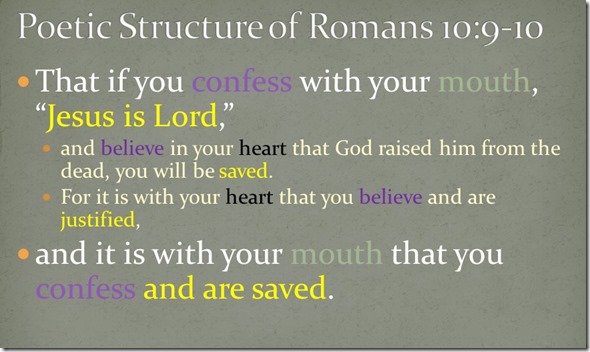
Romans 10.9-10

poetic structure Romans 10.9-10

Saving Faith proceeds from a “Heart” that trusts (gives full allegiance) in the resurrected Christ, resulting in a “confessing mouth” that demonstrates this trust in daily life.

A Few More Spring Vacation Pictures

906

We did enjoy spending time with family in Palm Desert. With four grandchildren we spent a lot of time at parks with playgrounds. Palm Desert certainly has some beautiful public parks. Here are a few pictures of our adventures at the parks.

20180328_120211 (1024x768)20180328_125825 (768x1024)20180328_125850 (768x1024)

Swings are always popular, especially when you can get someone to give you a push.

20180329_090501 (768x1024)20180329_114053 (768x1024)20180329_120155 (1024x768)

Joyce was in grandma heaven

Saturday, March 31, 2018

A Day at the Zoo–Family Vacation

20180327_120317 (1024x768)

20180327_124430 (768x1024)20180327_124522 (768x1024)Last week we were blessed to be able to spend Spring vacation with Matt and family down in Palm Desert California. Missy, Leila, Joyce and I drove down on Monday morning and we came back home on Thursday evening. It was nice to be able to spend some time with them, although we missed Mike and family with the other half of our grand-children. We stayed busy with a trip to the Living Desert and Zoo on Tuesday. We did a lot of hiking (I walked more than I have in a long time, but I survived). It was nice to be warm again too. Here are a few pictures from the day at the Living Desert.

20180327_110831 (768x1024)20180327_114304 (768x1024)20180327_120646 (768x1024)

We enjoyed the touring the zoo sections with the animals of Africa and North America. The kids got to pound on the African drums for a while. They also went on a desert hike. I sat out of that one.

Reading Genesis 1 as Ancient Cosmology by John H. Walton #4

Walton GenesisToday’s post concludes my read through of Genesis 1 as Ancient Cosmology, by John H. Walton. This section will discuss “rest” of Day 7 and present a summary of his conclusions. I strongly agree with Walton’s main points that Genesis must be read as an ancient document and that it presents creation as a cosmic temple. I am not convinced that Genesis deals only with functions, but I think it is an important discussion.  I have been posting quotes from the book on my Facebook page on Tuesday, Thursday and Saturday (NT is Mon-Wed-Fri) and we can discuss comments and questions about the passage there. As usual my comments are in black and quotes from the theology are in blue below. I am using the Logos version of the book.

Walton closes chapter 4 with a section on Day 7 entitled "Temple and Rest in Genesis." His point is that Day 7 portrays God as "resting" on his throne in his "cosmic temple" on Day 7 and assuming rule over his creation and its functionaries that were created on the previous 6 days. This makes the seventh day the climax of the creation story, unlike the way it is usually portrayed in a more traditional material creation. Thus, the creation is a temple building project. The entire universe functions as a temple (Psalm 132, Psalm 78.69, Ezekiel 47, Isaiah 66.1) and the garden of Eden is the hub, control center, of the universe. Unlike other ANET texts, humans function with God in the temple and share in its rule. I would see the command to "subdue" the earth as God tasking humanity with spreading his rule and garden throughout the entire earth as happens at the end of the book of Revelation. Thus, rest is not God disengaging from the work of maintaining the universe. It is God taking control of his creation and ruling it in partnership with the human imagers he has created on Day 6. 

As is the case in temple construction, the mere completion of the material construction phase does not produce a functioning temple. Only when the functions are identified, the functionaries installed, and the deity has entered the temple does it begin to function. This is creation as it was understood in the ancient Near East. 183

God’s presence in Eden is understood to be the source of all life-giving waters. “It is not only the dwelling place of God. It is also the source of all the creative forces that flow forth from the Divine Presence, that energize and give life to the creation in a constant, unceasing outflow of vivifying power.” In conclusion then, the Garden of Eden is understood to function as the antechamber of the holy of holies in the cosmic temple complex. 186

The creation account at its core is a narrative of the initiation of the functioning of the cosmos by recounting the primary purposes for which the elements of the cosmos have been put in place and by officially installing the appropriate functionaries in their place. The entire cosmos is viewed as a temple designed to function on behalf of humanity; and when God takes up his rest in this cosmic temple, it “comes into (functional) existence” (real existence in ancient thinking) by virtue of his presence. The rest that God thereby achieves and enjoys facilitates his rule of the cosmos by providing the means by which he engages in the control of the cosmos that he has set in order (which is what is meant, in modern terms, by “he created”). 190

Chapter 5 is a short chapter summarizing the basic conclusions of the study. His main point is that Genesis is written to ancient people in a form they would understand, not to answer modern questions of material origin. Thus, Genesis shares much of the cosmology of the ancient world, but reworks what is shared to reveal information about the nature of God, the functions of the cosmos, and the identity and functions of human beings. For example, Genesis does not correct the three-tiered (waters below, waters around and waters above) ancient material view of the cosmos, but instead corrects its view of God:one God, not many, who is separate from His creation and has no beginning. There is no "battle of the gods" for control of the universe, but the One God who has designed and manages the universe to bless his human image bearers. Humans are not slaves to God, but are in covenant relationship with Him, with an important task to care for his sacred temple space (Eden), which ultimately extends to the entire cosmos. The key to reading Genesis is to read it as an ancient book which is revealing answers to timeless questions. We must understand it within its own time and context before we can apply its timeless answers to modern questions.

The God portrayed in Genesis 1 does not set up the cosmos to function for himself but for humanity alone, though his presence in the ordered cosmos is important for maintaining this order. Finally, the role and station of humanity in the cosmos is different. The archetypal presentation in Genesis relates people to God only through his image, thereby delegating to them a ruling role in the cosmos (not just over other people); furthermore, it views them as serving deity not by meeting his needs but by caring for sacred space. Thus, Israel shares with the rest of the ancient Near East the idea that cosmology deals with questions regarding human archetypes, but the archetype that is developed has a different shape entirely. 194–195

The greatest differences in both degree and number pertain to the divine world. Israelite thinking has no element of theogony, for the Creator-God of Israel has no beginning, and there are no other gods whose existence needs to be explained. Furthermore, divine functions are not related to cosmic functions in Israel as they are in the rest of the ancient world, so the origins of cosmic functions (i.e., their existence) is not related to the existence of deity. 198

The most important result of this study for the interpretation of Genesis is the realization that the Genesis account pertains to functional origins rather than material origins and that temple ideology underlies the Genesis cosmology. 198–199

Friday, March 30, 2018

Reading Through the Acts of the Apostles #3 (6-8)

Larkin ActsThis post continues my reading through the book of Acts accompanied by Acts, vol. 5, The IVP New Testament Commentary Series, by William J. Larkin Jr..Acts 6-8 records the beginning of the transition of the church from a Jewish only movement to its extension to the Samaritans and a preview of the Gentile outreach with Philip’s ministry to the Ethiopian eunuch. I am posting from my reading in the New Testament accompanied by various commentaries on Monday, Wednesday and Friday and welcome comments and discussion on my Facebook page. I am using the Logos version of the book. As usual my comments are in black and quotes from the book are in blue.

Chapter 6 presents 2 "problems" that will lead to further growth for the church: an internal administrative problem and an external threat from persecution. With the growth of the church the Grecian Jews felt their poor were being treated unfairly by the Hebraic Jews in the distribution of resources. The disciples did not want to be distracted from their pastoral ministry and work with all sides to appoint some godly men to handle the issue. The second issue was the lynching of Stephen. A group of Hellenistic Jews accuse him of blasphemy and take him to the Jewish authorities who condemn him to death. Luke notes that Paul takes part in the execution. However, instead of slowing church growth, this persecution will incite the Samaritan and Gentile missions and bring about growth the church never could have imagined.

The proposed solution reveals the values that guided the decision: commitment to unity, to a holistic ministry and to growth by means of preaching and teaching. The decision-making process reflects equally important values for church order...If unity and growth are to be promoted, then, structures in the church must be flexible. Decision-making must be participatory, with distinctive roles for leaders and congregation. Acts 6.1-7

Should we expect more “Stephens” today? Though normally signs and wonders are the work of apostles and prophets at particular junctures of God’s salvation history, Stephen’s activity is witness to the fact that even “this restriction is not absolute.” Let us pray to be full of the Spirit and let God’s “gracing” do what it will. Acts 6.8-15,

Chapter 7 recounts Stephen's speech to the Sanhedrin after their pronouncement of death. He defends his actions and message from the story of Israel in the Old Testament. His first point is that the most important events in God's revelation, the appearances and promises to Moses and Abraham, happened outside the land and required the recipients to take bold stands of faith which required them to leave their comfortable lives and be misunderstood by those around them. The rejection of Moses and Abraham by their own people led to them missing out on God's blessings. The second point is that God and his revelation initiate worship, not human desire. Thus, a temple building is not necessary to worship God in spirit and truth. The leadership was in the same danger as the generation that missed the Promised land after Moses and that went into exile. They were about to miss God's promised salvation in the Messiah Jesus.

This encounter in the desert at Sinai should remind Stephen’s audience, Luke’s readers and us that wherever God chooses to make himself known, there is holy ground. For a second time outside the Holy Land, God had appeared to a person of his choosing and made known a portion of his covenant promises and saving will. This presents a challenge to first-century Jews, so jealous for “this holy place,” the temple, and to all others who cling to certain sacred spaces of their religious heritage. Acts 7.1-43

Today too the church may face the temptation of an “edifice complex,” assuming that unless a visible structure for the worship of God is raised and maintained, we haven’t truly worshiped or borne an effective witness. Stephen gives us perspective. Remember, it is the transcendent God we are worshiping. He does not need our buildings to receive our praise. We may need them to facilitate worship and witness. But we must make sure we need them and use them for the right reason. Acts 7.44-50

Like his Lord, Stephen dies at peace with God, himself and the world—even his enemies. He fell asleep. By showing us how to die, he also shows us how to live and models the secret of staying power of Christian witness even to death. If he can die for his Lord like that, confidently, forgiving his enemies, there must be something to this Jesus who he says reigns at God’s right hand. Acts 7.54-8.3

The aftermath of the death of Stephen is a great persecution of the church, that drives most of the church leadership, except for the disciples, away from the city. This leads to the church beginning ministry to the Samaritans and Gentiles as Jesus commanded. Philip preaches the gospel to the Samaritans with a great response. When Peter and John come down to see what has happened and place their hands on the new believers they receive the Spirit with the same signs as at Pentecost showing that God has opened new covenant blessing to these believers. When Simon the magician tries to buy this authority Peter strongly rebukes him. There can be no syncretism with the old occult and magical ways. Jesus must be the only LORD. Philip then proceeds to the wilderness road and meets a Gentile, Ethiopian court official who was a Jewish convert. He preaches the gospel from Isaiah and the Ethiopian believes and is baptized. The gospel is going out to all nations, all ethnic groups and God's plan is beginning to be accomplished.

What makes the difference is repentance from a magical mindset through an affirmation of the sovereign power of God, who grants salvation blessings when and where he will. We must affirm that it is not the power of miracle, so easily seen in our unregenerate mindset as magic, that saves us, but the power of the Word of God which by the Spirit we receive, believe and follow and so are liberated.  Acts 8.1-25

The conversion of the Ethiopian eunuch graphically demonstrates the inclusiveness of the gospel. No apparent obstacle—whether physical defect, race or geographical remoteness—can place a person beyond the saving call of the good news. Acts 8.26-40