
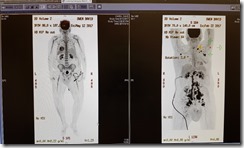
Thank you for praying for my previous prayer requests. Again I have had some side effects from the chemotherapy, but they have been fairly mild. My main concern was the edema. My body has swelled up somewhat, but it is nowhere near as bad as it was in the last round of chemotherapy. That's an answer to prayer. Tomorrow morning Joyce and I will drive down to Stanford for my PET scan. We are praying and hoping for good news that the lymph nodes have shrunk and I'm getting better. We know this is all in God's hands.
After the test at Stanford we will drive down to Scotts Valley on Friday evening. We will be staying in the missionary apartment at the Kvamme home. We won't be very mobile but we would love to have visitors at the apartment a few at a time.I was hoping we would be able to attend church at Gateway Bible Church on Sunday, but it looks like that won't happen because of my still-compromised immune system. I can’t have contact with anyone who is sick or even may be sick. Nevertheless, we would still like to see as many of our Scotts Valley friends as we can. We will head back up to Stanford on Sunday evening for a doctor's appointment on Monday morning. After that we will head back up to El Dorado.
Thank you for your prayers for us we appreciate them very much.

The book of Ruth is a beautifully crafted story about ordinary people who trusted God in very difficult times - the "days of the judges." Ruth and Boaz are examples of faithful, heroic "people of valor/strength," who live lives of integrity, loyalty and responsibility in a time where those were very rare. Boaz is rewarded with success for reaching out and caring for the Moabite outcast, Ruth. This will have much wider results, as their descendant, David, will be God's means to rescue the nation from the anarchy of the judges. Even more significant will be Ruth's role in the Davidic covenant, fulfilled by Jesus Christ, and acknowledged by Matthew in his genealogy introducing his Gospel.
The message of the book of Ruth may be considered from at least two vantage points. Viewed in strictly human terms, it underlines the importance of persistent relationships in moments of crisis. Viewed from a faith perspective, it communicates confidence in the ongoing work of God to fill the empty, to protect the vulnerable, and to bring joy into a broken world. In a small way, Ruth’s story anticipates that which is only fully realized on this side of the cross. Ruth, 322
Chapter 1 sets the scene for the rest of the story. Naomi moves from Bethlehem to Moab and loses her husband, sons, and all her means of life and support. When she decides to return, her daughter-in-law Ruth chooses to remain loyal to her and to YHWH, even though this does not seem to be to her advantage. Ruth, the Moabite is more faithful and loyal than her Hebrew mother-in-law. When they return to Bethlehem, Naomi shares her story and mourns her hopelessness. But, the barley harvest is a sign that better things may be around the corner.
Naomi is reduced to the most vulnerable of characters. She is a widow living without progeny in a foreign land. Hence, in this crisp, staccato-like cadence of narrative delivery, she is tragically and systematically deprived of her home, blood-family, security, a decade of life, and quite possibly, the blessing of Yahweh. Her future could not be bleaker. Ruth 1.1-5, 334
In the end, there is no turning back for Ruth...The task ahead will require that she muster “all her physical and mental resources.” When Naomi recognizes Ruth’s resolution, possibly at the level of personal relationship as well as faith commitment, she stopped urging her, or more literally, she simply falls silent. Ruth 1.6-18, 340–341
The long famine that initiated the flight of Naomi and her men has now given way to harvest. Similarly, Naomi’s life is about to change yet again, as a result of events in a harvest field and the actions of Ruth, still identified as the Moabitess. Ruth 1.19-22, 343
Ruth then goes out to a "random" field to glean barley and just "happens" to go the field of Naomi's relative, Boaz, who also "just happens" to be there that day. What he witnesses is a heroic effort from Ruth, as she harvests a portion equal to the wage earned by a female worker over a four-week period (357) in one day. Boaz is impressed by her and offers her the full hospitality of his operation. God is already starting to bless Ruth's faithfulness.
Just as Naomi’s people have welcomed Ruth, the blessing of Boaz invokes Yahweh’s welcome, and correspondingly, Ruth’s admittance into the people of God. The border between Moab and Israel is seemingly more porous than expected. Ruth 2, 355
Naomi then makes a bold plan to have Ruth meet Boaz while he is sleeping on the threshing floor and goad him into taking action as her kinsman-redeemer. Ruth follows Naomi's instruction to the letter until Boaz wakes up. Instead of waiting for him to act, as instructed, she assertively makes the marriage proposal herself. Boaz is thrilled to accept because Ruth's character and devotion to Naomi were well known in Bethlehem, but there is the legal problem of a closer relative. Again Boaz gives a generous gift for Ruth to take to Naomi.
Those who are in the gate know that Ruth is a “mighty woman.” The NIV’s rendering, “woman of noble character,” is a good interpretation given the larger context, but it still misses the nuance. In order to capture it, it must be remembered how other men are described in the book as “young,” or “choice”; but only Boaz is “mighty” (2:1). Clearly, the alert reader cannot escape the conclusion that the pairing of this “mighty man” with this “mighty woman” makes perfect sense. It may even explain why Ruth has not pursued others. No one else was her match! No one else was her equal! Ruth 3, 373
The next day Boaz takes care of the legal problem. He finds the closer relative, called "Mr. Whatever" by the author of Ruth, and brings him into the village court. Understanding the text and customs here is difficult, but Ziese sees Boaz' words as a challenge to the man to redeem the property, knowing that Boaz will marry Ruth and possibly father a child who could make a claim on the property. "Mr. Whatever" bows out at that point. Boaz then marries Ruth and they have a child, Obed, who will be the grandfather of King David. Thus, this has much wider implications than rest and blessing for Boaz, Ruth and Naomi. The blessing of the women reflects the wording, "build a house," of the Davidic covenant. Ruth's faithful actions become a key event in the salvation history of the whole world leading to the birth of another, greater, more important baby, Jesus Christ.
The end reveals that this small story, opening with the smell of death, is really about the triumph of life, and that the feelings of hopelessness associated with the annihilation of a family name, will grow into the celebration of a dynasty. Ruth 4, 379
A temporary and local fulfillment, to be sure, is seen in the image of what must have been regarded as a miracle baby, resting in the arms of widowed Naomi. However, an eternal and worldwide fulfillment is recognized in the image of another miracle baby, likewise born in Bethlehem, some thousand years later. Through his teachings and actions, this son will offer the final and fullest meaning to the expression gō’ēl-redeemer. Ruth 4.13-22, 398

Proverbs 22.17 begins a new section (22.17-chapter 24) of the book entitled The Sayings of the Wise. It contains "30 sayings" designed to train young leaders in ethics, wisdom, and prioritizing their lives in accordance to what YHWH wants them to be. It describes the pitfalls of wealth and greed, laziness, pleasure etc. and how to minister to the needy and use wealth and power wisely.
The process of growing in wisdom...is subtly embedded in verses 17 and 18. The initial phase involves the ear: “pay attention and listen,” says the teacher. Then the student engages the mind, apply your heart to what I teach. That which is reflected on is also committed to memory, keep them in your heart. Finally, the lips are brought into service: and have all of them ready on your lips. Wisdom involves hearing, memorizing, reflecting, and speaking with rhetorical sensitivity. Proverbs 22.17-18, 204–205
The goal of the punishment is not the venting of parental anger and frustration but the saving of a youth’s life from untimely death. In Proverbs, the rod is always administered in the context of a loving family environment (13:24b). This admonition to parents should be read in light of the succeeding instruction in verses 15–16, which speaks of the affection a father has for his son. Proverbs 23.13-16, 210
All through Proverbs, those who are wise learn to respect their enemies (17:13; 20:22; 24:29). The enemy must not only be respected, he is to be treated with kindness (25:21–22). This is a principle taught in the Old Testament (Exod 23:4–5). Proverbs 24.17-18, 217
Chapter 25 begins a section of proverbs of Solomon collected and edited by the "men of Hezekiah." 25-27 are a collection of analogical proverbs which encourage us to observe life closely to better understand how to apply words and actions of wisdom. Wisdom is built on the foundation of God's revelation, but is worked out practically in daily life through research, observation, hard work, developing good habits, listening to good advice and figuring out how God's creation works.
The more fundamental difficulty in this couplet, however, is not the meaning of burning coals but the admonition to actually practice doing good to those who hate you. To love one’s enemies is a recurring theme found in Proverbs. Proverbs 25.21-22, 230
These verses describe the contextual nature of words and actions. According to Van Leeuwen, such a concern is a hermeneutical one: “Wisdom, to a very large extent, is a matter of interpreting people, events, situations, actions in relation to norms for existence.” Proverbs 26.1-12, 234
Human life is lived in a constant state of change. The sages, however, did not respond with a fatalistic attitude; they did not live in a state of anxiety, wringing their hands in despair. Instead they offer a vignette of a hard-working farmer who goes about his task responsibly and carefully in the face of an uncertain tomorrow. The farmer cares for the creation over which God has placed him. He cares for his family and loved ones. Through such responsible caring, he finds wisdom, satisfaction, and fulfillment in life. Proverbs 27.23-27, 251
Chapters 28-29 contain antithetic proverbs which contrast thinking and behavior of wise and evil, righteous and wicked people, and the outcomes of those lifestyles. The qualities of the wise and righteous include humility, confession of sin, openness to rebuke and advice, hard work, generosity to the poor, fair treatment of others, integrity, resistance to greed, self-control, gentle in words and actions, and submissive to God's revelation. Societies with this kind of people, especially that are led by wise, righteous leaders, will be healthy and productive and tend to last longer.
The lines are clearly drawn between those who contribute to society and those who dehumanize society. There is no middle ground. In a pluralistic culture, such clear demarcations do not sit well, but to make such distinctions is essential to the health of the nation in which one lives. God calls his church to represent these qualities of righteousness in its body life. Proverbs 28, 252
The evil find themselves entrapped by their own destructive lifestyle. But the righteous face the snares and temptations of life confidently, knowing that they will overcome. Proverbs 29.6, 262
Proverbs ends with four sections. First the words of Agur show that wisdom takes into account the limitations of humans and the limitlessness of God. Chapter 30 the concludes with several numerical sayings that contain wise observations about human behavior. The words of King Lemuel (31.1-9) recall his mother's wise advice about how a righteous king should rule. Finally, Proverbs concludes with an acrostic praise song to wisdom personified as a woman. If one "marries" wisdom they will tend to have a prosperous and successful life.
Verses 1–9 reflect a worshipful reverence to God. In the face of the uncertainties of life, the worshiper comes to rely on God’s word (vv. 5–6) and on God for the necessities of life (vv. 7–9). Trusting in God enables the worshiper ultimately to accept human limitations. Proverbs 30.1-9, 273
The virtue highlighted in this instruction is central to the life of the wise, and that is self-control. The specific thought is that foolish behavior, especially uncontrolled speech, will produce nothing but negative consequences. Trouble follows those who create it. Proverbs 30.10-33, 280
The queen mother calls for her son to take action for the cause of the poor. He must speak out for the rights of all who are destitute. Once again, the focus of the admonition is not on the privileges the son receives as king, but on his responsibilities. Proverbs 31.1-9, 282
Chapter 31:10–31 complements the Woman Wisdom described in chapters 1–9...Placed at the end of the book, the “woman of noble character” represents the culmination of a life lived by wisdom. She is wisdom incarnate. The house she builds is the goal toward which all strive (cf. 9:1; 14:1; 24:3–4). Proverbs 31.10-31, 283


In chapter 6, Taking the Holy Spirit Seriously, Packer looks at the person and ministry of the Holy Spirit, and urges the church to re-emphasize his role in it. He laments that institutionalism, formalism, moralism, and traditionalism (I would add bibliolatry which substitutes biblical knowledge and doctrinal precision as the main goal for the church, instead of that being the means by which the Spirit produces Christ-likeness in the individual and unified effective ministry in the church) have removed emphasis on the Spirit in many evangelical churches. Renewed emphasis on the Holy Spirit is absolutely critical, because he is the Divine Person who strengthens and empowers the church to be what Christ called it to be. He is God working inside us, renewing our hearts, causing faith to spring up, convicting us of sin leading to repentance, and connecting us to other believers. He maintains the unity that Christ has provided for the church. If we want to be what Christ has called us to be we must take the Holy Spirit seriously.
As we Christians are upheld by the Holy Spirit in the life that we live with God and for God, so was our Savior before us. As we live in a simultaneous relationship with the Father, the Son, and the Holy Spirit, who are always together and never apart from each other, so were the Father and the Spirit together with the Son when he was on earth, as they are still and always will be. 114
The Spirit, using the Word of God as both scalpel and exercise machine, straightens out our inner crookedness and energizes us for spiritual understanding, spiritual response to God, and spiritual, love-led, Christlike, God-honoring behavior as our lifestyle henceforth. 116
The unity of the church embraces all believers—Protestant, Roman Catholic, and Orthodox—while paid-up church adherents everywhere who lack personal faith in Christ are still outside the church as God discerns it, however zealous for their own denomination they may be. Packer, 122
Next, in chapter 7, Taking Baptism Seriously, Packer says that the average church member does not really understand the significance of baptism or value it the way we should. As one of the two rites commanded by Christ it is critical for the Christian life as the symbolic entrance into the relationship with Christ. It is a mystery (there is more to it than the mind can grasp), a sacrament (a pledge of loyalty from God and to God) and an ordinance (a covenant ceremony). It represents that we are now "under the new management" of the Trinity, "plugged into" Christ and all his benefits, and joined in unified discipleship to His church. Baptism is significant and should always remind us of our identity in Christ, our supernatural holiness through Christ and our loyalty to Christ.
The symbolism of first going under water as a sign of saying good-bye to the style of life one is renouncing and then coming up from under as a sign of starting a new life pattern is clearly expressed, and that evidently is what is important. The washing symbolism shows that this commitment is conceived within the frame of an absolution from the past that sets one free for the new beginning. The rite is thus one of termination, initiation, and commencement. J. I. Packer, Taking God Seriously, 128
Paul wants us to know what has happened to us through our faith-union with Christ: namely, that within our unchanged personal identity, the power that made the world has made us into new creations (2 Cor. 5:17), terminating our old, self-centered, naturally sinful mode of existence and, to borrow again Paul’s elegant horticultural image, grafting and implanting us into our risen Lord—plugging us into him, as we might less elegantly put it—with new desires, new powers, and new joys directly resulting. 138
Loyalty to Christ requires that we seek to make a difference by being different; and as in baptism the Father, the Son, and the Spirit pledge loyalty to us, so we the baptized must see ourselves as having pledged our loyalty to Christ categorically, without any ifs or buts, and as committed here and now to live out that loyalty every day of our lives. 144
In chapter 8, Taking the Lord's Supper Seriously, Packer accuses the Western evangelical church of devaluing the ordinance/sacrament of the communion/Eucharist. He says it should be the "twin" in the worship service with preaching and should be observed every Sunday. It is a symbolic ritual where we remember what Christ's death and resurrection accomplished for us and a covenant ceremony in which we confess sin, express our faith and publically pledge our loyalty to Him. God engages with us as we approach Him at the communion table. The communion table is also a place where we commit to help our needy brothers and sisters in the Body of Christ.
The words instituting the sacrament have shown us that remembering our Lord should mean both calling to mind his sacrificial death for us and embracing his covenantal commitment to us. And the act of actually taking the food and drink as from him should express the renewal of our trust in him and our ongoing dependence on him as our Savior, Master, discipler, friend, and our life itself. 154–155
So as we share in the Supper, we should be asking ourselves, and asking the Lord Jesus to show us, what human needs we should devote ourselves to serving once our Eucharistic service is over and we have scattered back into the wider world. 157
It is the presence of the triumphant, sovereign Savior, who is there in terms of his objective omnipresence and here in terms of being always alongside each believer with a sustaining and nurturing purpose. Clarity requires us to say, then, that Christ is present at, rather than in, the Supper. Though not physical, his presence is personal and real in the sense of being a relational fact. Christ is present, not in the elements in any sense, but with his worshippers; and his presence is effected, not by the quasi-magic of ritual correctly performed by a permitted person, but by the power of the Holy Spirit, who indwells believers’ hearts to mediate Christ’s reality to them. 161–162

Chapters 10-15 begin the Proverbs of Solomon. These chapters mainly focus on the differences between the righteous, wise lifestyle and the wicked lifestyle by means of antithetic parallelism. When one thinks, speaks, acts righteously one develops good character which generally leads to success. Wickedness, deception, manipulation and other acts that proceed from sinful character generally lead to disaster. The wise life is worth living.
These proverbs emphasize that the choice one makes has far reaching consequences. There is an intrinsic order to the way in which the universe runs. Actions have consequences. For the wicked, there is poetic justice; the punishment fits the crime. In contrast, the lives of the righteous stand secure. This is the “elementary” teaching of wisdom. Proverbs 10, 117
In Proverbs, pride is the fundamental sin of the fool. Humility is the fundamental virtue of the wise. These proverbs speak of the results of living a righteous life. According to verse 3, the internal character of the upright governs their life (cf. 6:22–23). Character is viewed not as a single act, but as a habit. Proverbs 11, 119.
The righteous are individuals who treat all of God’s creation with care. In contrast, the wicked make it a practice to exploit others. The proverb in verse 11 highlights an essential quality of the wise person, and that is discipline. The wise one exercises diligence in all that he does. He is not fickle, pursuing worthless dreams. Proverbs 12, 127
With emphasis on diligence and discipline, the sage is cautious about anyone who gains wealth quickly. This is the basis of verse 11. Get rich quick schemes usually involve fraud. On the other hand, wealth that is slowly acquired will last. Proverbs 13.11, 132
The majority of antithetic sayings in these chapters express a simple belief: God rewards those who choose the right path, but he punishes those who deliberately choose another way. Choices in life are clear and simple. The sages seem to oversimplify life. Yet in the midst of what appears to be a dogmatic perspective, the sages themselves acknowledge their limitation (v. 12). Anyone can be misled by what appears to be the right path. Humans cannot always know what is appropriate. Proverbs 14.12, 137
Wisdom expresses its fundamental character in saying and doing the right thing at the right time (cf. 16:24; 18:13; 25:11, 15; 24:26). Proverbs 15, 148
With Proverbs chapter 16 we move into a different style of Proverbs. 10-15 has given us the basics with antithetic proverbs contrasting good and evil. The next few chapters tend more toward synonymous parallelism and "better than" sayings. These bring out the ambiguous nature of life and the need for wisdom in navigating life in a world where corrupt officials or unexpected events may negate the good rewards that come from wisdom. One emphasis is that good character, wisdom and righteousness are their own reward, and a better reward than wealth, honor or power.
Typically humans plan and then work the plan. However, here the process is inverted. Humans work, but their plans fail unless God establishes them...The proverb is not a formula for unfailing success but only a reminder that success does not ultimately lie in human hands. Proverbs 16.3, 153
Quarreling is a major enemy of the community. Like water, it erodes the foundations upon which relationships exist. It undercuts the mutual respect necessary to hold a people together. Proverbs 17.14, 164
Gossip is compared to junk food. It is quite tasty. Nonetheless when absorbed into the blood stream, it remains a permanent part of the person. Once absorbed, it destroys character. Proverbs 18.8, 169
When internal desires and external actions are not informed by reflective thought (wisdom), they will not achieve their goals. This is a fitting proverb for an anti-intellectual climate, which sometimes exists in the church (cf. also 17:16). Proverbs 19.2, 174
Wisdom is realistic about human nature. On the one hand, it sees humans with great potential accomplish much through wise planning and implementing. On the other hand, wisdom sees every human involved in sin. No one escapes its clutches. Proverbs 20.9, 182–183
Life is more ambiguous than at first glance. The righteous do not always prosper. This proverb pair acknowledges human limitation and calls on the wise to accept such limitations. Such is the nature of true wisdom...The proverb concludes, in the second line, with the element of surprise. A third party enters the picture, Yahweh. He is the one who really determines the result. Proverbs 21.30-31, 196–197
