One can’t be serious all the time so I thought the time was ripe for another post making my NFL predictions for the 2017 season. I have done this a few times in the past, but not the last couple years. I am not a prophet, or the even the son of a prophet, and my past predictions have been pretty bad (just like the experts you see on TV) but it is fun to do it. I am looking forward to this season because I think my 49ers are going to be a little better. So my first prediction is that they will win 5-7 games this year. I am looking for them to steadily improve over the next three years and become more like the great team they were in the 80’s and 90’s. We also have a family fantasy football league on NFL.com. My team started out badly Thursday night (Brady is my QB) but I still hope to achieve my main goal of not getting beat by Joyce’s team every time we play. Yep, that happened last year. So below are my predictions for the coming year. You can hold me accountable. <Smile> The picture above is from my 2013 predictions.
NFC Playoff Teams: Cardinals, Packers, Falcons, Giants, Wild Cards: Cowboys, Seahawks
AFC Playoff Teams: Raiders, Texans, Patriots, Steelers, Wild Cards: Chiefs, Titans
NFC Playoffs: Round One: Cardinals over Cowboys, Giants over Seahawks
Round Two: Cardinals upset Falcons, Packers over Giants
NFC Championship: Packers over Cardinals
AFC Playoffs: Round One: Steelers over Titans, Chiefs over Texans
Round Two: Raiders over Steelers, Patriots over Chiefs
AFC Championship: Raiders over Patriots
Super Bowl: Raiders 34 – Packers 31
We will revisit this post next February and see how I did!

Tomorrow: I will get my second immuno-chemotherapy. 
Mobilization : This step involves moving stem cells out of the bone marrow and into the blood for collection. It is accomplished by administering chemotherapy and hormones to stimulate the recovery of my white blood cells I will get some chemotherapy and receive a hormone to stimulate the blood cells. This will also involve a surgical procedure in which they will remove the port I have in my chest and put one in that can be used in both directions at the same time; putting in and taking out.
Collection: When my blood and bone marrow are clear of cancer they will quickly proceed to collect the stem cells from my blood before the cancer has a chance to recur. This will be done in 3 or 4 days at the Stanford Hospital. I'm hoping that they will be able to do this the first week of October. If the collection is successful they will store it for when they need to transplant it back into my body.

Transplant: Then, at some point during my 3 week stay in the Stanford Hospital, my stored stem cells will be transplanted back into my blood. If they are not able to harvest stem cells from my own blood, we will have to look for a compatible donor. I am really praying that it does not come to that because it creates many new risks.
Follow Up: it will take several weeks for my blood counts to recover and for my body to heal from the preparation regimen and stem cell transplant. I will need to be seeing the doctor for at least 3 months afterward (doctor said maybe a year) for follow up to see how the transplant is working. The key to all this is to get clean stem cells from my own body. The doctor yesterday told us that if they can get the clean stem cells the odds of success are 70 to 80%. That sounds pretty good to me.
We arrived at Stanford about 12:15 for our 12:30 appointment. We missed lunch and had a protein bar in the waiting room. The consulting and blood draws took us until about 4:30. Again, we were very impressed with the 
So we headed out into 5 o’clock traffic, going through San Francisco and over the Bay Bridge, on our way back to El Dorado. By the time we got to Vallejo we were starving so we headed into Olive Garden for a nice dinner for the two of us. By the time we got back to El Dorado it was almost bedtime. It was a long day but I think it was very productive. Hopefully, we have our next two to three months planned out. As I said, this is a best case scenario. A lot of things can happen, but again we know these are in God's hands. I know a lot of people were praying for us yesterday. Thank you very much and we would ask that you continue in prayer as we head into this next phase of our cancer adventure. We appreciate your prayers and we will keep you informed on how it goes.
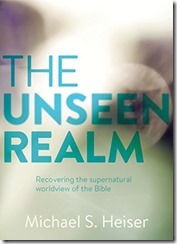
The purpose of this book is to look at the "unseen realm," the spirit world, as it is seen in the Bible, apart from modern approaches, and as it would have been understood by its original ancient audience. The first short introductory chapter, Reading Your Bible Again- For the First Time, relates the "watershed moment" for the author when he realized that Psalm 82 taught that there was a heavenly "Divine Council" of supernatural beings that were under God's judgment for mismanaging the nations. This blew apart his rationalistic understanding of the text and drove him to try to understand the OT in its original cultural and literary contexts. Thus, the main point of the book is to get the reader to interpret the Bible in the context of its ancient supernatural worldview. I agree that this is critical. My experience as a missionary is that the unseen spirit realm affected my ministry regularly, as it does in the biblical narrative, and yet Western Christians tend to act as though this realm does not exist. This is why I chose to blog through this book.
A theology of the unseen world that derives exclusively from the text understood through the lens of the ancient, premodern worldview of the authors informs every Bible doctrine in significant ways...What you’ll read in this book will change you. You’ll never be able to look at your Bible the same way again. 13
Seeing the Bible through the eyes of an ancient reader requires shedding the filters of our traditions and presumptions. They processed life in supernatural terms. Today’s Christian processes it by a mixture of creedal statements and modern rationalism. I want to help you recover the supernatural worldview of the biblical writers— the people who produced the Bible. 13
The second chapter of the book, Rules of Engagement, lays out the principles by which Heiser interprets and correlates scripture, his hermeneutic. He says that we tend to interpret scripture with filters, by which we understand it, but our modern filters keep us from understanding scripture as it was originally intended. We tend to filter out verses that don't fit our overall worldview, which means that we rationalistic moderns tend to filter out things that are supernatural and weird, or that don't fit with our preferred systematic theology. Instead we need to read scripture as a mosaic, in which ALL the parts, which may not make sense by themselves, put together provide the unifying meaning, a complete biblical theology. Tradition is important, but we need to read the Bible with our traditions, not under them. It is more important to interpret the Bible according to its own cultural, literary, and historical context and then adjust our overall theologies accordingly, in concert with others in the body of Christ who are doing the same thing. I have the same concern as Heiser: that we restore the supernatural worldview of scripture and re-open ourselves to the unseen world, our interaction with it, and miracles. If we really believe in a Triune God, virgin birth, and bodily resurrection already, why not?
Psalm 82 has at its core the unseen realm and its interaction with the human world. And that psalm isn’t the only piece like that; there are lots of them. In fact, the intersection of our domain and the unseen world— which includes the triune God, but also a much more numerous cast— is at the heart of biblical theology. 15
Modern Christianity’s view of the unseen world isn’t framed by the ancient worldview of the biblical writers. One segment wrongly consigns the invisible realm to the periphery of theological discussion. The other is so busy seeking some interaction with it that it has become unconcerned with its biblical moorings, resulting in a caricature. 17
My main contribution is synthesis of the ideas and articulating a biblical theology not derived from tradition but rather framed exclusively in the context of the Bible’s own ancient worldview. 20
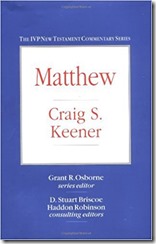
Keener begins by stating his desire to write a commentary that will "echo and apply Matthew's own message." He applies all the critical methods because he believes they tend to support the historicity of Matthew's biography of Jesus. He sees Matthew as using Mark and Q as his major sources, but that he also had other sources unknown to us. For example, he may have taken notes when Jesus was speaking. Keener suggests that we read through each Gospel completely to get the impact and unique message it brings and that is exactly what we are going to do this year with each book of the New Testament.
Jesus ate with sinners as he won them to God’s kingdom, and reserved his fiercest denunciations for those who claimed to be doing God’s will but were not doing so.
Rather than reading a story about Jesus here and there, skipping from one Gospel to another, Christians should read the Gospels the way God chose to give them to us, one Gospel at a time. Further, we should read the Gospels as narratives, as stories (in this case true stories). Like the first Christian readers, we must ask, “What is the moral or point of this story?”
As Christians we also read each book of the Bible as a message from God. We ask a final question: “Given what God inspired the author to say to the book’s first audience, how does this message address God’s people and our society today?”...For us the Bible is both history and literature, but it is far more: it is a message from God that we live by.
Keener tentatively puts the writing of Matthew in the 70's, within 40 years of the resurrection, and sees the member of the 12, Matthew, as having a part in the production of the Gospel, with it probably being completed by his disciples. Matthew was written to a Jewish audience which was being persecuted and in conflict with rabbinic Judaism. Thus, the emphasis is on Jesus as Messiah and the completer of the expectations of the Old Testament prophecies and history. Jesus also was the living "Shekinah," God's presence among humans.
Matthew probably functions as a discipling manual, a “handbook” of Jesus’ basic life and teaching, relevant to a Jewish Christian community engaged in the Gentile mission and deadlocked in scriptural polemic with their local synagogue communities.
One of the most prominent characteristics of Matthew’s Jesus is how he fulfills Scripture, sometimes literally and sometimes as the embodiment of Israel’s history. Matthew is clear that Jesus is the goal of the Law and Prophets; hence anyone faithful to the heritage and the Bible of Israel must recognize and follow him.
When Christians dare to believe that they are citizens of a future age, empowered by the Spirit who rules among them, they will begin to live like people of the future age instead of letting the world define their identity and establish their values. Through the Spirit, Christians can live out the reality that Jesus is King of the deepest values and sentiments of their hearts (Gal 5:16).
Matthew records events from Jesus' childhood and early preparation for ministry to show that he is the culmination of God's plan for the history of Israel and the mission to the Gentiles, and that, as Savior, he identifies with people in their pain and depression and saves them through it.
Matthew begins with a genealogy to show a basic truths about Jesus' mission: He came as the culmination of God's plan for Israel to bless the entire world. Besides detailing Jesus royal lineage, Matthew includes four Gentile women that married into the royal family and typify God's plan to bless the world. In the birth story of Jesus, while Luke emphasizes Mary story, Matthew emphasizes the righteousness of Joseph. Joseph chooses to obey what God tells him in a dream rather than cling to his honor which would have allowed him to divorce Mary. Joseph chooses obedience over cultural norms and the honor of his peers.
Genealogies like those in Genesis typically list a person’s descendants after this phrase, rather than his ancestors. Matthew’s point here is profound: so much is Jesus the focal point of history that his ancestors depend on him for their meaning. In other words, God sovereignly directed the history of Israel and preserved David’s line because of his plan to send Jesus. Matthew 1:2-17
As God “with us,” Jesus is also the fully human one who save[s] his people by the cross. Matthew thus invites us to consider and worship the God who accepted the ultimate vulnerability, born as an infant to poor and humiliated parents into a world hostile to his presence. Oppressors must hate such a God, for his abandonment of power for love is contrary to everything they stand for. But the broken and oppressed find in him a Savior they can trust in a world where trust is generally dangerous. Of all the world’s faiths, only Christianity announces a God who embraced our pain with us. Matthew 1:18-25
The story of the Magi is another of the indications that Matthew is concerned for the mission to the Gentiles. The irony here is that pagans are honoring God's Messiah, while the religious leaders of the Jews, who know enough to know where Messiahs born, are not willing to go out of their way even to go find him. Herod typifies the oppressor of God's people. He reminds one of pharaoh. And like the Israelites in Egypt, Jesus's family becomes refugees fleeing Herod, but preserved by God. Ultimately the oppressor dies and God's plan goes on. Jesus lives his early life in Nazareth and Matthew makes a word play off the Hebrew word nazar, the “branch,” to show that the plan for Messiah will start small, but moves on despite the opposition of the world.
God who rules the heavens chose to reveal himself where the pagans were looking. Without condoning astrology, Matthew’s narrative challenges our prejudice against outsiders to our faith: even the most pagan of pagans may respond to Jesus if given the opportunity. What a resounding call for the church today to pursue a culturally sensitive yet uncompromising commitment to missions! Matthew 2:1-12
The past exodus with which Jesus identified (Hos 11:1) was the historic sign of the covenant anticipating a new exodus (Hos 11:11). By quoting the beginning of the passage, Matthew evokes the passage as a whole and shows how Jesus is the forerunner of the new exodus, the time of ultimate salvation. Matthew uses God’s pattern in history to remind us that our call and destiny, not the ridicule of outsiders, must define us. We are the people of the new exodus, the people of God’s kingdom. Matthew 2:15
Matthew 3-4 record the preparation and early organization of Jesus' calling and ministry. In chapter 3 Jesus submits to John's baptism as a witness to the nation, which John and God the Father confirm, that Jesus will bring in the promised kingdom. John's lifestyle and message confirm that he is the promised Elijah who will announce the coming of Messiah. He calls the nation to a change of lifestyle (repent) to become ready for the kingdom and denounces the religious leaders who have misused their position for personal gain. John challenges all of us to live our lives according to the promises of God's word rather than allow our culture to dictate our lifestyle.
Matthew is telling us that John lived simply, with only the barest forms of necessary sustenance. Although God calls only some disciples to such a lifestyle (Mt 11:18–19), this lifestyle challenges all of us to adjust our own values. Others’ needs must come before our luxuries (Lk 3:11; 12:33; 14:33), and proclaiming the kingdom is worth any cost. Matthew 3:1-12
Jesus’ example also calls us to offer ourselves sacrificially for an undeserving world as he offered himself for us. In a world that regards moral boundaries as impractical, where nothing higher than selfish passion guides many lives around us, Jesus reminds us of a higher mission and purpose for our lives. By submitting to baptism by one of lower rank who was nevertheless fulfilling his calling, Jesus also models humility for us. Matthew 3:13-17
Keener makes the point that all callings from God must be tested. Jesus passes his test in the temptation. He repeats the history of Israel in the wilderness, but he passes the test that they failed and trusts God for all His needs. He resists the temptation to use God's power for selfish needs, for getting God to miraculously back his own agenda, or to gain political power. Jesus uses scripture in context to defend against temptation while the devil tempts by taking scriptures out of context. Chapter 4 ends with the beginning organization of Jesus' ministry. Matthew defends Jesus' choice of Galilee as a base of operations and emphasizes the prophesied outreach to the Gentiles. Keener also sees Matthew emphasizing the high cost of following Jesus and a holistic view of ministry that meets the physical and spiritual needs of people.
Political and social involvement are important; marketing strategies are not necessarily wrong; but when we substitute any other means of transforming society for dependence on God, we undercut the very purpose for our mission...Atheists and Christians often use the same methods of social change; but if we genuinely embrace a faith worth defending, can we also have the faith to go beyond those methods and depend on God to give us revival? The temptation narrative strikes at the heart of human religion and worldly conceptions of power—and reminds us of how close that danger can come to believers. Matthew 4:1-11
Jesus cared about people in their totality and was concerned for their pressing needs. His example summons us to a more well-rounded ministry that preaches the gospel through evangelism and demonstrates the gospel through ministries of compassion, justice and Spirit-empowered healing. Matthew 4:23

Tuesday: I get a complete blood test to see if I'm ready for the immuno-chemotherapy session that will take place on Friday. My blood numbers have been good over the last couple months so I'm anticipating this will go well.
Wednesday: Joyce and I will head down to Stanford for a consult on the upcoming stem cell transplant. The appointment is at 1PM and we will be there probably until about 4:30. I have a lot of questions about what a stem cell transplant consists of so I'm looking forward to this consult. One impressive thing about the doctors at Stanford is how much time they take with you. The first half of the consult will be with the doctors who will be doing the stem cell transplant. They'll be telling me what to expect, which I've been eager to hear. The second half of the consult will be with the social worker who will explain the side issues; insurance etc. that go with us. We will have some opportunity to discuss our future Insurance options, possible disability status, and other issues like that. Will drive back up to El Dorado after that appointment.
Friday: Friday morning we will begin the second session of the second round of the of immuno-chemotherapy. Last time it took about 2 hours. I would anticipate about the same time frame on this one. Hopefully, Joyce will stay upright throughout the whole procedure and be able to drive me home instead of having to go to the hospital in an ambulance.
Monday: We are scheduled to go back to Stanford with another consult with the Stanford oncologists. They will be going over the bigger picture of our treatment over the next few months. At least I think that's what we'll be talking about. Hopefully after this consult we will know a lot more about what's going on.
So, this coming week is going to be a very busy one. We would appreciate your prayers for a good outcome to the chemotherapy and a good outlook in terms of the stem cell transplant. There are a lot of issues that are up in the air for us, but God knows what's coming and is walking through it with us. Thank you for praying for us. We appreciate it very much and would appreciate a few extra prayers being thrown up for us this week. God bless and thank you.