Tuesday, September 19, 2017

Reading The Unseen Realm by Michael Heiser #5

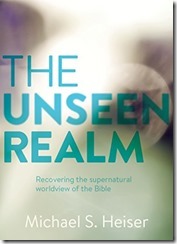
HeiserI am continuing to read through The Unseen Realm: Recovering the Supernatural Worldview of the Bible, by Michael S. Heiser. Chapters 10-11 continues the discussion about Eden, focused on the identity of the serpent, the nachash.  I have been posting quotes from the book on my Facebook page on Tuesday, Thursday and Saturday (NT is Mon-Wed-Fri) and we can discuss comments and questions about the passage there. As usual my comments are in black and quotes from the commentary are in blue below. I am using the Kindle version of the book.…

Part 3, Divine Transgressions begins with Chapter 10, Trouble in Paradise. This section deals with the rebellions of God's supernatural imagers and their effect on creation. Chapters 10-11 will discuss one of the main rebels, the nachash, or serpent, that tempted Eve in the Garden of Eden. Ancient readers would have understood that the story in Genesis 3 was not talking about a normal snake. This was a divine, supernatural being that was trying to mess up God's plan for humanity and creation. Heiser compares the description of Eden and the guardian cherub there in Ezekiel 28 with the Genesis snake to show that they are describing the same supernatural being. The exegesis within Ezekiel is disputed, but his conclusion makes the most sense with the context of other passages (Rev. 21:7-9).  

An Israelite would have known that the episode described interference in the human drama by a divine being, a malcontent from within Yahweh’s council...If it’s true that the enemy in the garden was a supernatural being, then he wasn’t a snake. 74

Ezekiel 28 browbeats the prince of Tyre using an ancient tale of divine arrogance in Eden, where a member of Yahweh’s council thought himself on par with the Most High. This divine throne guardian was expelled from Eden to the “ground” or underworld. 82

In chapter 11, Like the Most High?, Heiser compares the elements in the story of Eden with the description of Lucifer, helel ben-shachar, the “shining one, son of the dawn.” in Isaiah 14. The issue here is "to whom is the king of Babylon being compared?” (83). Heiser's answer is that he is being compared to the nachash in Eden. Heiser sees the clues in Genesis 3 that this must be more than just a mere snake in the word nachash, which can also carry the meaning, in adjectival form, of being "shiny." There is a little conjecture here with the word meaning, but the immediate and biblical context provides strong enough support for Heiser's point that the snake is surely a divine being. So the nachash tempts Eve and brings about the "Fall" necessitating God's judgment. The nachash is cast out of heaven and consigned to the realm of the dead, while the humans are forced to carry out their mission to subdue the earth with opposition, in drudgery, and without the contingent immortality they had in Eden.

The serpent (nachash) was an image commonly used in reference to a divine throne guardian. Given the context of Eden, that helps identify the villain as a divine being. The divine adversary dispenses divine information, using it to goad Eve. He gives her an oracle (or, an omen!): You won’t really die. God knows when you eat you will be like one of the elohim. Lastly, a shining appearance conveys a divine nature. All the meanings telegraph something important. They are also consistent with the imagery from Isaiah 14 and Ezekiel 28. 88

After the fall, though humankind was estranged from God and no longer immortal, the plan of God was not extinguished. Genesis 3 tells us why we die, why we need redemption and salvation, and why we cannot save ourselves. It also tells us that God’s plan has only been delayed— not defeated— and that the human story will be both a tragic struggle and a miraculous, providential saga. 91

Monday, September 18, 2017

Reading The Unseen Realm by Michael Heiser #4

HeiserI am continuing to read through The Unseen Realm: Recovering the Supernatural Worldview of the Bible, by Michael S. Heiser. Chapters 8-9 continues the discussion about Eden. The big point here is that, although God created a world in which evil is possible, He is not morally responsible for evil. Evil happened because of the free moral decisions of God’s supernatural and earthly imagers. I have been posting quotes from the book on my Facebook page on Tuesday, Thursday and Saturday (NT is Mon-Wed-Fri) and we can discuss comments and questions about the passage there. As usual my comments are in black and quotes from the commentary are in blue below. I am using the Kindle version of the book.…

In Chapter 8, Only God Is Perfect, Heiser discusses some overlooked elements in the story of the Fall in Genesis 3. First, the snake, the nachash, in the garden is not identified as the devil in the Old Testament. This comes later in Jewish writings and in the New Testament. In fact, in Job, the satan appears to be a working member of God's counsel. The snake is a rebellious elohim who does not agree with God's plan for Eden or for creation. God took a "risk" in Eden allowing free will beings, the elohim in the spiritual realm and humanity in the earthly realm, to administrate His creation. Both humans and elohim gained the experiential "knowledge of good and evil" as they exercised their God-given ability to choose to make a bad choice.  

The function of the office of the satan is why later Jewish writings began to adopt it as a proper name for the serpent figure from Genesis 3 who brought ruin to Eden. That figure opposed God’s choices for his human imagers. The dark figure of Genesis 3 was eventually thought of as the “mother of all adversaries,” and so the label satan got stuck to him. He deserves it. The point here is only that the Old Testament doesn’t use that term for the divine criminal of Eden. 57

Only God is perfect in the possession and exercise of his attributes. Every lesser being is imperfect. The only perfect Being is God. This is why things could, and did, go wrong in Eden...being in the presence of God is no guarantee that free-will beings will never stray or act out of self-will. 59

Heiser entitles Chapter 9 Peril and Providence because he discusses the relationship between God and evil, predestination and foreknowledge. His point is that God is not morally responsible for evil because free will decisions of His imagers made them morally responsible for their own disastrous decisions. God did foreknow that they would make these bad decisions, but that does not mean God predestined evil. Heiser gives an example from 1 Samuel 23 that God foreknows events that never happened. Foreknowledge does not necessitate predestination. God knew that evil would enter the world but he decided that would be preferable to never creating His imagers and He has made a plan to deal with the evil. "God does not need evil as a means to accomplish anything” (66).

Prior to knowing good and evil, Adam and Eve were innocent. They had never made a willing, conscious decision to disobey God. They had never seen an act of disobedience, either. When they fell, that changed. They did indeed know good and evil, just as God and the rest of his heavenly council members— including the nachash (“serpent”). 63

Evil does not flow from a first domino that God himself toppled. Rather, evil is the perversion of God’s good gift of free will. It arises from the choices made by imperfect imagers, not from God’s prompting or predestination. God does not need evil, but he has the power to take the evil that flows from free-will decisions— human or otherwise— and use it to produce good and his glory through the obedience of his loyal imagers, who are his hands and feet on the ground now. 66

Saturday, September 16, 2017

“Our Father”

20170914_094953 (1280x960)For several months I have been using the Lord’s prayer from Matthew 6 as the template for my evening prayers. It started in February when I was so sick and drugged up that all I could do was just recite the Lord’s prayer from memory and then go back to sleep. But it has developed into a long meditation on the implications of what Jesus was teaching in the prayer. One thing I have been thinking about lately is the word “Father.” Why do I want to call God father? First, it is an acknowledgement that I am a contingent, dependent being and God is my Creator. Everything I am and have comes from Him. He is “in Heaven” at the steering wheel of the control room of the universe. The Father has both the means and the desire to provide for me and for all His sons and daughters.

Second, God the Father is a gracious provider. I have worked hard to dispel the idea I see in the church that God the Father is a mean, wrathful judge who sits in heaven waiting to squash us when we mess up. The Exodus description of God begins with ”the compassionate and gracious God, slow to anger, abounding in love and faithfulness, maintaining love to thousands, and forgiving wickedness, rebellion and sin,” and yes I know it ends with “punishment to the 3rd and 4th generation,” but even that is gracious as God lets us be free to experience the consequences of our behavior or receive the loving discipline He provides. He wants to give us what we need to flourish as His children, not just now but for all eternity. As Jesus said in the sermon on the mount, He knows what I need before I even ask Him and He is a loving Father who is willing to give it to us.

20170914_094911 (1280x960)Joyce and I have experienced this is in very practical ways since we have begun the cancer adventure. God has provided so many things, some that we didn’t even know we needed, like the free cancer camp. Jesus says that the Father knows our basic needs like housing, food and clothing and we have seen God supply these in abundance through His people. We came for Christmas vacation with no summer clothes and God’s people have provided for us. We came without the funds necessary for covering deductibles and co-pays, and God has provided above and beyond so that we could cover expenses we did not even know existed. God has provided homes for us to stay in (the beautiful place we are staying now is pictured above) and we are covered now through at least the end of 2017. God provided us with a 2004 Toyota Sienna van for $20 (right), in which Joyce has made a bed for me in the back for long trips to the doctor, and which she loves to drive. The list goes on and on. So right now, I am obeying the command to praise God for what He has done for His people. God has blessed us by meeting our needs throughout this whole experience. He really is “Our Father who art in heaven!”

Thursday, September 14, 2017

Reading Through the Gospel of Matthew #2 (5-7)

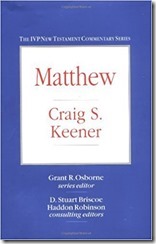
Keener MatthewWe continue reading through the Gospel of Matthew accompanied by Matthew, vol. 1, The IVP New Testament Commentary Series, by Craig S. Keener. This section is probably a summary of Jesus’ teaching and the content here was likely spoken by Jesus many times in many venues. I am posting from my reading in the New Testament accompanied by various commentaries on Monday, Wednesday and Friday and welcome comments and discussion on my Facebook page. I am using the Logos version (for some reason I cannot make the page numbers come up in the quotes) of the book. As usual my comments are in black and quotes from the book are in blue.

Keener sees Matthew 5-7 as a summary of Jesus' teaching, placed in a mountain setting to emphasize that Jesus is a "greater than Moses" means of God's revelation. He emphasizes the shocking nature of the teaching's requirements to be a kingdom disciple, but also emphasizes that the entire sermon must be understood in a context of grace. The introduction in 5.1-16 must be read holistically as the required character for a kingdom disciple. Basically, the main point is that the disciple of Jesus must live the kind of self-giving lifestyle that Jesus lived. We cannot live for ourselves or for our own personal agendas, but instead be focused on God's will and kingdom even if that brings persecution and death.

Jesus summons those who would be his followers to radical devotion and radical dependence on God. His followers must be meek, must not retaliate, must go beyond the letter’s law to its spirit, must do what is right when only God is looking, must depend on God for their needs and pursue his interests rather than their own, and must leave spiritual measurements of others’ hearts to God. In short, true people of the kingdom live for God, not for themselves. Matthew 5:1-16

If we truly repent in light of the coming kingdom, we will treat our neighbors rightly. No one who has humbled himself or herself before God can act with wanton self-interest in relationships. Those with the faith to await the vindication of the righteous in God’s kingdom can afford to be righteous, to relinquish the pursuit of their own rights, because they know the just judge will vindicate them as they seek his ways of justice. Matthew 5:3-9

Here Jesus takes his ethic of nonretaliation to its furthest possible length: not only must we refuse to strike back, but we are to rejoice when persecuted. The persecution itself confirms our trust in God’s promise of reward, because the prophets suffered likewise. The prophetic role of a disciple is analogous to and greater than that of an Old Testament prophet...But here Jesus summons us to a greater honor than being prophets; he summons us to bear the name—the honor—of Jesus.  Matthew 5:10-12

In the rest of chapter 5 Jesus challenges those who would be His disciples with some very hard, perhaps hyperbolic, teaching about our relationship to God's law. The point is that legalistic fulfilling of the letter of the law is not enough. God wants total transformation of our hearts, goals,and desires to match His character and that we value His kingdom above our own desires and even our own needs. It is not enough to agree with Jesus. We must imitate His actions here. Jesus gives six examples in the chapter of His very stringent application of the law. God eternally judges based on the motivation of the heart, not just the action. We may seem okay on the outside but the law judges unjust anger, lust or coveting, betrayal (divorce), integrity (oaths), what we really love (retribution or resistance) and what we really value (love for enemies). Jesus calls us to carefully consider, not just what we do, but our motivations for being and doing, and humbly commit to imitation of Christ in the power of the Spirit.

Jesus essentially says, “Look, if you thought the law was tough, wait till you see this. If you really want to be my disciples, give me your hearts without reservation.” This passage seems to suggest that an uncommitted Christian is not a Christian at all...After grabbing his hearers’ attention with such a statement, Jesus goes on to define God’s law not simply in terms of how people behave but in terms of who they really are. Matthew 5:21–48

Through a variety of terrible images, Jesus indicates that when we damage our relationships with others, we damage our relationship with God, leading to eternal punishment. A man who beats his wife, a woman who continually ridicules her husband, and a thousand other concrete examples could illustrate the principle. We must profess our faith with our lives as well as with our lips. Matthew 5:21-26

Jesus reads the humanly unenforceable tenth commandment as if it matters as much as the other, more humanly enforceable commandments. If you do not break the letter of the other commandments, but you want to do so in your heart, you are guilty. God judges a sinful heart, and hearts that desire what belongs to others are guilty. Matthew 5:27-30

We can appeal to no law to tell us that we are righteous enough—that would be legalism. Instead, we must desire God’s will so much that we seek to please him in every area of our lives—that is holiness. Jesus says that God’s law was never about mere rules; instead, God desires a complete righteousness of the heart, a total devotion to God’s purposes in this world. Matthew 5.21-48

Chapter 6 continues Jesus' teaching and focuses on the need for disciples to prioritize God's kingdom in everything we do. Personal piety should be practiced before God as an audience of one, not for a human audience (1-18) and God's kingdom work should be prioritized over personal wealth and possessions as evidenced by our generosity to the needy (19-34). Jesus uses 3 examples of personal religious practice, charity, prayer and fasting, to teach that grandstanding religion to impress people is useless. Instead our prayer and service should come from a heart devoted to God and His kingdom. Wealth is not a bad thing, but its use reflects our real devotion to God. Wealthy people should use their wealth, not to gain luxuries for themselves, but to serve God's kingdom by serving God's people. Less wealthy people should not worry about their needs and live their lives focused on getting rich, but should trust God to meet their needs. Keener rightly emphasizes that Jesus is speaking somewhat hyperbolically here, but this does not mean we can dismiss or try to get around what He is saying. We need regular self-examination of our motives for ministry and evaluation of how we use the resources God gives us.

Much of today’s church is divided between those who emphasize personal intimacy with God in prayer and those who emphasize justice for the true poor. Like the prophets of old, however, Jesus demanded both (6:2–13; Mk 12:40); he also recognized that without keeping God himself in view, we can pervert either form of piety. Matthew 6:2-18

Because prayer promises the hearing of an Advocate more powerful than any other, it goes without saying that those who spend little time in prayer do not in practice believe much in a God who answers prayer; but Jesus goes one step beyond this charge. Those who spend much time in prayer so they may impress others with their piety likewise lack faith in a God who rewards us by answering prayer or at the coming of his kingdom. Slicing through the veneer of human religion, Jesus exposes the functional atheism of our hearts. Matthew 6:5-15

Jesus exhorts us not to value possessions enough to seek them (6:19–24), quite in contrast to today’s prosperity preachers and most of Western society. Yet he also exhorts us not to value possessions enough to worry about them (vv. 25–34), a fault shared by most believers who rightly reject the prosperity teaching. Jesus’ words strike at the core of human selfishness, challenging both the well-to-do who have possessions to guard and the poor who wish they could acquire them. His words are so uncomfortable that even those of us who say we love him and fight to defend Scripture’s authority find ourselves looking for ways around what he says. Matthew, 6:19-34

Church buildings are valuable, but when they take precedence over caring for the poor or evangelism, our priorities appear to focus more on our comfort than on the world’s need—as if we desire padded pews more than new brothers and sisters filling the kingdom. Have we altogether forgotten the spiritual passion of the early church and nineteenth-century evangelicalism? Matthew 6:19-24

Chapter 7 concludes the "sermon on the mount" by gathering more of Jesus' regular teachings. The distinctive of this chapter is the authority of Jesus. He equates His word with that of torah and makes final judgment dependent on obedience to His words (24-29). On judging, Jesus urges thorough self-examination before we try to deal with issues in the lives of others. On prayer, Jesus talks about the Father's great willingness to answer the prayers of kingdom focused people and the great power their prayers have. On discerning our own hearts and recognizing false prophets, Jesus urges us to look at behavior and lifestyle, not giftedness. Do we and do our leaders live a life of obedience to Jesus' teachings? Growing obedience is the demonstration of real faith.

Just in case we have been too obtuse to grasp that Jesus addresses us rather than others in 5:3–6:34, Jesus renders the point explicit in 7:1–5. We are objects of God’s evaluation, and God evaluates most graciously the meek, who recognize God alone as judge...he is not warning us not to discern truth from error. Further, Jesus does not oppose offering correction, but only offering correction in the wrong spirit. Matthew 7:1-6

Jesus intends his words to jar us from complacency, to consider the genuineness of our commitment to him. One wonders how many members in our churches today assume that they are saved when in fact they treat Jesus’ teachings lightly—people who give no thought to their temper, their mental chastity, their integrity and so forth during the week then pretend to be religious or even spiritually gifted in church...Some texts in the Bible provide assurance to suffering Christians that the kingdom is theirs; this text challenges “cultural Christians,” those following only Christian tradition rather than Christ himself, to realize that they need conversion. Matthew 7:13-23

One cannot be content with calling Jesus a great teacher, for he taught that he was more than a mere teacher; one must either accept all his teachings, including those that demand we submit to his lordship, or reject him altogether. Jesus is not one way among many; he is the standard of judgment.  Matthew 7:24-29

Wednesday, September 13, 2017

Fear of the Process

20170913_151713 (960x1280)This afternoon my reading was the Stanford Blood and Marrow Transplant Program. This is the 101 page handbook for the procedure, an autologous blood and marrow transplant, that I am planning to go through beginning September 27th. I am trying to absorb a whole ton of information now after carefully reading this thing. In Joyce’s words, “this is going to be a horrible experience” and yet, “this is going to be a hopeful experience that probably will save my life.” I know that I most likely will not experience all the listed side effects and possible “life threatening” situations. In fact my local oncologist said that people in my general health range usually do well with this procedure. Nevertheless, It is a bit unnerving to read about everything that could happen in the procedure. It is going to be a long 3-6 month procedure. I am thankful that Joyce is committed to being there throughout the process and, of course, for Jesus’ promise “I will never leave you or forsake you.”

Someone asked me the other day how I go through this process with so much positivity and lack of fear. I laughed a little because, when I think about it, I am terrified. First, as I always warn the nurses, I am a wimp when it comes to pain and I’m scared of that. Second, even though there is a detailed plan here, there is a huge unknown factor as well which can make one very nervous when dwelt upon. So there is not a lack of fear in my heart. I have been encouraged to talk about it and have felt better when I do. In fact, I feel better by writing this. I know this is what I need to do, so I am strapping on my helmet and will carry the ball into the line as hard as I can (Sorry I still think in sports analogies) no matter how big the opponents are. I also know that healing comes faster to positive people and so I have tried hard to take my thoughts into captivity and avoid the dark mind caves and holes. I have to say my prayer and meditation discipline has improved considerably with all this extra motivation. I am taking the “how” of going through the cancer process as my ministry right now and try to stay focused on that. I appreciate that many people are praying for me and I know that has been a major factor in being able to stay positive through all of this. Thank you!.

Reading The Unseen Realm by Michael Heiser #3

Heiser

I am continuing to read through The Unseen Realm: Recovering the Supernatural Worldview of the Bible, by Michael S. Heiser. In chapters 6-7 Heiser shows that Eden was designed to be the place where heaven and earth would come together and God’s kingdom would be completed. I have been posting quotes from the book on my Facebook page on Tuesday, Thursday and Saturday (NT is Mon-Wed-Fri) and we can discuss comments and questions about the passage there. As usual my comments are in black and quotes from the commentary are in blue below. I am using the Kindle version of the book.…

In Chapter 6, Gardens and Mountains, Heiser shows how the biblical description of Eden supports the idea that it was intended to be the place where God's heavenly council and his human imagers would come together and rule heaven and earth under YHWH's authority. Ancient Near Eastern civilizations viewed the abode of the gods as both a lush garden and an inaccessible mountain and the Hebrew scriptures reflect that view. The Fall delayed this from happening, but moving toward this is the focus of all the Bible. The humans are tasked with "subduing" the earth, that is bringing it all under the authority of God so that the entire earth becomes an "Eden" as depicted in the last section of Revelation. I think Heiser is correct that what God does in the world, he desires to do through his representatives, even if He has to become human Himself to do it.

Eden was God’s home on earth. It was his residence. And where the King lives, his council meets. 44

The biblical version of the divine council at the divine abode includes a human presence. The theological message is that the God of Israel created this place not just as his own domain, but because he desires to live among his people. Yahweh desires a kingdom rule on this new Earth that he has created, and that rule will be shared with humanity. 47

Chapter 7, Eden— Like No Place on Earth, describes the nature and purpose of the garden and the imagers of God that were to care for it. It is important to understand that Eden and the rest of the earth were not identical. The human beings were to care for the garden, but they were to subdue the earth. One does not subdue that which is perfect. Heiser also points out God's commitment to administering, both the heavenly and earthly realms, through his imagers in each one. We see examples of the Divine Council's role in administration in 1 Kings 22 and Daniel 4. God does this even though both groups of imagers are free to rebel, and they do rebel in both realms, yet God will accomplish His kingdom plan through both groups.

Adam and Eve lived in the garden. They cared for it. But the rest of the earth needed subduing. It wasn’t awful— in fact Genesis 1 tells us that it was habitable. But it wasn’t quite what Eden was. The whole world needs to be like God’s home. He could do the job himself, but he chose to create human imagers to do it for him. He issued the decree; they were supposed to make it happen. They were to do that by multiplying and following God’s direction. 51

God rules over the heavenly realm and the earthly realm with the genuine assistance of his imager-representatives. He decrees and they carry out his commands. These points are clear. What is perhaps less clear is that the way God’s will is carried out and accomplished is open— imagers can make free decisions to accomplish God’s will. God decrees the ends, but the means can (and apparently are at times) left up to the imagers. 54, 1 Kings 22 and Daniel 4

Monday, September 11, 2017

Reading The Unseen Realm by Michael Heiser #2

HeiserI am continuing to read through The Unseen Realm: Recovering the Supernatural Worldview of the Bible, by Michael S. Heiser. In these chapters 3-5 Heiser lays out his basic thesis. God desires to rule heaven and earth through the representatives He has created. He has created a “Divine Council” through whom He rules in the heavenly realm and human beings through whom He rules in the earthly realm. God desires ultimately to bring these two realms together after overcoming the rebellions in both. I have been posting quotes from the book on my Facebook page on Tuesday, Thursday and Saturday (NT is Mon-Wed-Fri) and we can discuss comments and questions about the passage there. As usual my comments are in black and quotes from the commentary are in blue below. I am using the Kindle version of the book.…

In chapters 3, God's Entourage, and chapter 4, God Alone, Heiser describes the "Divine Council of God" and defends his view of it from some objections. Psalm 82 is Heiser's key passage on this, but this council is referred to all through scripture, especially in the Old Testament. The Divine council is a group of divine beings created by God, called "sons of God" in several places in the Bible, who witnessed creation and help YHWH administrate it. They are called elohim, which has the basic meaning of "supernatural or divine being. When elohim is used to refer to YHWH is takes a singular verb, but when it refers to the council it takes a plural verb (Ps 82.1). The arguments against this are that Psalm 82 is speaking about the Trinity or human leadership, but neither of these fit the context of the Psalm. This is not polytheism because YHWH is the only Creator and these other elohim are all created beings. There are no elohim like YHWH! Some of the members of this Divine Council become the demons (and other evil spiritual entities) whose reality is asserted throughout the scriptures. I think in these chapters Heiser makes a very good case for the existence of both the evil and good hierarchies of created supernatural spiritual beings.

God has created a host of nonhuman divine beings whose domain is (to human eyes) an unseen realm. And because he created them, he claims them as his sons, in the same way you claim your children as your sons and daughters because you played a part in their creation. 25

The biblical use of elohim is not hard to understand once we know that it isn’t about attributes. What all the figures on the list have in common is that they are inhabitants of the spiritual world. In that realm there is hierarchy. For example, Yahweh possesses superior attributes with respect to all elohim. But God’s attributes aren’t what makes him an elohim, since inferior beings are members of that same group. The Old Testament writers understood that Yahweh was an elohim— but no other elohim was Yahweh. He was species-unique among all residents of the spiritual world. 31-32

Ancient people did not believe that their gods were actually images of stone or wood. We misread the biblical writers if we think that. What ancient idol worshippers believed was that the objects they made were inhabited by their gods. 35

In chapter 5, As in Heaven, so on Earth, Heiser discusses the meaning and significance of humans being "in the image of God." When God says, "Let us make man in our image," Heiser says that he is addressing the Divine Council, and is asking them to watch Him create man on earth. The point is that the Divine Council images God in heaven and human beings will image God in the physical world. The image of God, thus, is not an ability or capacity, but an assigned responsibility to be God's representative. Eden was to be the place where the heavenly imagers and the earthly imagers would come together and we see this realized in Revelation when the "heavenly Jerusalem" and the renewed earth become one. This, the establishment of the kingdom of God on earth, is the main theme of the entire Bible.

The story of the Bible is about God’s will for, and rule of, the realms he has created, visible and invisible, through the imagers he has created, human and nonhuman. This divine agenda is played out in both realms, in deliberate tandem. Michael S Heiser, The Unseen Realm, 38

We are created to image God, to be his imagers. It is what we are by definition. The image is not an ability we have, but a status. We are God’s representatives on earth. To be human is to image God. Heiser, 42-43