Wednesday, May 25, 2016

Trip to FestPac

Festpac (3)

Yesterday was the last full day the grandkids would be on island for a while (Mike’s program is at least 3 years) so when Samantha asked if anyone could take the kids to FestPac (the Pacific Festival of the Arts) I volunteered. The programs did not start until the afternoon but we spent some fun time looking at the booths full of art from the many Pacific Islands represented. Above, Courage poses with some carvings.

Festpac (1)Festpac (4)

Titus sticks his hand in the mouth a carved shark from Pohnpei, while Courage and Serenity pose with some musical instruments

Festpac (6)Festpac (7)

The girls liked all the jewelry

Festpac (10)Festpac (13)

I think the Guam booth was their favorite because they got to pet the monitor lizard

Festpac (14)Festpac (15)

We watched artists at work from New Zealand

Festpac (17)Festpac (18)

Actually I think they preferred going down to the beach and playing by the water

Festpac (21)Festpac (23)

Serenity enjoyed collecting and playing with hermit crabs – I made her put them back before we left. We finished by listening to a Palauan band.

Tuesday, May 24, 2016

Outing With Grandma

DSC08523 (1280x960)

Since yesterday was one of the last full days the kids will be with us for a while (I was thinking that we when they come back from the Mainland these three will be 9, 11 and 13 years old – yikes) Joyce decided to spend the afternoon with them at a local hotel pool and beach. The picture above is from the end of the day. We are going to miss these kids!

DSC08509 (1280x960)DSC08514 (1280x960)

They do enjoy the water

DSC08513 (1280x960)DSC08515 (1280x960)

They went down the water slides multiple times

DSC08517 (1280x960)DSC08519 (1280x960)

There is a pretty nice view from the top of the water slide

DSC08521 (1280x960)DSC08524 (1280x960)

I think that looks like a day well spent – Why did I go to work again?

Sunday, May 22, 2016

Last Sunday

2016-05-21 15.45.23

13246164_10208754769320122_1602879908194222396_o13268394_10208754769440125_2654159993259477629_oNo. it’s not the end of the world, but yesterday was the last Sunday Mike, Samantha and family will be here on Guam before they head out from Guam on Thursday for Mike’s post-graduate studies at Hebrew University in Ohio. Mike was asked to preach at the Lutheran Church of Guam yesterday and we all went there for the service. Mike preached on the “wisdom woman” in Proverbs and the importance of being “married” to her. I appreciated his emphasis on reading in Proverbs in the context of the whole book. We enjoyed the service and the lunch after with giant hamburgers from Meskla Dos. I had the kid-watching chores while Mike preached. Arie did a good job entertaining everyone while they were being recognized by the congregation (above).

Saturday, May 21, 2016

Reading in Kings This Week #1 (1 Kings 1-11)

First Kings Chart

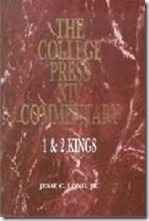
3478This week we continue the story of Samuel in the book of Kings accompanied by 1 & 2 Kings The College Press NIV Commentary by Jesse C. Long. Kings tells the story of how the Davidic Covenant works out in the history of Israel. Each king is compared to David and fails.  I am posting quotes from the book on my Facebook page on Tuesday, Thursday and Saturday (NT is Mon-Wed-Fri) and we can discuss comments and questions about the passage there. As usual, quotes from the commentary are in blue below…

The story in Kings begins with the death of David and succession of Solomon to the throne. David is now an old, impotent and unable king who is vulnerable to others. The world around him has been made dangerous by David's previous manipulations and abuses of power, especially the Bathsheba affair, and the succession of Solomon has been made especially dangerous. In response to the rebellion of Adonijah, Bathsheba and the prophet Nathan work a manipulative scheme to bring Solomon to the throne. David expresses great trust in God's promise and covenant, but continued to try to manipulate the situation. These faithless actions will sow the seed for the mistrust of the other tribes and the subsequent divisions and exile of the nation.

Herein lies a primary theological issue of Kings: How is God’s sovereign will enacted with imperfect people and institutions? How does God’s will interface with free will, especially when Israel and her kings choose another course? This is the real tension of Kings. The answer will call attention to Yahweh’s power and grace, for he will remember his promise to Abraham, Isaac, Jacob, and David and emerge as the sole hero of the story. 1 Kings 1, 58

So, with his controlled use of irony, the narrator allows the inconsistencies in David’s final words to Solomon, with all of their ambiguity, to characterize Israel’s greatest king. David is a complicated character, sometimes a model of devotion to Yahweh, at other times as self-serving as any king in Israel. When he is humble and “giving,” he receives the blessings of Yahweh. The “grasping” David suffers both personally and politically. 1 Kings 2.5-9, 75

This accomplished use of literary technique enables the storyteller to bring out the tension between Yahweh’s sovereign will and human choices. God fulfills his promise to David but is not responsible for the way Solomon establishes the throne “in his hands” (2:46)...In the opening act of his story, the narrator demonstrates that Yahweh’s will is accomplished in spite of human weaknesses. He is behind the scenes, keeping his promise, but there is not anything here to suggest that he condones Solomon’s purge. 1 Kings 1-2, 84

Chapters 3-5 describe the way in which Solomon received wisdom from God and the humble and wise attitude with which he begins his reign. However, God's gift of wisdom, wealth, peace, power etc. is conditional. Solomon must follow torah and the ways of God. When he does this the nation is blessed with God's gifts. However, there are hints that Solomon does not always do this. The story begins with a marriage to an Egyptian princess. Mostly, the beginning of the reign is good with the classic descriptions of a prosperous, peaceful Israel as promised. But Solomon's foolish choices of wives, multiplying horses (in disobedience to Deut. 17), and forcing his own countrymen into labor gangs will bear bad fruit later in his reign.

Solomon humbly presents himself as a novice who is unprepared for the responsibilities of state. But his deference is not hollow or contrived. Remarkably, he asks for a discerning heart (literally, “a hearing heart … to discern good and evil,” v. 9), not for his own good, but to govern this great people Yahweh had chosen! 1 Kings 3.6-9, 90

The wisdom that Yahweh promises will discern good from evil (vv. 9, 12). Even this divine wisdom, however, will conflict with the foolish choices Solomon makes. Yahweh may give wisdom, but Solomon, as each king in Israel, has free will to choose his own course. 1 Kings 3-4, 92

By naming Israelite conscription for the king’s building projects mas, the narrator is consciously calling attention to Solomon’s oppressive policies, which were predicted by Samuel...Again, how wise was this most blessed of kings, who apparently built a glorious kingdom, not on his faith in the God who blessed him, but on the backs of the people he ruled? 1 Kings 5.10-18, 106–107

The story of the building and dedication of the temple is placed around the story of the building of Solomon's house. This highlights the faithfulness of God in keeping his promise to David and contrasts with Solomon's lack of faithfulness, despite the blessings God gave him. The passage mentions Solomon's marriage to an Egyptian princess and that Solomon took almost twice as long to build his palace as he did building the temple. The whole passage is seen as a conclusion to the Exodus story. God has redeemed his people from slavery and takes his place on his throne (the ark was seen as the "footstool" of God's throne in heaven). God now visibly lives with his people, but warns them that His Presence will only stay as long as they "live according to my regulations, follow my rulings and observe all my mitzvot and live by them." (Complete Jewish Bible 1 Kings 6:12) Sadly, the kings of Israel will not do this and Israel will return to slavery in the exile to Babylon.

The temple will be a symbol of Yahweh’s commitment to David and represent his presence in Israel. He will dwell (שָׁכַן, šākan, the word from which “Shekinah” is derived) with them in this house. Yet in spite of Yahweh’s choice, Solomon and his descendants will break their covenant with Yahweh. Both temple and kingship will be shattered. 1 Kings 6.11-13, 112

Judah will go into exile, back to Egyptian captivity in Babylon, because of forsaking the covenant and serving other gods—and because her kings will pursue wealth and honor over righteousness and justice...Solomon starts Israel on that path. 1 Kings 7.1-12, 116

In Solomon’s prayer, he repeatedly calls attention to the fact that he had constructed the temple for Yahweh. “I have indeed built” recurs six times in the verses that follow and appears to reflect a self-absorbed attitude that suggests that the temple may be as much about Solomon as the one who will dwell in the house that he builds. In the end, it may be that this spirit is what keeps this son of David from sustaining the devotion to Yahweh that characterized his father. 1 Kings 8.1-13, 125

Solomon's prayer in chapter 8 explains how God could "live" in a house and yet be transcendent. God lives and rules from "the heavens" and is omnipresent, but his "Name" lives in the Temple. In other words, the sovereign God has chosen this building as the place where he can be approached by his subjects and hear their prayers. Solomon lists several scenarios where this would happen. God honors Solomon's prayer, but reminds him, as in Deuteronomy, that this will only be valid as they are fully devoted to God and avoid idolatry. Solomon vows this, but, even as chapter 9 recounts Solomon's blessing of wealth, we see the things that dilute this commitment to God, (many wives, trust in military power and money) and lead to the later problems that he will have and will ultimately result in exile. Solomon's mention of exile makes one think that he expected, again as in Deuteronomy, the nation to fail. Will God restore them when that happens?

Yahweh may be misrepresented in the very trappings of power that are symbolized in the magnificent house Solomon has constructed. Only when this same edifice lies in ruins, will Israel’s kings learn that Yahweh and his temple are not objects to be manipulated and used for political ambitions. 1 Kings 8.14-21, 126

Solomon may be sincere as he dedicates a house for Yahweh, but he is also self-serving. Remarkably, Yahweh responds to his devotion. In the end, however, a self-absorbed Solomon will be unable to live his professions! 1 Kings 8, 135

Yahweh placed Solomon on the throne of his father to have dominion (māšal, 4:21 [5:1]) over Israel and blessed him with wisdom to rule (māšal), with which he had written many proverbs (māšāl, 4:32 [5:12]). Yet, if he does not live by Torah and serve Yahweh, as did his father, the temple will become a ruin and Israel a māšāl (“byword”)—a tragic folly for a man with wisdom from God. 1 Kings 9.1-9, 140

In 10-11 the story of Solomon comes to a tragic end. The author of Kings has cleverly laid out the story so that the blessings in the early part of Solomon's story are paralleled in the back half of the story by the way Solomon has co-opted those blessings to indulge himself. In the end these compromises lead Solomon into idolatry and the shattering of his kingdom. The very things that Moses predicted would lead the nation into ruin - reliance on wealth, many wives (reliance on foreign alliances)  reliance on military power (horses)- are the very things Solomon does, and these things turn the wisest man into a foolish idolater.

The stress on luxury items and wisdom for Solomon’s glory that characterizes 9:10–10:29, in contrast with the blessings of Yahweh that were used for the people of Israel in chapters four and five, suggests a shift toward the type of king of whom Samuel warned (1 Sam 8:11–18). By the creative use of structural irony, Solomon is exposed as a self-indulgent leader who has lost sight of his divinely ordained role as shepherd of Israel. 1 Kings 10.1-13, 146

The oath to David may still prove to be unconditional. The God of Israel has torn the kingdom from Solomon as he did from Saul, but Yahweh’s love will remain with the descendants of David. There may yet be grace—hope for the return for which Solomon prayed (8:33–34). 1 Kings 11.26-40, 155

God is still gracious and will leave David's family one tribe to rule.

Solomon’s father, David, is the ideal standard. Solomon is the king who took Yahweh’s blessings and made them a curse. For God’s people in exile, the story of this king’s tragic reign explains why they had been abandoned and, at the same time, offers hope that Yahweh may be their savior once more. 1 Kings 11, 157

Friday, May 20, 2016

FestPac Begins Early For PIU

13235229_10208204627066562_1574044750564857149_o

This week the PIU campus was able to house over 70 delegates from Yap for the Festival of the Pacific Arts which begins tomorrow on Guam. The delegates arrived early and needed housing for a couple days. We enjoyed being able to serve and get to know some of our guests. The Pacific Daily News interviewed Juan Flores, PIU provost, as part of an article about the Festival.

Juan Flores, vice president of academics/advancement at the Pacific Islands University said they were happy to welcome about 70 delegates from Yap.

“It’s a good show of hospitality,” he said. PIU has its roots throughout Micronesia, he said, and it was important to do its part to help out.

The Yapese delegates were enjoying their time at the university playing basketball and hanging out in the university’s grounds.

“We gotta pitch in. It’s not going to work if we’re going to sit back,” Flores said.

Marie Laamar, from the Yapese delegation, thanked the university for its hospitality.

Their flight to Guam was very last minute and had to come early because there aren’t many flights out to Guam from Yap, she said. They wouldn’t have made it on time for the opening ceremony by Sunday.

“We’re very thankful to be here,” Laamar said.

She said it was good to arrive a little bit early so the delegation can prepare by getting materials for the festival. The local Yapese community in Guam have also been helping them.

The delegation will showcase traditional dances, including one just by men and a co-ed dance. They also will have a popular tattoo artist from Yap and handicrafts on display.

We are looking forward to attending the festival next week. Since this festival circulates between dozens of Pacific Island nations it is a once in a lifetime event to have it on Guam

Wednesday, May 18, 2016

Paul and the Faithfulness of God Chapter 10, Part 2

Paul AFOGWe continue in chapter 10 of Book Two and Part III of Paul and the Faithfulness of God, vol. 4, Christian Origins and the Question of God, by N. T. Wright. His big point is that Jesus accomplished everything that Israel expected YHWH and His Messiah to do. Again, this is a very brief summary of this very important book.  I welcome comments and discussion on my Facebook page. I am using the Logos version of the book.

In the next section Wright moves into his main argument- that Paul sees the purpose of Israel accomplished in the death, resurrection and enthronement of Jesus as He brings in the New Covenant predicted in the Prophets. This was exactly what 2nd Temple era Jews expected the Messiah to do.

The purpose for which the covenant God had called Israel had been accomplished, Paul believed, through Jesus. The entire ‘theology of election’ we have examined in the preceding pages is not set aside. It is brought into fresh focus, rethought, reimagined and reworked around Jesus himself, and particularly around his death, resurrection and enthronement. 815–816

The Messiah, in other words, is ruling the world while God himself acts, through him, to defeat all his enemies...the narrative role which Paul assigns to Jesus in this passage (Ps 110) is that of Israel’s Messiah. There can be no doubt that the biblical quotations and allusions are to passages commonly used as messianic in early Christianity. N. T. Wright, 821

In passage after passage in Paul the point being made is that Jesus, as Messiah, has drawn together the identity and vocation of Israel upon himself. 825

Jesus, as the Divine Messiah had completed the purpose and mission of Israel and the torah. As the Messiah King he brings those who are "in Christ" into relationship and sharing in his promised kingdom in the present and more fully in the future.

The resurrection also declared, for Paul, that the divine purpose for Israel had been fulfilled, uniquely and decisively, in this Messiah, this Jesus. He was, in effect, Israel in person. And it was precisely as Messiah that he therefore represented his people. 828

Paul sees Jesus as the one who has been established as Messiah through his resurrection, drawing Israel’s history to its strange but long-awaited resolution, fulfilling the promises made to Abraham, inheriting the nations of the world, winning the battle against all the powers of evil and constituting in himself the promise-receiving people, so that all ‘in him’ might receive those promises, precisely not in themselves but insofar as, being ‘in him’, they are incorporated into the True Jew, the one in whom Israel’s vocation has been fulfilled. 830

In the Messiah Jesus, God has launched his project of bringing the human race together into a new unity, and those who believe in him are summoned into that koinonia tes pisteos, that fellowship of faith, in which their previous differences are transcended. 833

Wright understands the righteousness of God and faithfulness of Jesus in Romans 3-4 from this perspective: Jesus as the faithful Israelite, the Messiah, provides the new Exodus for the idolatrous world and unfaithful Israel into the promised blessing of the covenant. Romans 3-4 are basically a commentary on Genesis 15 making the point that Abraham's justification meant, mainly, that he was brought into God's covenant and its promises, through faith. From the beginning the covenant was intended to deal with the sin problem and lead to a universal restoration of creation.

If the covenant God is going to bless the world through Israel, he needs a faithful Israelite. In 3:21–26 Paul argues that this is exactly what has now been provided. Once we understand Christos as the Messiah, Israel’s representative, Israel-in-person if you will, the logic works out immaculately. (a) The covenant God promises to rescue and bless the world through Israel. (b) Israel as it stands is faithless to this commission. (c) The covenant God, however, is faithful, and will provide a faithful Israelite, the ‘faithful Israelite’, the Messiah. 839

The covenantal perspective on election, and its redefinition through Jesus the Messiah, provides the larger category within which ‘juridical’ and ‘participationist’ categories can be held together in proper Pauline relation. 846

Abraham’s faith in God the creator, the life-giver, is thus well re-expressed in terms of Christian faith in the raising-Jesus God. Same God, same faith, same justification. But this is no mere parallel, no mere wearing of the same badge. This is about the fulfilment of a two-millennia-old promise, the unveiling of the faithful covenant justice of the God who told Abraham he would give him an Adam-rescuing family, and who has now done exactly that. 850

He then moves on to Galatians 2-4 to show that Paul now saw this universal covenant people oriented around the Messiah, rather than Torah. The point here is that there is one family of God, not separate Jewish and Gentile family. Jesus is the fulfillment of Torah and the Covenant promises and His people are defined by faith in the crucified, resurrected Messiah.

Far too many discussions of ‘justification’, which is a central and vital topic in Galatians, assume that ‘salvation’ is more or less the same thing, which for Paul it certainly is not. 855

What matters is not now Torah, but Messiah. Justification is all about being declared to be a member of God’s people; and this people is defined in relation to the Messiah himself. 856

Once you understand how the story works, the great covenant story from Abraham to the Messiah, you can see (a) that the Torah was a necessary, God-given thing, with its own proper role within that story, and (b) that the God-given role of Torah has now come to a proper and honourable end—not that there was anything ‘wrong’ with it, but that it was never designed to be permanent. 862

Palau #3–Sunsets and Churches

2016-05-13 23.31.33

2016-05-14 14.15.362016-05-14 15.01.07-2We saw some spectacular sunsets during my week in Palau. Every evening we sat on Steve and Anne’s porch and looked forward to the spectacle. We were not ever disappointed. I did not spend all my time there looking at sunsets. Sunday morning I preached at the Airai church. I saw several old friends there and enjoyed the fellowship very much. On the left, is the bulletin from the service and, on the right, a picture of me in the pulpit taken on my phone by Steve Stinnette. After church I enjoyed a healthy lunch with Steve, Anne and Mac Alfonso at a local vegetarian restaurant.


2016-05-14 23.00.192016-05-14 23.00.42

Sunday afternoon I took a look at the old apartment where we lived in 1984-86. After all these years it is getting a full renovation. When we lived there the walls between apartments were just sheetrock and you could see light coming through them. Now they have rebuilt with concrete. The apartments look nice. This is where teachers for the new school in Koror will live.

2016-05-14 23.12.292016-05-14 23.30.47

Finally, we went to a fund raising concert by the Koror Church worship team. They will be part of a gathering of Palauans in Sacramento California on May 23-29 (next week). If you are in Northern California and want to attend you can get info by calling 916-934-3096.