Tuesday, October 31, 2017

Reading The Unseen Realm, by Michael Heiser #13

Heiser

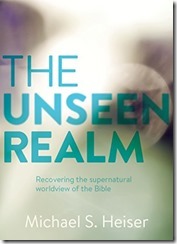
I am continuing to read through The Unseen Realm: Recovering the Supernatural Worldview of the Bible, by Michael S. Heiser. This post continues the discussion of the New Testament from the Divine Council point of view and focuses in what Jesus accomplished in His 1st coming to defeat Satan, redeem humanity and begin the reclamation of the nations. I have been posting quotes from the book on my Facebook page on Tuesday, Thursday and Saturday (NT is Mon-Wed-Fri) and we can discuss comments and questions about the passage there. As usual my comments are in black and quotes from the commentary are in blue below. I am using the Kindle version of the book.…

Chapter 34, Infiltration, is about the reclamation of the nations begun in Acts 2. The coming of the Spirit was an undoing of Babel in which the new believers would take the message of Jesus to the nations that had been disinherited by YHWH at Babel and bring them back into His kingdom. There are several allusions to Babel in Acts 2. The nations in Acts 2 are listed in an East-West order which would become the strategy for evangelism in Acts. Paul's desire to take the gospel to Spain would be the end goal of reclaiming the farthest west nation, Tarshish, for God. The Gospel would be God's means of reclaiming the world.

The wind and fire in Acts 2 signified to readers informed by divine council scenes that the gathered followers of Jesus were being commissioned by divine encounter. They were being chosen to preach the good news of Jesus’ work. The fire connects them to the throne room. The tongues are emblematic of their speaking ministry. 297

Paul was convinced that his life’s mission as apostle to the Gentiles— the disinherited nations— would only be finished when he got to Spain. As incredible as it sounds, Paul was conscious that his mission for Jesus actually involved spreading the gospel to the westernmost part of the known world— Tarshish— so that the disinheritance at Babel would be reversed. 303, Romans 11.25-27

Chapter 35 Sons of God, Seed of Abraham, describes the identity and mission of those who belong to Christ. We are God's family and will rule with Him as His Divine Council. Jesus accomplished God's plan and brings the disinherited Gentiles back into the family of Abraham and back into the family of God. In a way we work in the "family business" of managing God's creation.

In Christ, believers are “the sons of God.” The language of inheritance is crystal clear. It derives from and advances the Old Testament idea that humans were meant to be in the family of God all along...The believer’s destiny is to become what Adam and Eve originally were: immortal, glorified imagers of God, living in God’s presence as his children. 308, Galatians 3:6–9, 26–29

Once the nations are restored to Yahweh through the gospel, believers will displace the divine beings who presently dominate the nations and rule in their place as Yahweh’s children and corulers. 311

In Chapter 36, Lower Than the Elohim, Heiser makes the point that our right to rule is based on our connection to Jesus. Jesus, the 2nd person of the Trinity, became human to fulfill God's plan for humans, which was for us to become perfect imagers of the Creator as we rule His creation. We stand in God's council and we will share the Divine nature (theosis), because we are beside our brother Jesus. Our privileged position-we will judge the angels-is based on what Jesus has done for us.

Hebrews is clear— earth wasn’t created to be subject to the members of God’s divine family, but to his human family. The council was with God in Eden, and so heaven and earth were meant to be transposed, but the task of administrating God’s good world was ours. This despite the fact that we were lesser beings compared to God’s divine family-council. 317

The message of “theosis” is that, in Christ, we are being transformed into his likeness— the perfect imager of God. The Spirit— who, as we saw earlier in our study, “is but isn’t” Jesus— conforms us to Jesus’ own image. Scripture is clear that immortality as a divinized human is the destiny of the believer, and that our present lives in Christ are a process of becoming what we are:...sharers of the divine nature. 320, 2 Peter 1.2-4, 1 John 3.2, 1 Corinthians 15.44-54

Lunch With Nino

20171029_124320 (1024x768)

20171029_124600 (768x1024)After the apheresis, harvest of stem cells, we decided to take Saturday off and stay at the Stanford apartment so we could rest and catch up on the sleep we lost from the 3am drive the day before. It worked out well for us, because PIU CFO, Nino Pate, was in San Francisco, on his way back to Guam from the TRACS conference in Orlando. We met at a café right across Highway 101 from the SF airport. FB_IMG_1509321845086It was great to see Nino. We spent almost two hours talking about our families, how things are going at PIU and what has been going on in our lives. Nino and I had offices right across the hall from each other and I really miss being able to talk with him regularly. I also miss Gwen poking her head into the doorway of my office to check out what I am doing. We were very happy to be able to get some news about the school and to hear how the PIU family is doing. We pray for PIU and the people there every day and now we can pray more knowledgeably. We were also sad because seeing Nino reminded us how much we miss our life, ministry and relationships at PIU and our other friends on Guam. It was really a blessed time and thank you to Nino for making the effort to come and see us.

Monday, October 30, 2017

Apheresis at Stanford

20171026_164742 (768x1024)We got the word from Stanford on Thursday afternoon to be there early the next morning. The drive from Shingle Springs to Stanford is about 3 hours, up to about 5 hours, if the Bay Area traffic is heavy. Both of us felt like we were a little too tired to make the trip in the evening, 20171025_081129 (768x1024)so we decided to drive down at 3.30 am on Friday morning for our 7am appointment. We had to get there an hour before the appointment so Joyce could give me the required neupogen shot an hour before the appointment. I was a little worried because Joyce doesn’t always do so well in the early morning hours, but she came through this time like an expert chauffeur and nurse. We actually made the drive in about 2 1/2 hours. She gave me the shot in the van and we slept about 45 minutes, on my futon in  the back of the van, in the parking garage at Stanford hospital. We did have to scramble Thursday afternoon to get ready for the trip and were able to do so with some help from my sister (left) and my mom. We also had time to check out Leila’s loose teeth (right).

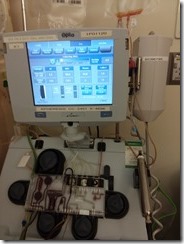
20171027_105139 (768x1024)We arrived at the apheresis center at 7am for the blood test to make sure I had enough stem cells to proceed. That took about 30 minutes and they turned us loose while we waited for the results. We had a little breakfast at the hospital café, surfed the internet on our phones 20171027_142134 (768x1024)and read the newspaper while we waited. At 10am we got the word to come back because my blood had passed the test. In fact, my stem cell count was very high which promised a good result. So we went right in and got ready to go. First, they hooked me up to the machine. There accessed both tubes on my chest catheter, one to put blood in and one to take it out. The machine was really amazing. My blood would go out to a centrifuge, where it was spun to separate out the stem cells. The stem cells were then collected in a bag (right). The blood then went into a warming tube and was returned to my body. I thought my stem cells looked a little like cream of tomato soup. The process took about 4 1/2 hours and we were done at 3.30pm.

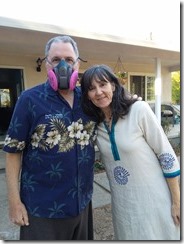
20171027_103328 (768x1024)We then went to our apartment at Stanford and they told us the lab would call with the result. If they got enough stem cells we would be able to go home as soon as we wanted to. Otherwise, we would come back Saturday to collect more cells. That process could extend for up to four days until they got enough stem cells. About 5pm they called us and said that they had collected twice as many stem cells as they needed and we were free to go home. I could also put away the mask until I returned to Stanford for the transplant (except for when I am in hospitals or doctor’s offices) and I was no longer on the anti-microbial diet. They told us to go out and enjoy the evening, so we went to Jack in the Box for celebration tacos. I know a lot of you were praying for my body to generate a lot of stem cells and those prayers were answered with much more than I needed.  We will be resting for the next couple weeks and are getting ourselves ready for what will be the hardest part: the transplant process, which will begin November 9th in the Stanford hospital. After that we anticipate being there in the hospital until at least November 30th. Thank you for praying. We appreciate your prayers as we approach what we hope will be the beginning of the end of cancer treatment and the last big step to being “cancer-free.”

Reading The Unseen Realm, by Michael Heiser #12

HeiserI am continuing to read through The Unseen Realm: Recovering the Supernatural Worldview of the Bible, by Michael S. Heiser. This post begins discussion of the New Testament from the Divine Council point of view and contains two sections; The Kingdom Already and The Kingdom Not Yet. I have been posting quotes from the book on my Facebook page on Tuesday, Thursday and Saturday (NT is Mon-Wed-Fri) and we can discuss comments and questions about the passage there. As usual my comments are in black and quotes from the commentary are in blue below. I am using the Kindle version of the book.…

Chapter 31, Who Will Go for Us?, opens section 7, The Kingdom Already, which begins the New Testament section of the book. Heiser's point here is that the visible YHWH has now been incarnated as a human being to complete God's plan to reclaim His creation. He focuses on two points made in the Gospels. One is that Jesus reveals the Name of God much as the Angel of YHWH did in the OT and that the Divine Council is in session. John the Baptist takes the role of Isaiah (Isaiah 40.1 ff) as the spokesman for the Council. Jesus is the Divine Davidic king who will lead all creation into a "new exodus."

Revealing God’s name to them meant showing them who God was and what he was like. He did that by living among them as a man. Jesus was God among them. He was the incarnation of God’s essence (Heb 1:3)...When Jesus says he has “kept them in your name,” he means he has kept those followers the Father gave to him by means of God’s own power and presence—the Name, now incarnated in Jesus. 269

Mark wants readers to see that a new exodus event is happening. The kingdom of God is back, and this time it will not fail because it’s being led by the visible Yahweh, now incarnate as Jesus of Nazareth...When God refers to Jesus as his “beloved” he is affirming the kingship of Jesus— his legitimate status as the heir to David’s throne. Heiser, Mark 1.11, 274

In Chapter 32, Preeminent Domain, Jesus begins the battle to take back the earth with two basic means: calling disciples and casting out demons. The sending out of the 70 to do this is a clear reference to the 70 nations, given over after Babel, that he intends to retake. This puts the evil powers on notice as to who he is. He chooses the occultic center of Mount Hermon to announce his identity in Peter's confession and in the Transfiguration. The evil powers will act in response which is exactly what Jesus expects them to do.

The kingdom of God is the aggressor. Jesus begins at ground zero in the cosmic geography of both testaments to announce the great reversal. It is the gates of hell that are under assault— and they will not hold up against the Church. Hell will one day be Satan’s tomb. 285

Jesus picks Mount Hermon to reveal to Peter, James, and John exactly who he is— the embodied glory-essence of God, the divine Name made visible by incarnation. The meaning is just as transparent: I’m putting the hostile powers of the unseen world on notice. I’ve come to earth to take back what is mine. The kingdom of God is at hand. 286

Chapter 33, A Beneficial Death, deals with what happened at the crucifixion. Heiser notes Matthew's connection of Psalm 22 to the events of the crucifixion and focuses on the reference in the Psalm, "surrounded by the bulls of Bashan." He sees this as a reference to the battle that was going on between Jesus and the forces of evil. Jesus wins this battle and one of the benefits of his victory is the giving of the Holy Spirit and his gifts. Thus, believers experience the benefits of Jesus' victory over the evil powers as they serve Him.

The implication is that Jesus, at the moment of agony and death, was surrounded by the “bulls of Bashan”— demonic elohim who had been the foes of Yahweh and his children for millennia. 291, Psalm 22.12, 68.18

First, not only did the sacrifice of Jesus on the cross mean the fall of Bashan, emblematic of the cosmic powers of evil, but it also triggered the empowerment of the Church by the gifts of the Spirit. Second, that victory and empowerment also had something to do with Pentecost. 295, Ephesians 4.8-9

My First Blood Transfusion

20171026_094747 (768x1024)So far, up to last Thursday, I had made it through my life without a blood transfusion. But because my red blood cell count was low, my doctors thought it was important that I get one. So I headed up to Marshall Hospital and spent the whole day there getting a couple pints of blood put into my body. It wasn’t a real difficult process for me. It just took a long time. Because of my edema problems, again, they gave me a separate room. I even had my own bathroom. I had time to do my devotional reading (I love having Logos on my phone), nap, and watch a lot of ESPN. I even got a nice anti-microbial hospital lunch. The process took about 8 hours and went without problem. I did feel pretty tired afterward, but otherwise I felt ok. The outcome was that my white and red blood cell counts were high enough for apheresis and we were told to report to the apheresis room in the Stanford Cancer Center on the next day at 7am. We prayed that things would move quickly and they certainly did.

Wednesday, October 25, 2017

Reading Through the Gospel of Matthew #7 (21.17-25.46)

Keener MatthewI am continuing reading through the Gospel of Matthew accompanied by Matthew, vol. 1, The IVP New Testament Commentary Series, by Craig S. Keener. This section records Jesus’ final presentation of His kingdom to the nation and their final rejection of Him. He then turns to His disciples and teaches them about their responsibilities in the inaugurated kingdom to be ready for His judgment when He brings the present age to a close. I am posting from my reading in the New Testament accompanied by various commentaries on Monday, Wednesday and Friday and welcome comments and discussion on my Facebook page. I am using the Logos version (for some reason I cannot make the page numbers come up in the quotes) of the book. As usual my comments are in black and quotes from the book are in blue.

In 21.17-22.46 the Jewish religious leaders challenge the source of Jesus' authority to teach the people. Jesus responds by showing that they have rejected God's authority, which He and John the Baptist represented, and they are in the same danger as past leadership of receiving God's judgment. The parables illustrate their rejection of God and his prophets and warn them, that God is patient, but judgment is coming soon. The Jewish leaders were more concerned with preserving their privileged place in society and thus, were more evil than the tax collectors and prostitutes who recognized their sin and repented. Jesus offered the kingdom but the nation, because of the actions of their leaders, was about to miss it.

Jesus and John represent the same source of moral authority, and those who rejected John’s way of righteousness showed the hypocrisy of their own claims to be God’s servants... Neither Jesus nor Matthew contends for God’s rejection of Israel as a people, but for his rejection of the religious leaders. Matthew 21:28–44

The welcoming of both good and bad (v. 10) echoes Jesus’ own mission to sinners (9:11–13), but it may also remind us that grace not only forgives but also transforms. All are welcome, but no one dare remain the way he or she entered, in view of the final separation of “the wicked from the righteous” (13:49)...salvation is not simply a matter of those who begin the race, for we must finish it. Matthew 22:1-14

To render to Caesar what was Caesar’s was to return his own coin to him; to render to God what was God’s was to render worship to him alone (compare 4:10)...The appropriate response to living in a society whose beliefs differ from one’s own is to critically evaluate and withstand its claims, not to censor such claims from being heard or to boycott all participation in the society.  Matthew 22:15-22

Matthew 23 begins Jesus' final discourse before His passion. This passage is a denunciation of the hypocritical way the Pharisees applied the torah, but the passage is directed at all Christians to examine themselves to make sure we don't "have a place with the hypocrites." Religion should produce people who live out what they teach, who don't use religion for personal honor, special treatment or titles. Our standards should be God-made not manmade and should emphasize what God thinks is important. They should be applied to ourselves before we apply them to others. This is critical because these actions will all be brought to judgment by God.

Although Pharisaic ethics emphasized being as lenient or strict with others as one was with oneself, in practice Jesus accuses them of being too strict with others and too lenient with their own failings (compare 5:18–20; 15:1–20), which fits the way Christians often evaluate sins today. Matthew 23:1-12

I suspect that much of what passes for Christianity today is little more than human religion with the name of Jesus tacked onto it, because like most of the religion of Jesus’ contemporaries, it has failed to transform its followers into Christ’s servants passionately devoted to his mission in the world. When rightly understood, Jesus’ woes may strike too close to home for comfort. When religion becomes a veneer of holiness to conceal unholy character, it makes its bearers less receptive to God’s transforming grace. Matthew, 23:13-32

Many of us today do not like to preach on judgment, but the prophets of Scripture, including Jesus, heavily emphasized warnings about judgment. If we are to be faithful to our calling as Christ’s followers and if we care about others, we dare not shortchange Scripture’s message of judgment on individuals and nations. We must recognize that every nation, including our own, will face divine punishment (if Israel, how much more Gentiles!). Yet we must remember that God’s heart of judgment sometimes sounds most like a lament (v. 37). Matthew, 23:33-39

In Matthew 24-25, Jesus answers the disciples questions about the nature and timing of the destruction of the temple and the end of the age. Jesus answers that the destruction of the temple is coming soon and it will be a complete destruction from which God's people need to flee. That event will begin the "birth pangs" of the final age which will consummate with the return of Jesus Christ. Jesus seems to fuse the prophesies of the temple destruction, the persecutions of the present age and the coming final tribulation that will immediately precede His coming. The only prerequisite for the coming of the end which Jesus mentions is the spread of the gospel throughout the world. The end will come when the great commission is completed and with the cosmic visible return of Jesus to this world.

While catastrophic events do not allow us to predict how soon the Lord is coming—such events have happened throughout history—they do remind us that such problems characterize this age, summoning us to long for our Lord’s coming all the more fervently. Matthew 24:1-14

Christians who remember the nature of the time ought not to be attached to worldly possessions; we should value our lives enough to flee immediately. Indeed, God may judge materialistic Western and other societies at times to turn us from our pursuit of what does not matter so we may learn to pursue what really does. Nor ought we to believe false prophets of peace proclaiming that judgment will never strike our own locality; rather than sparing a locality, God sometimes warns his servants to leave. Matthew, 24:15-28

24.32-25.46 contain several parables about the end of the age. Each of them focus on the coming end of the age and what Jesus' disciples need to do now to prepare for the judgment and coming kingdom. Disciples need to "keep watch" and "be prepared" at all times because we don't know when Jesus will return to consummate the kingdom. Disciples do this by using the resources Jesus gives them wisely by investing their lives in His kingdom work. At the judgment we will all be judged based on how we advanced his kingdom mission and how we treated and responded those who made great sacrifices to announce the gospel of the kingdom and fulfill the great commission. 

After Jesus exhorts the disciples to “keep watch,” to stay awake, he illustrates what he means. We stay alert not by artificially and perpetually stirring expectation that he will come at a given time, but by living in such a manner that we would have no cause for shame if he did come at any time, since he may in fact do so. Matthew 24:32-45

Whereas the other servants are rewarded by the master’s benevolence, this servant, fearing the master’s harshness but unaware of his benevolence, experiences the very wrath he feared. This, says Jesus, is what will happen to those who claim to be his followers but do not invest their lives in the work of the kingdom. Matthew 25:14-30

The King thus judges the nations based on how they have responded to the gospel of the kingdom already preached to them before the time of his kingdom (Mt 24:14; 28:19–20). The passage thus also implies that true messengers of the gospel will successfully evangelize the world only if they can also embrace poverty and suffering for Christ’s name. Matthew 25:31-46

Tuesday, October 24, 2017

Reading The Unseen Realm, by Michael Heiser #11

HeiserI am continuing to read through The Unseen Realm: Recovering the Supernatural Worldview of the Bible, by Michael S. Heiser. This post ends the section, THUS SAYS THE LORD, which applies the Divine Council view through the rest of the Old Testament. With the failure of the Davidic Kingdom and exile, God adjusts His plan to restore His creation as another Eden and provides clues to what His plan is through the prophets. I have been posting quotes from the book on my Facebook page on Tuesday, Thursday and Saturday (NT is Mon-Wed-Fri) and we can discuss comments and questions about the passage there. As usual my comments are in black and quotes from the commentary are in blue below. I am using the Kindle version of the book.…

Chapter 29 The Rider of the Clouds explains one of these cryptic references to Messiah as the visible YHWH figure who will become human. The reference is in Daniel 7.13-14 to a "son of man" (human), who would be "coming on the clouds." The OT has several references to YHWH as the rider on the clouds. The "ancient of days" and "son of man" are both in the passage, a reference to the invisible and visible YHWH. When Jesus is questioned about His identity at His trial he quotes Daniel 7.13 and calls himself the "son of man" (Matthew 26:57–66). The OT prophecy only becomes clear with Jesus' statement at the trial.

Daniel 7 therefore describes two powers in heaven—two Yahweh figures, since, in all other places in the Old Testament, Yahweh is the cloud rider. Just as importantly, the one who rides the clouds in Daniel 7:13 receives everlasting kingship from the Ancient of Days. As we saw in the previous chapter, everlasting kingship belonged only to the son of David. We’ve just filled in more of the messianic mosaic: The ultimate son of David, the messianic king, will be both human (“son of man”) and deity (“the rider of the clouds”). That’s precisely what we get in the New Testament. 252

Jesus quotes Daniel 7:13 to answer Caiaphas. The reaction is swift and unyielding. Caiaphas understood that Jesus was claiming to be the second Yahweh figure of Daniel 7:13— and that was an intolerable blasphemy. Jesus’ answer provides the high priest with the accusation he needs for a death sentence, but also gives us a clear testimony of Jesus as the final son of David, Yahweh incarnate, through whom Yahweh will reclaim the nations disinherited at Babel. 253

Chapter 30, Prepare to Die, deals with the future of the kingdom in light of the failure of Israel after David and Solomon. God raised up the prophets to announce that the nation would be exiled to the lands of the rebellious gods, but the plan for God's kingdom would not be abandoned. God would make a new covenant, judge and destroy the rebellious nations and give the rule of His kingdom to the Son of Man and to "His Holy Ones" (Daniel 7.15-18). A great war between God's people and elohim and the rebellious ones will take place, which God will win and reclaim many people from the rebellious lands. The New Covenant will reestablish God's people in an Edenic new earth (Isaiah 66:16-22). Exactly how God would do this was not clear in the Old Testament, but would be revealed in the New Testament.

The kingdom will come. The divine holy ones loyal to Yahweh and Yahweh’s people are his agents to expand that kingdom. But the nations and the gods who rule them (“ princes” in Daniel’s description) will stand opposed. As the kingdom of God grows, the dominions of the dark powers will shrink and their gods will ultimately perish. 254

The kingdom of God is reborn at the first coming of Jesus. His arrival marks the beginning of the end of the rule of darkness and the initiation of Yahweh’s reclamation of the nations ruled by the other gods. Jesus is the son of man, and the kingdom is his. Ruling with him will be the holy ones of Yahweh’s (and his) council. 258

People from the disinherited nations will return to Yahweh, out from under the dominion of their gods. Where Israel failed in that mission as a kingdom of priests (Exod 19:6) Yahweh himself will succeed. He will be the agent for his own mission. This is the story of how Eden will be reborn— a story told by the New Testament. 261