Friday, September 28, 2018

Devotional: The All-Sufficient “Shepherd,” Mark 6:30-56

Mark 6.30-56 outline

After the disciples returned from their successful “ministry trip” Jesus pulled them aside for rest and another lesson in trusting him. Rest and withdrawal from ministry is something all followers of Christ need periodically. However, a crowd saw them go and followed them. Now, Jesus will use this opportunity for teaching the disciples a lesson about how ministry is done. The point is that Jesus is the all-sufficient resource for anything God calls us to do, so his followers need not fear their own inadequacy, failure or even all the forces of darkness. All ministry must flow out of faith in Christ.

With the feeding of the 5000+, (6:30-44) Jesus teaches this lesson quite graphically to the disciples and to the crowd that follows him. The people are hungry; for food, but also really need guidance, direction, protection and relationship with God. They are “sheep without a shepherd” (6:34). So he teaches them, not just with his words, but with a very physical object lesson. He asks the disciples to do the impossible task of feeding these people with five loaves of bread and two fish. How can they possibly do that? The only way is to bring the people to Jesus. So they sit the people in  groups of fifties and hundreds and look to Jesus. He does the miracle, the disciples distribute the food and everyone is fed and satisfied. The point is that the ministry of discipleship that God calls us to do is also impossible. The only way we can do it effectively is to bring people to Jesus. He is the only “shepherd” who has the resources the sheep need..

The second miracle (Mark 6:45-52) is done for the disciples after Jesus dismissed the crowd. It is significant that the miracle follows Jesus’ withdrawal and time of prayer. When he saw the disciples struggling against the wind and waves he moved from his intimate time with his Father to help them. When the disciples saw him walking on the water they thought he was a “ghost,” and their fear, already stirred up by the wind and waves, was increased by their terror of the supernatural. But, when Jesus got into the boat everything was instantly calm. The lesson: When you are with Jesus there is no reason to be afraid of anything in the physical or spiritual world. The disciples should have already learned this from the previous miracle. When you are with Jesus (and connect others to him) he has every situation well in hand.

How sufficient is Jesus? Just having contact with him, touching “the fringe of his garment” (Mark 6:56 ESV) healed people, overcoming the results of sin its curse. Whoever came to him was healed, Literally, the passage says ἐσῴζοντο, “they were saved.” Again the point is that Jesus is the only sufficient source for life and ministry. Ministry that is effective trusts Jesus and brings people into his presence.

Wednesday, September 26, 2018

Devotional: Jesus’ Mission and Opposition, Mark 6:1-29

Mark 6.1-29 outline

The next three chapters intersperse Jesus’ teaching and miracles with examples of misunderstanding and rejection from the people to whom he was sent. Mark’s point here is that Jesus is a superior king who brings a superior kingdom, and yet, people will misunderstand and reject him because he does not fit with their personal agendas. The section starts with two instances of rejection of Jesus; one by Jesus’ peers in Nazareth (the not powerful) and the other by Herod (the powerful) bracketing the sending out of the apostles to preach and demonstrate the kingdom. The kingdom will go out with God’s power, but those who preach it should expect opposition. It is amazing how much blessing we miss because we are not willing to accept God working beyond our expectations and in a way that conflicts with our own desires.

In the middle section (6:7-13), Jesus sends out the 12 to announce that God’s kingdom had come and to show this by doing the same signs Jesus was doing. In this case they were to make no preparation for the journey because, like Elijah and Elisha, God was going to raise up people who would hear their message and provide for their needs. However, they would also face opposition, to which they should not resist, but just turn and walk away. The 12 were God’s messengers and represented God’s authority so God was responsible for the results. Mark simply says that people were freed from the forces of darkness and were healed. Despite the opposition, the mission was a success. This is also our calling: to announce and live out the kingdom and leave the results to God!

The section begins (6:1-6) with the opposition to Jesus in his own home town of Nazareth. The amazing thing here is that the people recognized his superior teaching and wisdom, and saw the kingdom miracles, but refused to accept him because they insisted on evaluating his credentials by human standards alone, rather than being open to what God was doing and saying through him. Imagine, They had the 2nd person of the Trinity in their midst who was doing mass healings and they missed out on most of it because they did not like his pedigree! They could not see Jesus as Paul learned to see him, “Even though we once regarded Christ according to the flesh, we regard him thus no longer.(2 Corinthians 5:16 ESV) Because the people failed to regard Jesus correctly, many continued to be blind, lame, bound and defeated. Don’t make the same mistake.

Finally, the other half of the bracket tells the story of Herod’s opposition to God’s kingdom and execution of John the Baptist. Herod recognizes the connection between John’s preaching and that of the disciples and Jesus. John's death prefigures Jesus' death and gives a concrete example of the type of opposition that the disciples should expect. The success of the disciples’ mission is seen in the fact that even Herod had heard about the miraculous events of their ministry but, he rejects it because it threatens his own honor and power. This same dynamic will also bring about the death of Jesus and most of the 12.

We can be sure that God’s kingdom will succeed but God's people will suffer first in this evil world. The reassurance is that God Himself has experienced this, walks with us through these trials and will bring victory now and in the end. The challenge to us is how do we “regard Jesus.” Will we trust him as God or regard him “according to the flesh?”

Tuesday, September 25, 2018

Reading Through The Revelation #6 (Chapters 19-22)

IRevelation Wright conclude the read-through of the Revelation in my 2017-18 devotional read through of the New Testament, accompanied by The Early Christian Letters For Everyone by N.T. Wright. Chapters 19-22 conclude the book of Revelation with the judgment and removal of the “Babylon” system that has opposed God and hurt his people throughout history and the re-creation and joining of the new heavens and earth, ruled and blessed by the eternal presence of Jesus Christ. I am posting from my reading in the New Testament accompanied by various commentaries on Monday, Wednesday and Friday and welcome comments and discussion on my Facebook page. I am using the Logos version of the book. As usual my comments are in black and quotes from the book are in blue.

Chapter 19 describes two banquets. One, is the marriage supper of the lamb in which Jesus, the groom, returns to claim his bride, the church (interestingly believers are both the bride and the guests in this metaphor) and celebrate the joining of God to his people and the coming union of heaven and earth. The second feast is enjoyed by "the birds" who feast on the aftermath of the judgment of these evil nations. Jesus judges and completes the victory won through his own blood poured out on the cross and by the power of his word.

The glossy, glitzy world of Babylon has been overthrown; God’s people emerge, with shining, pure linen to wear as God’s own gift. The marriage of the lamb and his bride is to be the focal point of the marriage of heaven and earth themselves, and Babylon, the symbolic equivalent of the ancient Babel which thought to climb up to heaven by its own energy, is shown up as a futile parody of the real thing, a human attempt to get, by sheer greed, what God proposed to give by sheer grace. 168, Revelation 19.1-10

This is how the King of kings and Lord of lords comes before the world. The ultimate justice which drives his victorious battle (verse 11) is the justice of God’s love, which will not work with anything other than the Word (verses 13, 15), and will not be dressed in anything other than purity and holiness (note the ‘shining, pure linen’ of verse 14, matching the bride’s dress in verse 8). Love will win the day, because in the person of Jesus it has trampled the grapes of wrath once and for all (verse 15). 174, Revelation 19.11-21

Chapter 20 begins the discussion of the reign of Christ on earth. The great controversy here is the nature of the "millennium." Is it a literal 1000 years or figurative? It seems to me that the round number must be symbolic, but it does appear that there is some kind of interim period of Jesus' rule before eternity begins. As with most prophecy, it will not be completely understood until it is fulfilled. Satan, who originally functioned in God's heavenly counsel as the "prosecutor," though bound, will get one last chance to accuse human beings which will bring evil to its final end. The nations will gather for battle but will be defeated by the word of Christ and will "burn" probably in the same fire that consumed Babylon. Christ then judges the world based on their works and they are removed from his presence, along with death and the place of the dead. (This chapter places them in the lake of fire, 22 places them "outside the city.")

At this point above all – above all the rest of the New Testament, in my experience – it doesn’t do to be too dogmatic. We must hold on to the central things which John has made crystal clear: the victory of the lamb, and the call to share his victory through faith and patience. God will then do what God will then do. 181, Revelation 20.1-6

When God chooses, he also redeems; when God chooses and redeems, he also works in people’s lives; and the miracle of the divine–human relationship, from the very beginning, has always been that human thought, will and action is somehow enhanced, rather than being cancelled out, by the divine initiative and power. 185, Revelation 20.7-15

Chapter 21 introduces the new heaven and new earth. God completes what was foreshadowed with the tabernacle in the wilderness and what was planned for the garden of Eden. The entire earth will become the temple of God (This was to be the goal of Adam and Eve "subduing" the earth) and the holy city would be the "holy of holies." The New Jerusalem is pictured as a city, a garden, a temple, a bride, and a group of people in this chapter. God will dwell incarnationally with his people, with sin and all its effects banished. Humans, according to God's plan, will rule with Christ with all needs met through intimate relationship with God. Earth and heaven have been renewed, cleansed and are completely united. The entire earth will be blessed and offer worship to God.

What God did in Jesus, coming to an unknowing world and an unwelcoming people, he is doing on a cosmic scale. He is coming to live, for ever, in our midst, a healing, comforting, celebrating presence. And the idea of ‘incarnation’, so long a key topic in our thinking about Jesus, is revealed as the key topic in our thinking about God’s future for the world. Heaven and earth were joined together in Jesus; heaven and earth will one day be joined fully and for ever. 188, Revelation 21.1-5

John is constructing a symbolic universe, not an architect’s design. The city will be an enormous, perfect cube . . . because that is the shape of the holy of holies at the heart of the ancient Temple in Jerusalem (1 Kings 6.20). The whole city has become God’s dwelling place, God’s temple. Or, more exactly, the very centre of God’s temple, the holy of holies, the place where God dwells for ever. 194, Revelation 21.6-21

The new Jerusalem, in John’s vision, is not the whole of the new creation. It is the centrepiece and glory of it, the fountain from which there flows freely all that the world could need. It is the holy of holies, but actually the whole earth is to be full of God’s glory, is to be the ultimate temple. 200, Revelation 21.22-22.7

The book closes with an exhortation to be ready for the return of Christ. John states that he was an eyewitness of these visions so we can be sure that the events prophesied will happen and the blessing in keeping the word of this prophecy is sure. The book then ends with a warning and blessing. The warning is that Jesus is coming soon for each one of us so we need to be ready. The blessing is that believers will be in presence of Jesus enjoying him for all eternity. The Spirit invites all to come to Christ and enjoy this relationship now and throughout eternity.

John’s readers may find it hard to see in their neighbours on the street anything but cold, hostile stares and the threat of informing the authorities. They may be so aware of the present rule of the dragon, the monster and the false prophet that all they want is to escape, to be rescued, not to hold out to their neighbours God’s repeated and generous invitation. But see they must, because the mercy of God is vast and his invitation wide as the world. 206, Revelation 22.8-21

Monday, September 24, 2018

Devotional: Jesus’ Kingdom Authority, Mark 4:35-5:43

Mark 4.34 - 5,43 outline

In the first four chapters of Mark, Jesus (and Mark) are making some pretty radical claims; that Jesus is YHWH, the Son of God and has come to bring in the prophesied new age of the kingdom of God. Jesus has come to open up a new way of access to God and provide the blessings of this new age to the whole world. It’s a huge claim and Mark does not expect the reader to accept it without evidence of its truth. This next section (4:35-5:43) provides this evidence and deepens the revelation of Jesus’ identity through three spectacular miracles and and Jesus’ teaching that accompanies each one. It is important to pay close attention to what Jesus says as to what he does in these miracle stories.

In the first miracle, the calming of the sea (35-41), Jesus shows that, as the Creator, he has authority over the sea, seen in the ancient world as the most untamed and dangerous part of creation. Jesus engineers this object lesson from the beginning with his command to cross the sea. The storm represents the powerful forces of chaos that only a god could deal with. There is no hint whatsoever that there is any doubt about what will be the outcome of this battle.Jesus sleepily dispels the forces of chaos with a commanding word. Just as YHWH ordered the watery chaos  at creation, Jesus brings order and calm to the troubled sea and asks the disciples “Why are you so afraid? Have you still no faith?” (Mark 4:40). When we realize who Jesus is and what he has promised us there is no reason to be afraid of anything. The person who fears God need not fear anything else.

When they reach the other side of the lake they are in Gentile territory. Jesus now goes into the enemy’s home turf and “plunders the strong man” (3:27) of his possessions; a man oppressed and bound by demonic power. Not only is Jesus not in his home area, he takes on a “legion” of demons. It is an “away game” and Jesus is badly outnumbered. Nevertheless he takes on the enemy with just a word. The legion of demons recognize Jesus’ authority to do what he wants with them and the inevitability of his victory. He sends the demons into a heard of pigs which then stampede off a cliff into the lake and drown themselves; a graphic picture of what the enemy wants for humanity (Remember that the next time temptation looks attractive!) Jesus then commissions this man as an apostle (he sends him) to announce the gospel (ἀπάγγειλον, apangellion) and the mercy (covenant blessings) to his Gentile countrymen. Jesus is already extending the covenant to “bless all the families of the earth.”

Finally, the section moves the story back into Jewish territory and concludes with a double miracle in which Jesus heals a woman with a bleeding issue and raises a young girl from the dead. In both of these miracles it is the “touch” of Jesus that is emphasized. The woman who touches Jesus is healed and Jesus takes the little girl by the hand before commanding her to rise. With both, Jesus breaks down the barriers that would have separated these women from God. A new situation has dawned in which sickness, sin, and not even death, can separate people from God. The gap has been permanently closed. God touches sinful people and overcomes death. Just as sin had infected the whole human race, Jesus’ resurrection is now communicated to all and is able to “save” (5:34) all.

The question the disciples asked, “Who is this (4.41)” is answered. This is the creator who controls the chaos and you can trust him to bring peace to your chaos. This is the one who has decisively defeated all the forces of evil in the world and in our lives and calls us to announce this good news to those around us. This is the one whose touch reverses the results of sin, heals them and brings us into the presence of God. Trust and follow him.

Saturday, September 22, 2018

Reading Through The Revelation #5 (Chapters 15-18)

Revelation WrightI am continuing the read-through of the Revelation in my 2017-18 devotional read through of the New Testament, accompanied by The Early Christian Letters For Everyone by N.T. Wright. Chapters 15-16 describe the bowl judgments and the destruction of “Babylon.” With these God puts an end to violence and oppression and judges the people and empires that profit from the enslavement and abuse of others. I am posting from my reading in the New Testament accompanied by various commentaries on Monday, Wednesday and Friday and welcome comments and discussion on my Facebook page. I am using the Logos version of the book. As usual my comments are in black and quotes from the book are in blue.

The bowl judgments are introduced in chapter 15. This will be the completion of judgment, because God's wrath will have accomplished its goal, the removal of all evil. The picture is one of celebration and worship in the throne room of God. The martyrs sing a song of victory as they are vindicated, through Jesus, as their blood will be the means of victory. This is a song of worship for God's righteous judgment and faithfulness to His promise to unite all nations in worship of God and defeat the evil powers of the earth (Exodus 15) and the evil spiritual rulers of the nations (Deuteronomy 32). These judgments are poured out in chapter 16. In the first four bowl judgments all creation fights back against those who have rejected God's purpose for humanity. In bowls 5 and 6 evil reaches its peak and destroys itself as the accumulated effect of sin is fully realized and all the world goes to war against itself. With the 7th bowl judgment is complete. Unrepentant evil, its systems, and all those who hang onto it are removed and God's judgment is finished. 

This is a solemn moment. The new song is exuberant, and heartfelt. Deliverance has occurred. But now we are homing in on the greatest showdown of them all. We left the dragon and the two monsters behind, two chapters ago. They have drawn many into their destructive ways. It is time, now, for the destroyers to be destroyed. This is the purpose of the seven last plagues, and of the cataclysmic judgments which follow them. 140, Revelation 15

The ‘wrath’ of the creator God consists of two things, principally. First, he allows human wickedness to work itself out, to reap its own destruction. Second, he steps in more directly to stop it, to call ‘time’ on it, when it’s got out of hand. If we knew our business, we would thank God for both of these, even though both can appear harsh. 142, Revelation 16.1-9

John is saying. I’m talking about the serious danger of deceitful spirits let loose into the world. Many of you have a poor track record at recognizing deceit when it stares you in the face...That would be the wrong mistake to make. These final three plagues, which complete the sequence of the seven bowls, are terrible indeed, and part of their terror is the sense of how easy it is to give allegiance to the systems that are here under judgment. 145-146, Revelation 16.10-21

Chapters 17-18 describe God's judgment of the world systems that began at the tower of Babel and refuse to submit to God. These "great empires" conquer by violence, oppress and enslave people, and entice them into idolatry and degradation. They create religious systems which abet and support the ruling powers and keep people enslaved. God will allow their evil to accumulate, and in one great climactic "beast empire," destroy themselves with their own violence. Those who have profited from the violence and oppression will mourn the destruction of this great economic power, but God's people will rejoice in God's righteous judgment of their persecutor. God is about to complete his judgment and that is good news for his people and for the entire cosmos.

This terrifying, multi-layered denunciation of the outwardly delightful and inwardly deceitful city ought to give pause for serious thought to all those of us who live within today’s glossy Western culture – and all others who look on and see our glitzy world from afar. Where are we in this picture? 153, Revelation 17.1-8

The brutal but seductive ‘civilizations’ and national empires, which ensnare the world by promising luxury and delivering slavery, gain their power from the monster, the System of Imperial Power...John’s readers already know that this system itself gains its power from the dragon, the accuser, the satan. Those who are caught up in the resultant battles need not feel that they are merely part of a dangerous confusion, of ignorant armies clashing by night. They are part of the lamb’s victorious army, who will conquer the monster in the usual way, by his blood and by the word of their faithful testimony. 157, Revelation 17.9-18

The angel who shouts out that Babylon has fallen (echoing Isaiah 21.9 and Jeremiah 51.8) is bringing the news that human arrogance and oppression, and the wanton luxury and vice to which they lead, will not have the last word. God will have the last word, and creation itself will hear this word as a word of freedom, a sigh of relief, a flood of glorious light (verse 1) let in upon a darkened dungeon. 159, Revelation 18.1-8

Babylon is a city founded on violence, not only the blood of the martyrs. Babylon has been at the centre of a network of violence that spanned the world, and all who have been slaughtered on earth have, in a sense, been slaughtered at the behest of Babylon. The merchants have grown rich on the back of military conquest. Money and power have done their collective worst, and John lumps them together, as we have seen, under the metaphor of fornication. Babylon the whore is gone, and will not return. 166, Revelation 18.9-24

Friday, September 21, 2018

Devotional: God’s Amazing Kingdom, Mark 4.26-34

Mark 4.1-34 outline

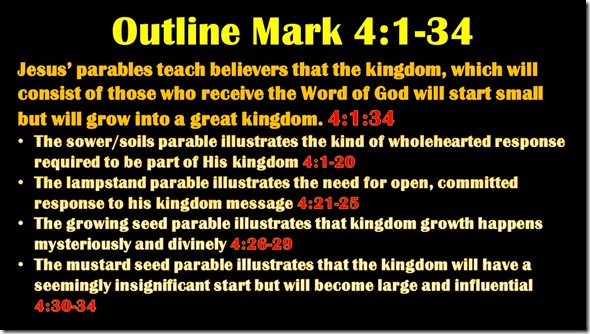
Mark concludes this teaching section with two parables about the nature of God’s kingdom in verses 26-34. The big point is that the kingdom will start small, just a few a people, and become very large and benefit many. This growth will not happen because of the efforts of people, but will be accomplished mysteriously by God and enjoyed by many people. Though the disciples and the subsequent generations that follow them in taking Jesus’ message to the world will be the “workers in the field,” the worldwide “harvest” that fulfills the promise to Abraham that “all the families of the earth will be blessed through you,” will be accomplished by the Father, Son and Holy Spirit.

The first parable (26-29) is about a farmer who plants the seeds and reaps the harvest but does not really do the main work of germinating and growing the plant and its fruit. The Creator has endowed the soil (see previous parable of the soils) and the seed with potential life and laid out and energized its process of growth. The farmer’s responsibility is to announce the gospel message (Jesus is King along with what he has done to liberate and lead his people) and then reap the harvest (continue to train those who hear as Jesus trained his disciples). The work of changing lives was already done (by the time Mark writes) by the resurrected, ascended Jesus at the cross and by his advocacy at the right hand of the Father, and is done in the heart of the people who hear by the Holy Spirit. Thus, the pressure is off the one who announces the gospel. God is the one  who has done and does the real work.

The second parable (30-32) teaches that the inevitable result of announcing the kingdom will be a huge movement that provides “shade” (comfort, protection, provision etc.) for all the varieties of “birds” indiscriminately (Jew and Gentile, slave and free, male and female etc.). This is a tremendous promise because it means that every small action and every word spoken to announce who Jesus is and what he he has done and that serves his people, has huge cosmic significance and contributes to God’s grand plan to restore the creation and its people. As God’s people, we participate (by his grace) in the most important operation of all time.

Finally, this is all done little by little through relationships. Jesus spoke these words to the disciples “as they were able to hear it.” (Mark 4:33 ESV) Jesus worked with them as they grew to be his witnesses, This is our calling and makes every relationship, every prayer, every deed done and every word spoken significant.

Wednesday, September 19, 2018

Devotional: Hearing Jesus, Mark 4.1-25

Mark 4.1-25 outline

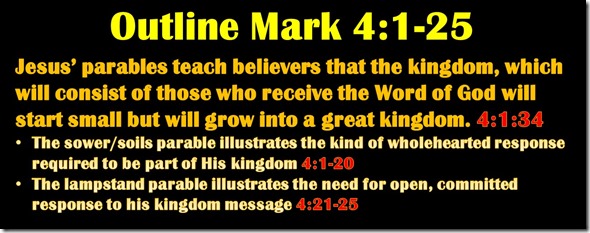
Jesus’ two parables, The Soils/Sower and The Lampstand, illustrate the kind of response that Jesus expects to his teaching and Kingdom gospel. The Soils parable teaches that Jesus expects a wholehearted response, “hear,” “accept,” and “bear fruit,” (Mark 4.20 ESV) in which the hearer meditates on what is said and the implications of the teaching for one’s daily life, believes it and commits to following it and then acts according to it. Jesus promises that this kind of response will accomplish the goals of the kingdom (“bear fruit”) in the believer’s life (conformity to Christ) and for the world (its restoration). The lampstand parable illustrates the need for open, committed response to his kingdom message so that all the world can see. The Spirit of God takes the word of God (see John 14-16, the fruit of the Spirit in Galatians 5) and progressively produces the likeness of God/Christ in the believer, whose witness becomes God’s means to transform the world.

The poor soils and the lampstand under the bed represent bad hearing of the kingdom gospel. Those who hear without commitment (along the path), or accept the word only for self-benefit (rocky soil) or just incorporate the word as one option to add the other commitments in their lives (thorny soil), or accept it privately without being willing to openly apply it before the world (lamp under the bed) will not accomplish the goals of the kingdom. This is a little scary because all of us have sometimes listened to the word in these ways. If salvation were dependent on how well we hear we’d all be in trouble. The good news is that Jesus’ faithfulness to his message has been applied to us and plows, fertilizes, and prepares us to become the good soil. We receive this by faith as we come to Christ and then each day as we “hear” we become more and more like the good, fruitful soil. The more we listen to Jesus the better we get at really “hearing him.” (verses 24-25)

So the next time you hear a sermon, study the Bible, or participate in Christian fellowship take the time to really hear." Meditate on the word and its implications for your life so that when you see and hear you will really understand. Take time to listen to the Spirit so that he can “make manifest the hidden” and bring your “secret things to the light.” (v. 22). Then, don’t ever walk away from the Word without committing to apply it to something specific in your life. Hearing the word without application makes one insensitive to it, while hearing the word with conscious commitment and application produces that intimate connection that brings the hearer into the ongoing conversation within the Trinity (Romans 8.26-27). Do you have “ears to hear?” Use them!