Monday, December 31, 2018

Devotional: God’s Standards For Daily Life #1, Matthew 5:21-32

Outline of Matthew 5.21-32

In the rest of Matthew 5 Jesus continued to reveal what living out the Torah according to what God really intended means. It is not enough just to agree with Jesus. We must imitate the way Jesus approached daily life in our closest relationships. Jesus gives six examples in the chapter of his very stringent application of the Torah. God eternally judges based on the motivation of the heart, not just the action. We may seem okay on the outside but the law judges unjust anger, lust or coveting, betrayal (divorce), integrity (oaths), what we really love (retribution or resistance) and what we really value (love for enemies). Jesus calls us to carefully consider, not just what we do, but our motivations for being and doing, and humbly commit to imitation of Christ in the power of the Spirit. In the first three examples we see that God wants peaceful relationships that deal with anger appropriately; service rather than exploitation of one another; and marriages that reflect the committed love within the Trinity. 

In Jesus’ first example we see that God calls us to attitudes and actions that create peace, not conflict. (5:21-26). Here Jesus corrects the Pharisee’s misunderstanding that God only judged the action, murder, and not the attitude, anger. It is not enough before God just to refrain from homicide because the anger itself is murderous in principle. Anger is dangerous because it leads to actions that will be judged by society and, ultimately by God. It must be dealt with quickly before it destroys relationships. First, it needs to be recognized as sin and honestly confessed before God. Then, you must do whatever is necessary to do to make the relationship right.. If you are the offended party you must forgive and deal with the issue in a way that will benefit everyone involved. If you have wronged someone make it right whatever that takes. Malicious anger is so evil and destructive, emotionally, physically and spiritually, that we must get rid of it before we murder ourselves with it. Forgive each other for no reason but God’s mercy and do whatever it takes to be at peace with others.

Jesus, next, uses male-female relationships to show that God desires relationships that serve, rather than exploit one another. (5:27-30) Again, Jesus is correcting a misunderstanding that only the act of adultery will be judged. It is not just the action that concerns God, but the selfish lust or greed that leads to the action. God desires a “pure heart” (5:8). To be pure in heart is to do everything to glorify God and serve others. Instead, lust or greed focuses on self and exploits others by using them for one’s own benefit. God calls us to purify the desires of our hearts by filling our minds with his word and by disciplining our bodies to keep busy and focused on doing the good things God has called us to do. This requires daily submission to God, honest confession, regular prayer and accountability to God and others in the body of Christ.

The third example of God’s standards for daily life is illustrated by the commitment of a godly marriage. (5:31-32). Again Jesus is correcting a misunderstanding, that Torah approved of divorce.(Deuteronomy 24:1-4) Instead, Jesus pointed out that Torah was regulating divorce in order to protect its victims from a sinful spouse. Divorce was never part of God’s original plan. It’s caused by sin and is sin. It was permitted by God to protect the offended one (mainly the wife in the patriarchal culture of the day) from an unfaithful spouse or spousal abandonment. Marriage is the ultimate picture of what godly relationships should look like: people committed to one another; able to trust one another totally; a loving ministry team perfectly fitted and brought together by God.

This is the standard that Jesus taught and lived out in his life. When Jesus was hurt and misused he didn’t give vent to His anger. When he was personally hurt he said “father forgive them” and he kept the door to relationship open as he reached out with God’s mercy. Even when he got angry he dealt with it quickly and appropriately confronting those in the wrong so they could be restored to relationship. Jesus was surrounded by women but never, ever exploited one of them in any way. He loved them so much that he wouldn’t even think about using one of them to satisfy himself. He was so focused on what God wanted Him to be and do he wouldn’t be distracted by his own interests. Jesus gave His life for us and sits at the right hand of God meeting our every need so that we, can be what God wants us to be. That is what Jesus did. That is what we should do too.


Monday, December 24, 2018

Owen Christmas Letter 2018

2018 Christmas Card

I know our Christmas card this year is a little "weird." We just wanted to point out what God has done for us in 2018. Our gift from God this Christmas was continued life and health. Last year at this time we had just returned home from my extended stay at Stanford Hospital for a stem cell transplant. I was confined to the house because of my weakened immune system. Joyce was recovering from a fall in the parking lot which broke her glasses and beat her up pretty badly. What a difference a year makes! Both of us are able to get out and enjoy celebrating the Christmas season this year. Last year we were the sick ones being ministered to by the carolers. Last night we were able to go Christmas caroling. We have also been to a few Christmas services and programs. We are looking forward to spending time with family over the Christmas and New Year holidays.

We are also thanking God for...

  1. Continued clear PET scans and blood tests. We have the big scan coming up in January. We are confident and praying that it will confirm that we are "one-year cancer-free" a major milestone.
  2. Our bill at Stanford is gone. We now owe 0$ on a bill that was $473,000 at the beginning of the month. Joyce said "it feels like we won the lottery."  We thank God for the amazing provision!

So now we are looking ahead to 2019 and are wondering where God is going to take us. I will still be officially in recovery but we are looking forward to being much more active in ministry in the near future. We are available still for sharing our ministry, preaching, teaching etc. in 2019. We would love to fellowship with you. Our schedule is wide open. Please contact me at dave.l.owen@gmail.com if you would like us to visit. We will be speaking at the morning service at Gateway Bible Church in Scotts Valley California  on December 30 and at the evening service at Gold Country Baptist Church on January 6th.

May God give you a blessed time celebrating the incarnation of Jesus and a joyful 2019.

God Bless

Dave and Joyce

Devotional: God’s Standards For Kingdom Living, Matthew 5:13-20

Outline of Matthew 5.13-20

In the rest of chapter 5 Jesus challenges those who would be His disciples with some very hard, perhaps hyperbolic, teaching about our relationship to God's law. The point is that legalistic fulfilling of the letter of the law is not enough. God wants total transformation of our hearts, goals,and desires to match His character and that we value His kingdom above our own desires and even our own needs. It is not enough just to agree with Jesus or believe the right things about him. Faith means that we follow Jesus without reservation and humbly commit to imitation of Christ in the power of the Spirit. Faith opens up God’s resources to us and allows God to make his home in us. It overwhelms us with the beauty of God’s grace and love so that we want to be different and then gives us the power to be different. What God wants from us is a love relationship with Jesus, guided by the revelation of him in the Bible and practiced publicly.

In verses 17-20 Jesus corrects some misunderstandings about God’s revelation to his people in the Torah which also apply to the revelation of the New Testament. The bottom line is that the whole revelation of God in the Bible is about Jesus, leads us into relationship with Jesus, and is only effective when actualized in our lives by Jesus in the power of the Holy Spirit. In these four verses Jesus gives four principles about how God’s revelation in scripture enables us to live out Jesus’ character and actions.

First, Jesus is the embodiment, goal and direction of every word of the Bible. (5:17) Jesus was not throwing away the Torah. Its principles still apply. But they all point to him. Jesus fulfilled the law by living it out perfectly. Jesus fulfilled the law by providing a way for it to change us from the inside-out. Jesus fulfills the law in our lives by giving us the Spirit who works it into our lives. Being like Jesus is the goal of the law and he provides the direction and the power for that.

Secondly, Jesus promises that God will accomplish everything he promises in his word. (5:18) Until “heaven and earth pass away” God is working in your life to accomplish every little detail of his plan for your life and for the entire universe.He will destroy evil, and present us to the Father transformed into the likeness of the Son. Each one of us participates in this righteousness now as we submit to Jesus’ direction in the power of the Spirit and let it lead us into deeper relationship in Christ.

Third, God calls to a deeper level of obedience at the level of priorities, commitment and attitude; not just adherence to an external standard. (5:19) Then he promises reward based on our heart commitment to these standards. God is preparing us for greater service in his eternal kingdom, and there will be levels of authority (“least, greatest”) there. Your obedience to God’s Word and commitment to emulating and following Christ will have effect on your eternal lifestyle. As we submit to the Word, read the Word, let the Spirit activate the Word in our lives, and teach the Word of God to others, then we grow into Christ who is the embodiment of the Word and are made ready for what is coming.

Finally, Jesus says that a righteousness imposed from the outside in is not enough. The standard for entrance into God’s Kingdom is perfection (5:20), God’s character. Our real problem is our corrupt heart; rules can never deal with that. Thus, we need Jesus’ righteousness which guarantees our entrance into the kingdom, the Spirit’s power to provide for our growth into Christ and ability to serve him, and the Father’s love that guarantees that his plan will be completed to make us perfect in the image of Christ.

Jesus tells us what that this looks like in verses 13-16. We need to live lifestyles (salt) that make people thirsty for God; lifestyles that display changed hearts in Godly relationships, words and action. We need to be light that shows Jesus to others, a lamp that teaches by words and example what Jesus is like and what he wants from us. We must be a “city on a hill,” a shining example of what relationship with God is all about that provides a place where hurting people can come for guidance, protection, and sanctuary. True Christianity cannot be kept private. We should live a life that says, “Here I am, I’m not perfect yet but I’m growing. Do you see Jesus in me?”

You can choose to live by your own power, by rules and external standards which can never please God. Or you can choose to live by Christ’s righteousness, trusting in His death and resurrection for your eternal destiny, living daily in submission to his Word and by the power of His Spirit. This is the kind of righteousness that will create the image of Jesus in you and allow you to experience kingdom living now. This is the kind of righteousness that will make you salty, creating a thirst for Jesus in those who come in contact with you and will make you a light that God’s people flock to for direction, care and safety. Walking with Jesus is a moment by moment choice to be with Him, submit to Him, love him and serve Him.

Friday, December 21, 2018

Devotional: Attitudes for Kingdom Living, Matthew 5:1-12

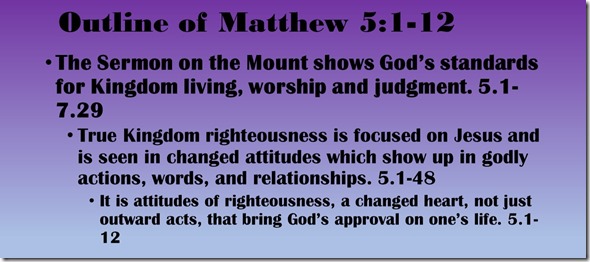
Outline of Matthew 5.1-12

In Chapters 5-7 Matthew presents Jesus as a “greater than Moses” revealing a fulfillment of the Torah under the new covenant.  This section is probably a summary of Jesus’ teaching and the content here was likely spoken by Jesus many times in many venues. He emphasizes the shocking nature of the teaching's requirements to be a kingdom disciple, but also emphasizes that the entire section must be understood in a context of grace. The point is that Jesus fulfills the purpose of the Torah by completely embodying the character of YHWH that it pointed to. So, the disciple of Jesus must live the kind of self-giving lifestyle that Jesus lived. We cannot live for ourselves or for our own personal agendas, but instead be focused on God's will and kingdom, even if that brings persecution and death. Jesus knew that kind of righteousness, that brings God’s blessing, is planted in our hearts by God as we trust him. It comes out from within and produces Jesus’ character and actions in us.

Matthew, in 5:1-12, emphasizes that true righteousness comes from the inside (attitudes) and then works itself out in our actions. It is not imposed from the outside by rules and laws. It begins in our hearts and is received by faith. It then produces Christlike lifestyle, conduct and relationships as we cooperate with God’s grace. So in verses 3-11 Jesus details the attitudes we should cultivate in our lives as Christians to cooperate with God as He works righteousness and its blessings into our lives.

Jesus begins with the right perspective about ourselves in verse 3, “Blessed are the poor in spirit.” Being right before God begins with a humility that recognizes my dependence on God. I am neither self-sufficient nor am I in control. I trust Christ and Christ alone for all my needs and submit my plans, ideas, and goals to Him. Jesus promises an experience of a little heaven now when we do this.

Verses 4-6 emphasize a right attitude before God. First, we sorrow over sin and its effects. This means we are brutally honest within ourselves as we confess our own sins to God so that we can experience his forgiveness and comfort. We then can mourn over what sin does to others and pass on the forgiveness we experience to them. Second, God calls us to “meekness,” a submission to God evidenced by a life of service to God and others as he has gifted. God entrusts his authority to those submitted to him. Finally, true righteousness is seen in a passion to know God and his ways. When we have that passion God promises to satisfy it.

Verses 7-9 emphasize attitudes of right service to God. Jesus is seen as we are merciful. Mercy comes out as forgiveness for the guilty and compassion for the needy. It is only when we are merciful that we truly experience God’s mercy. The second attitude is “purity of heart,.” single-minded devotion to God that allows nothing (good or bad) to get in the way of what God wants for us. This results in a daily experience of God. Finally, righteous people are “peacemakers.” Peacemakers seek reconciliation in relationships and seek to repair what sin has broken. This is how others recognize the image of God in us. 

Finally, verses 10-12 emphasize our attitude toward the hostile world. The real Christian responds to persecution with love and joy rather than in kind. This joy comes from an eternal perspective that realizes suffering and opposition are all for our ultimate good and will result in a greater experience of Jesus and reward in eternity. An added bonus is that our enemies may be defeated, not by being destroyed, but by becoming “friends of God” and his people.

These attitudes are completely counter-intuitive and make no sense without the promise contained in the repeated word “Blessed.” To be blessed mean to have God’s approval. God approves of your growing character as you seek Christ.and enters into your inadequate actions and completes them. Blessing means a satisfaction that does not depend on circumstances, a.joy that comes from knowing nothing can deter God’s plan and a peace that knows that “nothing can separate you from the love of God.” Blessing means a complete sufficiency for every situation and confidence that whatever God calls you to do he empowers you to do.

God offers you His righteousness. This leaves you with a choice. You can go with your own righteousness which says, “God, I’ll let you be part of my life. I’ll give you so much of my money, my time, my effort, my heart, but after that the rest is mine, keep your hands off. Or you can receive His righteousness which is experienced as we display these attitudes of humility, sorrow for sin, submission to God, passion for God, focus on God, and a desire to display his compassion and reconciliation to a sometimes hostile world. That kind of righteousness requires everything we have and everything we are, but it brings into our life everything Jesus’ is. That is what God made you for. That is what will fill the deepest needs of your heart. The other kind of righteousness doesn’t make it. Choose real righteousness. Choose real life. Be like Jesus.

Wednesday, December 19, 2018

Christmas Fun in El Dorado 2018

20181208_185040

We have been enjoying the Christmas displays and events here in El Dorado county this year. This is already our 3rd Christmas here, but it is really the first one we have been able to participate in. The last two I was too sick. So we have been going all out with driving to see Christmas lights (above), church and school Christmas programs, ice skating (I watched) and other fun events. Here are a few pictures.

20181214_18075420181214_184807

We went ice skating at the District Church in El Dorado Hills. I watched and drank coffee to keep warm.

20181214_20020220181214_20162720181214_201643

We celebrated with the El Dorado Hills Fire Department and Leila got to meet Santa. It was a lot fun to get out meet people at different churches and from different communities.


Devotional: The Beginning of Kingdom Ministry, Matthew 4:12-25

Outline of Matthew 4.12-25

Chapter 4 of the Gospel of Matthew ends with the beginning organization of Jesus' ministry and a brief summary of what kingdom ministry looks like. Matthew makes it clear that kingdom ministry is intimate and relational and ministers holistically to the physical and spiritual needs of all the people it encounters. Jesus’ gospel message is condensed to two short sayings, “Repent, for the kingdom of heaven is at hand.” (4:17) and “Follow me, and I will make you fishers of men.” (4:19). .As Paul reduced the gospel message to “Jesus is LORD” (Romans 10:9), so Jesus reduces it to “repent” and “follow me.” The rest of the Gospel will recount the events that show that Jesus is the promised king who has defeated death and sin (the gospel events) and, thus, we need to repent of our own ways of living and trust, submit to and follow Jesus (the gospel response). The kingdom of God has come in the person of the king and Jesus now begins to gather his disciples and minister to them.

He defends Jesus' choice of despised Galilee as his base of operations and emphasizes the prophesied outreach to the Gentiles.(4:12-17) Right up front Matthew lets us know that King Jesus is going to be a very unusual king. He does not go to the capitol to begin his ministry but, instead, goes to “Galilee of the Gentiles,” the least likely place in the nation for God to show up. Jesus would be a king who goes where the needy people are. He would also minister in unusual, unexpected ways. Isaiah 9 compares his victory to that of Gideon who did not win his victory by superior strength but in a weakness that displayed the power of God. This king would gain his throne by stooping down to help to help those in “the shadow of death”  and bring the light of life and victory over death by giving his life, rather than taking lives.

.Jesus would also gather an unusual group of people for his inner circle of attendants. (4:18-22) Just as God called Israel, when he was a “wandering Aramean” and “few in number” (Deuteronomy 26:5), to be in covenant relationship with him and to reveal YHWH to the world, so Jesus would choose very flawed men and women to be part of his inner circle through whom he’d reveal himself to the nation and to the world. That began with the calling of four Galilean fishermen to “follow me.” That is “give your lives to me,” “live with me,” “learn from me” and “become like me” so that “you can reveal me to the world.” Peter, Andrew, James and John, exemplified what “repent” means as they left their old lives behind and followed Jesus. These would become the people who “turned the world upside down.” This should be how we do ministry today. We follow Jesus and take others with us.

Matthew records a summary of Jesus’ ministry in 4:23-25. First, Jesus proclaimed the “gospel of the kingdom.” That is he announced the good news that God was there in his person and what that meant for them. For us, this would be the applicational preaching of the whole apostolic revelation of the New Testament message. Second, he taught them “in their synagogues.” Jesus went where the people were and clearly taught how the scriptures related to him and what God wanted from people in their present situation. A good teacher is in relationship with the students and is able to take eternal truths and apply them to new situations. Finally, Jesus ministered to the physical and spiritual needs of all the people he came in contact with.  For the church to be what Jesus has called us to be we must be reaching out to people in all three of these areas.

Jesus calls us into relationship. Proclaiming the gospel is basically introducing people to a Jesus that we know and love. Discipleship is basically being in relationships with people that invite them to  “walk with me as I walk toward Jesus.”

Tuesday, December 18, 2018

Devotional: Recognizing Your “Wilderness” Moment, Matthew 4:1-11

Outline of Matthew 4.1-11

In chapter 4 Matthew continues to show us how Jesus recapitulated and fulfilled the history of Israel. Just as the nation was nurtured in its infancy in Egypt and then was delivered to return to the promised land, so Jesus as an infant was saved from Herod and spent his infancy in Egypt before he grew up in Nazareth. Just as the nation was “baptized” in the Reed Sea and then experienced the presence of God at Sinai, so Jesus was baptized in the Jordan by John and the presence of God was seen as the Holy Spirit descended as a dove and the Father’s voice from heaven pronounced “This is my beloved Son, with whom I am well pleased.” (3:17) Now, just as God, in a pillar of cloud and fire led the nation of Israel into the wilderness to be tested before they could enter the promised land, so the Spirit led Jesus into the wilderness to be tempted by the devil. There is no wisdom gained apart from suffering. There is no calling to mission without testing. There is no paradise without a cross. Jesus must endure the same kind of testing and temptation all of us endure. The great difference will be that, while the nation failed the test in the wilderness – they worshipped a golden calf, they failed to trust God for their daily bread, and they failed to complete their mission – Jesus passed the test with a 100%. He knew God’s promises, trusted them and submitted himself to accomplish God’s mission with God’s resources and in God’s way.

The slanderer, the accuser, tempted Jesus with the three main temptations to which the nation succumbed throughout their history: idolatry, self-reliance, and lack of faith. The devil began by tempting Jesus to lack of faith in God’s promise to supply “daily bread.” Israel in the desert was sustained by God for forty years with manna, their daily bread, always fresh with just enough for that day. They responded with grumbling and complaining and several times tried to turn back to Egypt for the fried fish and seasoned food they liked. Jesus, on the other hand, had been fasting for forty days and is tempted to not trust in a time of deep need. He responds with the words of Deuteronomy 8:3, a reminder that God allows times in our lives where it appears that our daily needs are not being met (as and when we want them to be) so that we develop a trusting heart that knows that, God will not only handle the basics in our life as he promised, but the “big” issues as well. Jesus would fulfill his calling with a trust that God was with him in everything and would supply all his needs.

The second area of temptation was self-reliance. Would Jesus do things God’s way or would he try to manipulate God to do things his way? Again, the nation failed at this over and over. They asked for a king so they could be “like the other nations.” They made foreign alliances and trusted in vast armies to protect their safety. They tried to manipulate God to overlook their immoral lifestyles, misuse of power and blessing, and oppression of their fellow Israelites with their sacrifices and meticulous ritual. The devil here is trying to get Jesus to try a different way to glory than the way of suffering. This is a temptation Jesus will face again when Peter takes the role of the devil by opposing Jesus’ announcement of his death and in the Garden of Gethsemane. Jesus again quotes Moses (Deuteronomy 6:16) as he refuses to “put God to the test.” Expecting God to do things our way, according to our agenda tries to put us in the place of God as the decision maker. This was the sin of Adam and Eve in Eden and the sin of the “shining one” (Isaiah 14:12). Any time we back out of God’s will because it leads us into difficulty or fall back on old ways to deal with a problem we succumb to this temptation of the devil.

The third temptation was to the besetting sin of Israel in the Old Testament – idolatry. The history of Israel from Egypt to exile was a succession of periods of falling into idolatry and purges and falling again. Now the devil pulls out the big lie: He shows Jesus everything he wants and says, “All these I will give you, if you will fall down and worship me.” (4:9.) Of course, the problem is that the kingdoms of the world are not his to give and the devil never “gives” anything without exacting too high a price. The kingdom of God would come only when the principalities and powers of darkness would be defeated by the cross. Jesus knew the plan of God from Eden to Sinai, to the cross to the new heavens and new earth and he would stick with it. God is the only one worthy of worship and obedience and Jesus would not make the mistake of replacing God with something less, even if it meant giving his life.

Each one of us will have wilderness experiences as we pursue our calling from God. The devil is a clever tempter and knows how to use these difficult times. He will try to sidetrack us with worry about daily things God has already promised to take care of,  using blessing, power or position to serve ourselves instead of others, or to move God from the center position of our lives. He knows how to use religion and worldly power to get us off track. He may even twist scripture to do it. Like Jesus, we need to know and trust what God has promised, be people of prayer, and refuse any substitute for God and his Spirit as a way of accomplishing the mission he has called us to do. When we do that, like Jesus, we will see all the residents of heaven come to help us get through the wilderness. (4:11)