Friday, March 09, 2018

PET Scan Update

28238879_10156230183234312_4537359472903167754_oThis is the latest prayer letter from us…

Dear Prayer Partners

Today was the big day: We got the results of my PET scan from our doctor at Stanford. The result was mostly good, but mixed. The areas that were treated with chemo were all clear. There were two small areas in my pelvis that were lit up in the scan. The doctor thinks recurrence of lymphoma is unlikely. It could be a false positive or minor infection but he wants to be sure. So we will have another scan the last week of April. So we'll wait and pray a little more.

We also saw a lymphedema specialist last week. His diagnosis was that my edema is chronic but manageable. He prescribed some pressure garments and physical therapy. There are a few other treatments they will try and we will see what works. We would appreciate your prayers for this too.

So it looks like our lives and plans are still somewhat up in the air. We are getting used to that. On the positive side I seem to be improving health-wise every day. I am working on being more active and hope to get out and about more. We continue to pray for direction as we move forward. We don't like to wait, but we trust the Father who is taking us down this road. We do appreciate you coming down the road with us as you partner with us in prayer, care and being there.

Thank you and God Bless

Dave and Joyce

Reading Through the Gospel of John #4 (9-12)

JohnIn this post we continue reading through the Gospel of John accompanied by John, vol. 4, The IVP New Testament Commentary Series, by Rodney A. Whitacre. In Chapters 5-8 John has shown Jesus to be the fulfillment of the Torah (5) and the Jewish temple and feasts (6-8). He is the Light of the World who brings the ultimate revelation of God to his creation and chapters 9-11 present two more spectacular miracles that illustrate this. Jesus brings division between His followers and the official Judaism of his day and he begins to gather his followers into a new "flock" that is characterized by allegiance to Jesus. I am posting from my reading in the New Testament accompanied by various commentaries on Monday, Wednesday and Friday and welcome comments and discussion on my Facebook page. I am using the Logos version of the book. As usual my comments are in black and quotes from the book are in blue.

In chapter 9, Jesus illustrates and demonstrates that he is the Light of the World by healing a man with lifelong blindness. The OT prophesied this miracle as a sign of the New Covenant and the coming of the Messiah who remove both physical and spiritual blindness. Jesus uses clay, as God did in the creation of Adam, in the miracle to signify new creation and sends out the blind man to witness to what happened. The Pharisees reject the plain working of God in front of them and put the man out of the synagogue, showing their spiritual blindness. The separation between Jesus' followers and those of the Pharisees increases. 

Our sufferings are opportunities for God’s grace. If our suffering is indeed a punishment for sin, then it becomes an occasion for repentance and thus the manifestation of God’s grace as we are restored to fellowship with God. If our suffering is not a direct punishment for sin, then it is something God allows to happen in our lives, usually for reasons beyond our knowing, which nevertheless can help us die to self and find our true life in God. God does not allow anything to enter our lives that is not able to glorify him by drawing us into deeper intimacy with him and revealing his glory. John 9.1-23, 236–237

The Scriptures, in and of themselves, are not an infallible guide either, as the example of the Jewish opponents reveal. It depends on one’s interpretation. The Christian claim is that the Scriptures are an organic whole that make sense when interpreted in the light of Jesus the Christ under the guidance the Spirit has provided the church. The bottom line is that we need God to guide our understanding of both the Scripture and our experience. Once again we see the importance of humility and openness to God as a core attribute of true discipleship. John 9.24-34, 248

We need to realize our own utter poverty, blindness and need apart from Christ. We need to see with his eyes the desperate condition of all who have not been illumined by him, the light of the world. We need to consider before God whether there are ways we reject the evidence of our own experience because we have a faulty understanding of him and his ways. We need to consider before God whether we have God too figured out...we need Jesus to be our center of reference. John 9.35-41, 253–254

In chapter 10 Jesus reveals himself as God come to shepherd His people in a new community. He is qualified to do that because he has come from the Father as the full revelation of God's salvation and he will give his life and "take it up again" as the good shepherd to provide that salvation. The requirement to be part of that community is to "hear his voice" and respond by following him. The chapter ends Jesus’ public ministry with a very clear claim by Jesus to his shared Deity with the Father. John returns to his introductory idea that Jesus is one with the Creator who fulfills the Torah and brings the promised full salvation and revelation of God himself in human form. 

The Jewish leaders have rejected Jesus on the basis of their knowledge of God and his ways. They have expelled the man healed in chapter 9 from the people of God on the basis of his confession of Jesus. They believe they have consigned the former blind man to death, that is, to separation from God and his people. But Jesus has found him and incorporated him into his own company. John 10.1-10, 258

This new community is based in his death (10:15). The very pattern of life in this new community is that of life laid down for one another, a cruciform life. The possibility of such a life and the power for such a life come through the life of the Son of God poured out on the cross, thereby uniting God and mankind by taking away the sin of the world and revealing the glory of God. John 10.11-18, 263

Jesus does not claim to be Messiah in their understanding of that term, but all of his words and deeds have been those of the Messiah in truth. But the Jews were not expecting a messiah who shared in God’s divinity, and thus these opponents could not see his messiahship and were scandalized by his claims to equality with God. John 10.22-42, 271

In John 11 we see the climax of Jesus' miracle signs which point to Jesus as being the One who brings life and light. Jesus links the raising of Lazarus to the healing of the man born blind when he says that both happened to reveal God's glory. This ultimate sign done by Jesus shows that he is the one who will bring in the "age to come" with its great eschatological resurrection, judgment and an eternal life that begins in the present. Faith in Jesus is the key to being part of the people of God who experience eternal life now and in the incorruptible bodies of the future. Jesus is one who defeats death and sin and thus provides life.

In all that Jesus does we see the glory of God (1:14), for we see God’s love and life-giving power. Now, in the raising of Lazarus, we will have the most spectacular manifestation of this glory. God is the one who brings life to the dead out of his love for those in such need. This is the heart of the Gospel. John 11.1-16, 279

Jesus’ claim is mind-boggling. He says it is faith in him that brings one back to life at the resurrection at the last day. He is the ground of eschatological hope. But then he goes even further. “I am the life”: and whoever lives and believes in me will never die (v. 26). The life that comes through believing in Jesus is not interrupted by physical death...By taking humanity into Himself He has revealed the permanence of man’s individuality and being. But this permanence can be found only in union with Him. John 11.17-44, 286

Each aspect of the Gospel needs to be in place, or some deformed shape will emerge. The period of the New Testament saw the articulation of a variety of ways to express the Gospel, with the Holy Spirit guiding and protecting. The unity and diversity we now have in the canon provides a composite shape to the faith that is a guide to the truth of the Gospel—that is what “canon” means. John 11.45-54, 297

John 12 ends John's account of Jesus' public ministry. In this section we get a picture of what real and false disciples look like and a final summary of Jesus' teaching and a call to respond. Mary's extravagant anointing of Jesus for burial typifies the kind of worshiping disciple desired by God, while Judas' selfish money-loving attitude is condemned. The climax has come and God is about to be glorified through Jesus. The response to Jesus will determine one's judgment. Even when God speaks in the thunder only the true disciples understand. Though the crowd follows Jesus, they do not fully understand him. There are also others who believe him but will not follow him openly because they fear the opinions of others. These are also inadequate responses. The true disciple will believe Jesus and follow him in self-sacrificing love. This is the full revelation of God and also will reveal who his followers are. These are the ones who live out and will inherit eternal life.

The Good Shepherd is indeed gathering his flock from the whole world (10:16) in fulfillment of the prophecies of the universal messianic kingdom such as those found in Zechariah and Zephaniah. Jesus continues to form his community apart from the official structures of Judaism. John 12.1-19, 308

It is precisely the victory of the cross that enables the believer to hate his life in this world and keep it for eternal life (v. 25). Believers can claim the defeat of Satan at the cross, and they can effectually break his spell through union with Christ and, by God’s grace, through focusing attention on God and detaching attention from that which is not of God. As one is united to Christ one comes to share in his own life of sacrifice. John 12.20-36, 316

God’s sovereign action is never a violation of our moral responsibility, for such determinism would turn us into robots and preclude love and relationship. “The divine predestination works through human moral choices, for which men are morally responsible," as is made clear in the next section (12:47–48). But the human responsibility never violates the necessity of divine grace.  John 12.37-50, 323

Monday, March 05, 2018

Sunday Worship at Gateway Church

20180304_113338 (1024x768)

Joyce and I had an enjoyable Sunday yesterday as we worshiped at Gateway Church. We had the privilege of fellowship at the Lord’s table with our friends there yesterday. This is the church I grew up in and it was good to see so many old friends.

28471805_10156244704784312_8651194599601078272_o20180304_105629 (1024x768)20180304_111938 (1024x768)

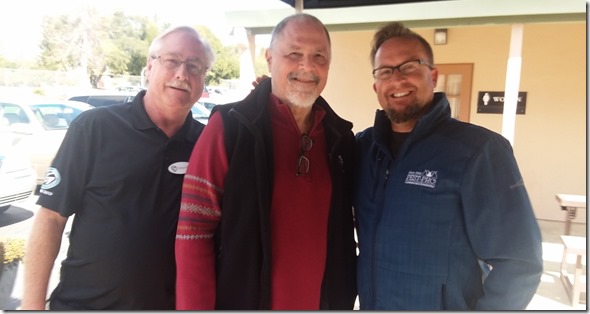
It was good to see Eugene (center) again and get to meet his son. Eugene played shortstop on the Baymonte team I coached in 1982. After church we went to lunch with Dave and Sally Beck (left). We also went out to Boulder Creek to have dinner with Jo and Chuck Romaniello. We forgot to take a picture there. It was great to see everyone at Gateway again.

Reading Through Theology of the OT: by Walter Brueggemann #17

BrueggemannThis post concludes my read through of Theology of the Old Testament: Testimony, Dispute, Advocacy, by Walter Brueggemann. Though I have posted some of my disagreements with Brueggemann I have enjoyed reading through his OT Theology and have received several insights from his treatment of the text. His recognition of the tensions in the OT text which should not be flattened out is especially helpful . I have been posting quotes from the book on my Facebook page on Tuesday, Thursday and Saturday (NT is Mon-Wed-Fri) and we can discuss comments and questions about the passage there. As usual my comments are in black and quotes from the theology are in blue below. I am using the Logos version of the book.…

As he moves his theology toward conclusion Brueggemann, in chapter 28, Some Pervasive Issues, deals with four key issues that keep coming up in Old Testament theology. The first is the relationship to historical criticism. He wants scholarship to move beyond criticism, which assumes a rationalistic worldview that eliminates the supernatural and removes YHWH from the discussion, but also resists "fideism" which assumes a flat reading of the text according to dogma. One can bring in the results of critical scholarship to better understand the text without compromising its message. A second issue is the relationship of the New Testament to the Old. He sees the use of the OT in the NT as an "imaginative," but legitimate, enterprise. While there is some "imaginative" exegesis there, I would see the NT as the intended conclusion of the OT. This also speaks to the third issue of the relation of Jewish tradition to the OT in Christian thought. I would agree that we need to avoid supersessionism, respect the Jewish origins and character of the Bible without mischaracterizing the Jewish environment it came out of, and that we need to be in friendly dialog and cooperation with modern forms of Judaism. But, I would disagree that we need to let go of the exclusive claims of Christ on Jews or any other nation or culture. Finally, I agree with Brueggemann that the Bible's call for justice requires us to apply the OT emphasis on taking care of the poor and marginalized without losing its call to order. How we do that is certainly up for discussion, but the church should be in the forefront of making that kingdom vision of everyone having what they need happen. 

We may now be at a moment when totalizing fideism is exposed as inadequate and when skeptical positivism is seen to be equally inadequate, when a genuinely thoughtful criticism can engage the density and depth of the text, which is available neither to fideism nor to skepticism. 729

The task of Old Testament theology, as a Christian enterprise, is to articulate, explicate, mobilize, and make accessible and available the testimony of the Old Testament in all of its polyphonic, elusive, imaginative power and to offer it to the church for its continuing work of construal toward Jesus. 732

A study of Old Testament theology must recognize, with social realism, that both advocates of distributive justice and of order are present and vocal in the community, and both claim the support of Yahweh in their theological testimony. At the minimum, it is important to recognize and explicate this tension. In my judgment, however, one may go further to insist that while both sorts of advocates bear testimony to Yahweh, there can be little doubt that the adherents of distributive justice occupy the central space in the theological testimony of Israel, so that in canonical Yahwism, distributive justice is indeed a primary urging. 738

Chapter 29, Moving Toward True Speech, concludes Brueggeman's theology by summarizing his main points and calling the church as a community to do Old Testament theology in a way that reflects commitment to the truth of the text and to being a relevant witness to the world in its words and practices. One cannot do good OT theology without being willing to order their lives around what God is saying in the text. All the voices of the OT, with the tensions and interpretive difficulties they bring, must be heard and applied in the church. We cannot, for example, hear only the voices of order and purity without also hearing the "disruptive" voices of the prophets calling the powerful to accountability and calling everyone to reach out to the needy and marginalized. We have a responsibility to make the witness of the OT text known in a world with many other competing worldviews.

It is my impression that the church in the West has been sorely tempted to speak in everyone’s idiom except its own. Liberals, embarrassed by the otherness of the biblical idiom, have kept control of matters through rationalistic speech that in the end affirms that “God has no hands but ours,” issuing in burdensome self-congratulations. Conservatives, fearful of speech that is undomesticated, have insisted on flattening biblical testimony into the settled categories of scholasticism that freezes truth. In both sorts of speech, the incommensurate, mutual One disappears. 746–747

The testimony of Israel concerning Yahweh is always of two kinds, one to reorder the internal life of the community in ways faithful to Yahweh, the other to invite the world out beyond this community to reorder its life with reference to Yahweh. Both enterprises are preoccupied with the recognition that the acknowledgment of Yahweh at the center of life (the life of Israel or the life of the world) requires a reordering of everything else. 747

Stanford Trip and Doctor Appointments

20180302_160403Last week was a week of doctor appointments for us. We started with an appointment with the local oncologist on Wednesday, with a blood test preceding it on Tuesday. That went well. The blood test was clear and all my numbers were good. The doctor was very encouraged by how much my health had improved since I last saw him. We also enjoyed seeing the nurses at the infusion center in Cameron Park. They celebrated my recovery with Joyce and me. We have been quite blessed by their care for us over the last year.

20180302_133215 (1024x560)Friday we headed down to Stanford for another PET scan and an appointment with an edema specialist.  The PET scan went well and we will be back at Stanford on Thursday to hear the results from our transplant doctor. Joyce was able to listen to some music (left) while I being scanned. We would appreciate your prayers for that appointment. 20180302_161209 (768x1024)We spent about an hour with the edema specialist. He thinks that the edema is going to be chronic, but he thought that there could be ways to manage it. It seems likely that the lymphoma damaged enough of my lymph nodes so that water will never drain properly through my body. He referred us to a physical therapist who may help. He also gave us prescriptions for various types of medical garments that will help my body process the water through me, like compression socks and shorts, special shoes etc. We are also waiting to see if our insurance will allow us to purchase some medical devices which the doctor prescribed. Joyce and I went out on Saturday and bought some of the clothes he recommended.. These are the most expensive clothes I have ever owned, but, if they help me become more mobile and able to function, they will be worth it. It feels a little weird to own an $80 pair of socks. We are thankful to those who donated to our medical fund so that we were able to go right out and buy this stuff.

Thank you for praying for us last week and for praying for us as we see the doctor on Thursday the 8th. It looks like our life will be a little different than it was before, but we are thankful for life and for healing and are looking forward to where God takes us in the next years.

Wednesday, February 28, 2018

Reading Through the Gospel of John #3 (6-8)

JohnIn this post we continue reading through the Gospel of John accompanied by John, vol. 4, The IVP New Testament Commentary Series, by Rodney A. Whitacre. The Gospel of John chapters 6-7 begin a new section in which Jesus shows His divine glory (he makes alive and judges) in his relationship to two Jewish festivals: Passover and Tabernacles. In both, he is not just a participant. Instead he is the God that is worshiped in these festivals. I am posting from my reading in the New Testament accompanied by various commentaries on Monday, Wednesday and Friday and welcome comments and discussion on my Facebook page. I am using the Logos version of the book. As usual my comments are in black and quotes from the book are in blue.

Chapter 6 shows Jesus as superior to Moses because He is the God of the Passover and Exodus event. The  feeding of the 5000 identifies him as the Passover lamb and the one who provided bread in the wilderness to sustain the life of his people. Walking on the water presents Jesus in terms of the way Old testament theophany presented YHWH, as ruler over the chaos. It also shows that Jesus is the One who gets his people across the water, as when God miraculously parted the sea to allow Israel to escape from Egypt. When the crowd asks Jesus to explain the miracles, he says "I am the bread" that comes from the Father. Jesus Himself is the one that sustains life now and provides eternal life (physical and spiritual) in the age to come. The only way to get this life is a daily regular, pictured by eating and drinking, trust in Jesus that humbly listens to his word and relies on his provision. He then provides the Spirit who enables this supernatural quality of life. Most of the crowd responds to this revelation the same way they responded to Moses in the wilderness: they grumbled and complained and many quit following Jesus. The question to us becomes, are we willing to acknowledge who Jesus is and make the daily commitment to base our entire lives upon him and what he provides. 

We do not expect a small amount of food to feed many people nor the surface of the water to support a human being, and neither do we expect body and blood to bring us eternal life. But, just as Jesus is far superior to Moses, so too the salvation he brings is far more than the provision of physical food and the protection from physical danger. John 6.1-21, 149–150

Our primary work is being receptive to God. All our actions and plans are dependent on the most important action—union with God in Christ by the Spirit. Ultimately it is not a matter of our working for God, but a matter of God’s living his life and doing his work through us as we trust him and align ourselves with him by his grace. John 6.22-30, 154

Along with the revelation of God’s sovereignty is the revelation of his desire that all be saved (1 Tim 2:4)...It is a mystery how salvation can be open to all yet dependent on the will of God...In practical terms, this dual teaching of Scripture leads us to two responses. The first is a life of praise and joy in the revelation of a gracious heavenly Father who is utterly good and completely for us. The second is a life of real effort, taking seriously our Lord’s call to enter the narrow gate (Mt 7:13) and to persevere to the end. John 6.30-71, 160

The next section (7-8) intensifies the conflict about Jesus, as he reveals himself even more clearly at the Feast of Tabernacles. The issue here is the origin of Jesus. Those who reject him are looking at Jesus as just a teacher from Nazareth, while Jesus' claim is that he came from the Presence of the Father. He has come from God and supplies the "bread" and "water" (37-39) of the age to come because He is the presence of God in the flesh and will provide God's continued presence to people through his giving of the Spirit. His credential is not from a rabbinic school, but from the Father as attested by his miracles and teaching. Jesus says that he handles the law correctly and truly understands its purpose, to reveal God and teach people how to image God in their relationships. This is why Jesus is justified when he heals on the Sabbath. The response is mixed with many of the audience, the temple guard and even one Pharisee, Nicodemus, listening to Jesus, but the almost all the Jewish leadership opposes him. Jesus forces us to take him on his terms alone and to interpret scriptures with him as the guiding principle.

If Jesus is Lord, then he cannot be wedded to any other religion or philosophy. Rather, he is the standard of truth by which we assess all other claims. There are elements of truth in all religions, but we are able to recognize those elements precisely because they cohere with Jesus, the truth incarnate. If Jesus is not the truth, then he cannot offer us life. John 7.1-13, 181–182

This call to right judgment is a challenge to each of us, for we are all guilty at times of judging by appearances. The only way to avoid such shallowness is to be united with God and to share in his truth about Jesus and about our own lives. This requires that we will God’s will (7:17), which means God’s will as God knows it, not as our prejudices and sins tailor it. To will God’s will is to have a purity of heart and a clarity of vision that come through death to self. Until we have found our own heart (which lies deeper than our emotions and imagination) and made contact with God there, we will be in danger of judging by appearances instead of with right judgment. John 7.14-36, 187

When Jesus cries out at the end of the Feast of Tabernacles on this particular day, the worshipers meet God in his sanctuary—in the person of his Son. The longing for God is met with God’s invitation to come and be satisfied. In Jesus, God’s own desire for man is expressed and the desire of man for God is met. All that the temple represented is now found in Jesus. John 7.37-39, 194

Like these Pharisees it is all too easy to mistake our interpretations of God’s revelation for reality. We should hold firmly to what has been revealed in Scripture under the guidance the Spirit has given the church, but we must do so in an abiding relationship with the living God in whose presence we live. We must hold firmly to him in his objectively real presence and allow him to correct our personal, faulty understandings of him and his ways. The truth is in Jesus in perfection, but our apprehension of him is not yet perfect. John 7.40-52, 203

The next section was certainly not originally part of John's Gospel. Whitacre sees it as a "patch" from one of the Synoptic writers which, though it does not do it with the language and style of John, fits the theme of this section. Jesus acts with the authority, and mercy and grace, of God to forgive a sinner and restore relationship with God.

Jesus' noncondemnation is quite different from theirs. They wanted to condemn but lacked the opportunity; he could have done so, but he did not. Here is mercy and righteousness. He condemned the sin and not the sinner. But more than that, he called her to a new life. The gospel is not only the forgiveness of sins, but a new quality of life that overcomes the power of sin. John 7.53-8.11, 209

The rest of chapter 8 deals with Jesus' teaching, during the "lamp-lighting ceremony" of the feast, to be the "Light of the world." Again Jesus is identifying himself with YHWH of the exodus experience who led Israel as a pillar of fire to light the night and lead the way. Jesus is the greater light who overcomes the spiritual forces of darkness, sin and death. Because the people do not understand the metaphor, Jesus makes his claim more concrete by claiming to be the One from above, who comes from the Father, reveals the Father, and distributes the blessings of the Father. When his opponents reject him again with accusations of being demon possessed, Jesus directly addresses their problem: they act like the devil who tries to live in independence from God and thus takes a stand against truth and life. Jesus then makes the explicit claim to be the "I AM" which they also reject. This is the decisive turning point of the Gospel. Though many Jews have believed in Jesus and received his message, the official leadership has rejected him and the nation will be judged. Jesus will now form his kingdom community apart from the temple. 

The world lies in darkness and death because it has rebelled against God and thus broken contact with the one source of light and life. Jesus claims to be the light that brings light and life back to the world and sets it free from its bondage to sin. All the salvation that went before, such as the deliverance celebrated at this feast, was a type of this deepest and truest salvation that Jesus now offers. John 8.12-20, 212

In this section we have Jesus’ very clear statement of his divine identity, of the necessity to have faith in him and of how the cross will reveal most clearly his identity as I AM. John 8.21-30, 218

Jesus has claimed to be I AM, the divine presence. So when he leaves the temple it is nothing less than “the departure of the Divine Presence from the old ‘Holy Space’.” He will not return again to the temple; he will come only to its outer precincts (10:23). His formation of a community apart from the temple will now become more apparent. John 8.31-59, 233–234

Tuesday, February 27, 2018

PIU Shirts

Here is Joyce and I modeling our new PIU shirts. Joyce brought them back from Guam. I really miss the people and the work we did there. Please pray for the school as they head into the annual PIU Days celebration and a very important board meeting in March.