Monday, July 02, 2018

Reading Through Colossians #1 (1.1-3.4)

witheringtonThis post begins a quick read through of Paul’s letter to the Colossians accompanied by The Letters to Philemon, the Colossians, and the Ephesians: A Socio-Rhetorical Commentary on the Captivity Epistles, by Ben Witherington III. Colossians and Ephesians are quite similar and provide commentary on one another. I am posting from my reading in the New Testament accompanied by various commentaries on Monday, Wednesday and Friday and welcome comments and discussion on my Facebook page. I am using the Logos version of the book. As usual my comments are in black and quotes from the book are in blue.

Paul writes to the Colossians to deal with a teaching in their church that would add other requirements to the gospel to become a complete or an elite Christian. In other words, some were teaching that faith in Christ was enough to get into the family of God, but to take God's blessings fully required additional rites, secret teachings, mystical experiences or ascetic practices. Paul counters that Jesus, who is fully God indwelling human beings, is all one needs to move from entry into God's family to the fulness of glory that will be received in God's eternal kingdom. Jesus is all you need!   

Paul insists that not specific Jewish practices (calendrical, ascetic, ritual, or mystical) but rather a relationship with the one mediator between God and humankind, Jesus Christ, is what ushers one into the presence of God and the doxological center of the universe...Paul shows how Christian belief affects and transforms Christian behavior and relationships. Intro, 114

Paul begins the letter by making a positive connection with the people of the Colossian congregation. He thanks God that they are already making progress in Christian growth and he prays that it will continue. He is thankful that they have already made so much progress toward being complete in Christ. He then reminds them, in a hymn, that Jesus, who indwells them through the Spirit, has all the qualifications (He is God the Creator in human form) necessary to complete God's plan for them. Thus, to add other requirements to Christ adulterates and weakens the gospel rather than making it more effective.

Christ is the key both subjectively and objectively. He will fulfill the objective hope when he comes, but he is already the basis of the Christian’s subjective hope: “Christ in us” is both the foretaste of glory and the solid basis for the hope of human glorification. Colossians 1.1-14, 122

“All things” are repeatedly connected to Christ. Everything points to him... The hymn thus not only makes clear the basis on which the Colossians already have the salvific benefits they need and the reason they need not entertain supplements or replacements for what they have already believed and have been doing, but also provides a pattern or trajectory of the Christian life which involves death, resurrection, and eventual glorification. Colossians 1.15-23, 129–130

He begins to support this argument in 1.24-2.5. First, he points to the Colossians experience of receiving Christ and their initial growth. Their experience of coming to Christ was life-changing. They have already experienced victory over sins and the dark powers that had controlled them. God indwells them and there is no rite or human teaching that can accomplish what God can do in their lives.

In its eschatological sense this term (Teleion, “complete”) refers to a completely Christlike condition, the opposite of being lost, bound in sin, or alienated from God. This is the eschatological hope of the believer: to be fully conformed to Christ’s image and so made perfect by means of the resurrection, which puts one beyond disease, decay, and death, beyond sin, suffering, and sorrow. Such a goal is of course not fully attainable before the return of Christ and the raising of the believing dead. Colossians 1.24-2.5, 147–148

Secondly (2.6-3.4), the methods the false teachers were advocating to become spiritually complete do not work. Asceticism, mysticism, legalism and syncretism are inadequate for becoming what God wants Christians to be. The way one gets into the family of God, by reliance on Christ and what He has provided, is also the way to maturity in Christ. Believers are now called to live under the new covenant and leave behind the "shadows" and rules of the old one. Practically, this is applied as believers focus on Christ and growing in relationship with Him. This begins to change the believer's character and values into those of Christ.

God dwells in the embodied Christ in fullness or in person. This would mean that there can be nothing inherently wrong or evil about matter, which the ascetic teachers may have been suggesting, hence the rules about abstinence, and that the fullness and personal presence of God is to be found in Christ and nowhere else. Colossians 2.6-15, 156

Christians are not under such OT rules. Rather they are creatures of the new covenant...Christ fulfilled or brought to an end (or both) all such rules and paid the price so that believers are no longer in their debt. We owe the rules nothing. As Paul says in v. 17, these rules, while good in their day, are but shadows to be left behind now that the real substance that they foreshadowed has appeared—Christ. Colossians 2.16-23, 160–161

Paul sees the starting-point and source of the believer’s life in the resurrected Christ in heaven, from where it works itself out into earthly life (3:5ff.) and from where it will eventually be revealed for what it is (3:4).” Life, power, and spiritual vitality flows from the heavenly Christ into his body and cannot be grasped by human efforts...Heavenly-mindedness is not an escape from worldly concerns but rather provides the basis for structuring human relations and proceeding in human affairs. Colossians 3.1-4, 166

Friday, June 29, 2018

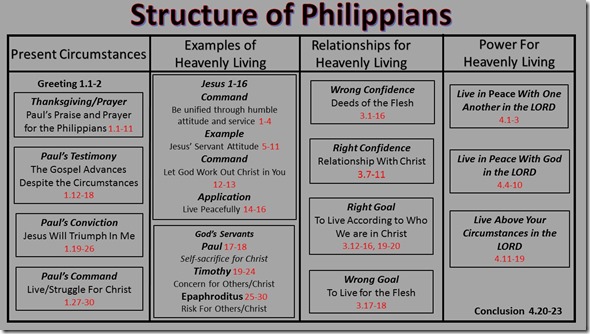
Structure and Message of Philippians

Philippians Color Chart

Message of Philippians

As citizens of heaven, we must rejoice and endure in the struggle because Jesus’ strength goes beyond any difficult circumstance or suffering we may face.

Outline of Philippians

God, in Christ, will accomplish His plan in His people, His church and in the world despite present circumstances and struggles.   1:1-30

  • The growth in the Philippian church is an example of how God can accomplish His plan.  1-11
    • The Gospel message is that God will complete what He began in His people. 1-6
    • The Gospel message results in brotherly love and concern in Jesus Christ. 7-8
    • The gospel message grows the believer into deeper relationship and imitation of Jesus. 9-11
  • Paul’s experience shows that adverse circumstances cannot stop the Gospel. 12-18
    • His imprisonment advanced the gospel through the palace guard and encouraged fearless preaching. 12-14
    • Even when the motivation is wrong, Gospel preaching will accomplish its goal. 15-18
  • Paul’s conviction is that everything done for and through Christ will be meaningful and successful. 19-26
    • Whether temporary circumstances are good or bad god will enable His people to glorify Him. 19-20
    • Even death cannot stop Christ from being glorified through his faithful people. 21-26
  • Therefore, no matter what the struggle, persecution or circumstance, live according to the gospel. 27-30 

Follow the humble and sacrificial examples of  Jesus, Paul, Timothy and Epaphroditus. 2:1-30

  • Have the humble, servant and self-sacrificing attitude Jesus had in His incarnation. 1-16
    • Command: Be unified by a humble attitude and service in the power of the Spirit. 1-4
    • Example: Jesus, God in the flesh, did not grasp his rights. Instead, He gave them up which resulted in the Father exalting Him to the ultimate position of power and authority.  5-11
    • Application: Allow Christ to work in you so that you can live peaceful, holy and contented lives.  12-16
  • Have the Christ-like attitude and actions of God’s servants. (Leaders should model sacrifice and service) 17-30
    • Paul’s life is an example of joyful self-sacrifice for Christ and His people. 17-18
    • Timothy’s life is an example of concern for God’s people and the work of the gospel. 19-24
    • Epaphroditus’ life is an example of the willingness to risk one’s own life for the gospel. 25-30

The confidence and focus of the successful Christian life is relationship with Jesus Christ. 3:1-21

  • The wrong basis for confidence is one’s own life, righteousness and rituals.  1-6
    • Beware of those who encourage legalism instead of relationship with Jesus through the Spirit. 1-3
    • Even Paul’s strict legalistic righteousness as a Pharisee was not enough. 4-6
  • The right confidence is Jesus’ righteousness found in a growing relationship with Him.  7-11
    • Compared to the benefit of knowing Jesus and His righteousness everything else is useless. 7-9a
    • Righteousness and relationship come through faith in Christ alone 9b
    • We experience Jesus’ righteousness and grow in it as the relationship with Jesus Christ grows.  10-11
  • Our goal should be to experience who we are in Jesus Christ. 12-16
    • We must focus on the heavenly goal and work hard to be what He calls us to be. 12-14
    • Maturity  is seen as, in Christ, we live up to the image of Christ. 15-16
  • To focus on the present and live for one’s lusts results in destruction. 17-19
  • You are destined to be a citizen of heaven. Live like you are now. 20-21

Only in relationship with Jesus Christ can we find power for heavenly living on earth. 4:1-23

  • Relationship with Christ gives you the power to stand firm and live in peace and unity with one another. 1-3
  • Relationship with Christ brings joyful, peaceful, pure and righteous thoughts and actions. 4-10
    Relationship with Christ allows you to live above the circumstances of life. 11-19
    • Circumstances do not matter because God can supply what is needed for any situation. 11-15
    • God often provides through the generosity of His people and rewards them for it. 16-19
  • The grace of God brings us together to bring glory to God 20-23

Reading Through Philippians #2 (2.19-4.23)

PhilippiansThis post concludes a quick read through of Paul’s letter to the Philippians accompanied by Philippians (The IVP New Testament Commentary Series) , by Gordon Fee. I enjoyed this commentary and plan on taking a closer look at it as I work through Philippians in the future. I am posting from my reading in the New Testament accompanied by various commentaries on Monday, Wednesday and Friday and welcome comments and discussion on my Facebook page. I am using the Logos version of the book. As usual my comments are in black and quotes from the book are in blue.

Paul now moves into the more applicational part of the letter in 2.19-4.3. He begins with the examples of his co-workers Timothy and Epaphroditus to show the Philippians what a Christ-centered and Cross-focused life looks like. Timothy exemplifies a life based on the truth of the gospel lived out in a self-sacrificial way that considers the needs of others as more important than one's own. Epaphroditus shows that this lifestyle is willing to risk suffering and death to meet the spiritual and physical needs of others and to accomplish the mission of bringing the gospel to the world. Paul then moves to the bad example of the "circumcision party" who were more concerned about their own welfare and wanted to come to God based on their own accomplishments rather than through faith in Christ. Paul could have chosen that path, and lived that way before he met Christ, but now considered any past righteousness he has as "smelly street waste" and considered that only pursuit of relationship with Christ had any value. Though this led to suffering in the present, the eternal payoff was worth it. Knowing Christ, through the Spirit, is the only thing that produces God's righteousness, unity, and the joy and peace of God.

Joy does not mean the absence of sorrow but the capacity to rejoice in the midst of it...The God he serves is full of mercy, both in healing the sick and in sparing the heavy-laden from further sorrow. Note too that Paul simply would not understand the denial of grief that some express today when they rejoice over the death of a loved one. No, death is still an enemy—ours and God’s (1 Cor 15:25–26)—and grief is the normal response; but it is sorrow expressed in the context of hope (1 Thess 4:13). Philippians 2.19-30, 124

What Paul has in view is neither congregational worship nor internal “spiritual” service (personal piety) over against external rite, but two ways of existing: in the flesh, meaning life centered in the creature as over against God, and by the Spirit, as people of the future for whom all life in the present is now service and devotion to God. Philippians 3.1-4, 134

Christian life means to be finished with one’s religious past as having value before God or as a means of right relationship with God; it means to trust wholly in Christ as God’s means to righteousness. But such “righteousness” has as its ultimate aim the surpassing worth of knowing Christ Jesus my Lord; and knowing Christ means to experience the power of his resurrection for present sharing in his sufferings, as those sufferings are in “conformity with his death.” Philippians 3.5-14, 151

Paul concludes with some final commands that sum up his example and the Christian life to which believers are called. Christians live a life of joy, despite suffering and persecution, because there is no greater source of meaning and peace now, and, just as Christ rose from the dead and rules, we will share in his kingdom and rule and experience completely the defeat of death, sin, and the evil powers that persecute God's people. Ultimately, the Christian life is not about our current situation or our abilities etc, but it is centered on knowing Christ. Thus, we can always be joyful because, whatever happens in our life, we will end up victorious in Him. It is all about Jesus; knowing and serving Him.

This passage reminds us that despite appearances often to the contrary, God is in control, that our salvation is not just for today but forever, that Christ is coming again, and that at his coming we inherit the final glory that belongs to Christ alone—and to those who are his. It means the final subjugation of all the “powers” to him as well, especially those responsible for the present affliction of God’s people. Philippians 3.15-4.3, 166

These concluding exhortations call us to embrace what is good wherever we find it, including the culture with which we are most intimately familiar, but to do so in a discriminating way, the key to which is the gospel Paul preached and lived—about a crucified Messiah, whose death on a cross served both to redeem us and to reveal the character of God into which we are continually being transformed. Philippians 4.4-9, 181

This passage points up the absolute Christ-centeredness of Paul’s whole life. He is a man in Christ. As such he takes what Christ brings. If it means “plenty,” he is a man in Christ, and that alone; if it means “want,” he is still a man in Christ, and he accepts deprivation as part of his understanding of discipleship. Philippians 4.10-23, 187

Thursday, June 28, 2018

Our Brief June 2018 Prayer Letter

Greetings,

There is not much new to report on our situation but I thought it good to give a brief update. We recently returned from 3 weeks in Cincinnati with our family there. We enjoyed being with the grandkids and were able to help Samantha with the kids while Mike is in Israel for 6 weeks of summer study. It was an opportune time for us to be there as Samantha had to go to Texas to be with her mother who has been diagnosed with Stage 4 cancer. We would appreciate your prayers for Martha Santana and for Mike and Sam as they try to help.

It looks like July will be a busy month for us. We have been blessed, since last September, by Gold Country Baptist Church allowing us to stay in their parsonage. It looks like they will have a new associate pastor soon so we may be moving before the end of July. We have put in an application at an apartment in El Dorado Hills but it looks like it will be at least 4-6 months until we hear anything on that. In the meantime, our plan is to move back in to my parents' house and stay in their downstairs apartment. This will allow us to help them out around the house etc. and we hope will become a home base for ministry as I continue to get better and more able to get out. We also have a week of medical testing July 23-26 at Stanford. We are anticipating a good outcome and ask that you be praying for that.

Our plans have not changed much. We are hoping that after all my scans are clear next month, we can begin working part-time with Liebenzell USA and receiving salary support again. I am working on applying to a work program for people with disability that allows this. This would also separate my medical insurance from Joyce's which would help. Please be in prayer for this. This would give us the opportunity to start slow and work our way back into a ministry representing the mission and providing training and assistance to Micronesian groups in the US. I am also hoping to teach a PIU on-line seminary course in the Fall. We have not been able to work out the details on all of this yet, but I would hope we'd be able to restart official ministry in August or September.

In the meantime I get a little stronger and feel a little better every day. My edema is still an issue. It took about 2-3 days to recover from the flights each way. I would say that an international flight is still out of reach. Joyce is doing well and is glad that she is available to help her mom and dad move into a retirement home nearby. She will be close enough to help her dad provide some care for her mom.

I get a little frustrated with the waiting but we are confident in God's care for us. If you have any questions please ask by email or give me a call. We appreciate your prayers and support very much.

Blessings

Dave

Reading Through Philippians #1 (1.1-2.18)

PhilippiansThis post begins the quick read through of Paul’s letter to the Philippians accompanied by Philippians (The IVP New Testament Commentary Series) , by Gordon Fee. In Philippians Paul urges the church to be joyful in the midst of persecution and united in the midst of disagreements. I am posting from my reading in the New Testament accompanied by various commentaries on Monday, Wednesday and Friday and welcome comments and discussion on my Facebook page. I am using the Logos version of the book. As usual my comments are in black and quotes from the book are in blue.

Philippians is a friendly letter to a church in which Paul has spent a great deal of time and knows the people well. He is confident of their faith and partnership in the work of the gospel. He wants to thank them for the gifts that they have already given to advance his mission work. He also wants to warn them to keep focused on Christ and not succumb to the kind of divisions that result (Galatians and Romans) when the gospel is adulterated with additional requirements or selfish motives. For Paul it is "all about Christ" and he wants to instill this focus in the Philippian church.

God’s essential character on display in Christ, who redeems us to share that likeness—also underlies the other well-known themes in this letter: suffering, joy, unity, pressing on toward the prize...Thus the theology of Philippians is held together by its singular focus on Christ. Philippians Intro, 36–37

Paul begins the letter with a greeting and prayer. The greeting is brief but the prayer goes far beyond the standard friendly letter. Paul views their friendship as a "three-way bond" that is centered around Jesus Christ. He is confident that the work of the Holy Spirit within them will complete the goal of making them over into the image of Christ. He already sees this at work as the Philippian church has participated in the work of the gospel through their finances and sending of Timothy and Epaphroditus to help him. His prayer is that, in the Spirit, they will experience the love of Christ even more deeply, know him in a growing relationship and that this will bear the fruit of acts of righteousness that resemble Christ. Paul himself is an example of this as he lives his life based completely on what Christ has done for him and what He has promised for the future.

Joy lies at the heart of the Christian experience of the gospel; it is the fruit of the Spirit in any truly Christian life, serving as primary evidence of the Spirit’s presence (Rom 14:17; Gal 5:22). Precisely because this is so, joy transcends present circumstances; it is based altogether on the Spirit, God’s way of being present with his people under the new covenant. Philippians 1.1-11, 46

Paul has learned by the grace of God to see everything from the divine perspective. This is not wishful thinking but deep conviction—that God has worked out his own divine intentions through the death and resurrection of Christ, and that by his Spirit he is carrying them out in the world through the church, and therefore through both Paul and others. Philippians 1.12-18, 64

One wonders what the people of God might truly be like in our postmodern world if we were once again people of this singular passion. Too often for us it is “For me to live is Christ, plus other pursuits.” And if the truth were known, all too often the “plus factor” has become our primary passion: “For me to live is my work.” Both our progress and our joy regarding the gospel are altogether contingent on whether Christ is our primary, singular passion. Philippians 1.19-26, 75

Paul now moves to his first main exhortation to the Philippians in 1.27-2.18. He wants them to be the image of Christ as they "stand" for the Gospel, despite the opposition of the empire which declares "Caesar is Lord," and live out the Gospel without "grumbling or complaining," as Christ did, by using his status as God for the benefit of others as he saved us by going to the cross. This makes sense because, just as God exalted Christ through the resurrection and ascension, he will exalt all of Jesus' people when all creation acknowledges that "Jesus is LORD." So Paul calls the Philippians to courage in the face of persecution and unity in relationships within the body of Christ. This is only possible when believers live by the power of the Spirit. Only then can salvation be "worked out" in relationship with one another and in our common mission to proclaim and live out the gospel. 

A crucified Lord produces disciples who themselves take up a cross as they follow him. We are thus to live on behalf of Christ in the same way Christ himself lived—and died—on behalf of this fallen, broken world. That is why salvation includes suffering on behalf of Christ, since those who oppose the Philippian believers as they proclaim the gospel of Christ are of a kind with those who crucified their Lord in the first place. Philippians 1.27-30, 81

Paul’s reason is singular: to focus on Christ himself, and thus to point to him as the ultimate model of the self-sacrificing love to which he is calling the Philippians—and us...In Jesus Christ the true nature of the living God has been revealed ultimately and finally. God is not a grasping, self-centered being. He is most truly known through the One whose equality with God found expression in his pouring himself out in sacrificial love by taking the lowest place, the role of a slave, and whose love for his human creatures found consummate expression in his death on the cross. That this is God’s own nature and doing has been attested for all time by Christ Jesus’s divine vindication. Philippians 2.1-11, 101

The underlying theology in all of this is God’s own character, as that is now reflected in his children who bear his likeness as we live out the life of the future in the present age. Only as we reflect God’s own likeness will our evangelism be worth anything at all, in terms of its aim and in terms of success. Philippians 2.12-18, 113

Tuesday, June 26, 2018

Structure and Message of Ephesians

Ephesians Color Chart

Message of Ephesians

The Church is a unity, with diverse members, formed by God’s eternal plan, with a shared salvation in Christ and a shared calling to glorify God in the power of the Spirit.

Basic Outline of Ephesians

  • The basis of the unity of the Church is a common salvation in Jesus Christ. 1:1-3:21
    • Because of God’s grace and peace the church is God’s “holy ones” through faith. 1:1-2
    • Salvation is a blessing from God that we can experience “in Jesus Christ.” 1:3-23
      • The entire Trinity worked together to bring salvation to the Church. 1:3-14 (one sentence)
      • Believers can have the full experience of all of God’s blessings through the power of Jesus Christ 1:15-23
    • Salvation unites people who are diverse and at odds with one another into one unified body. 2:1-3:21
      • Salvation by grace through faith is the one common means of entry into the church. 2:1-10
      • Salvation provides a common basis for peace with God and with each other. 2:11-22
      • Salvation brings a common purpose to life: To glorify God before all creation. 3:1-21
  • The Church must be unified because all its members share a common calling and mission. 4:1-6:24
    • All Believers have a common responsibility: Preserve the unity of the Church 4:1-16
      • The church’s unity is based on the Unity in the Trinity, common hope and common calling. 1-6
      • The church is made up of diverse members who work together with a unified mission. 7-16
    • Believers should have a common lifestyle: Like Jesus’ Lifestyle 4:17-5:14
      • Believers must live as a new creation by renouncing the deeds of the old way to live the way Jesus would. 4:17-5:2
      • Believers must be careful to live a lifestyle that accurately reflects Christ and pleases the Lord. 5:3-14
    • Believers have a common power to live like Christ: The Holy Spirit 5:15-6:9
      • Control by the Spirit provides power to live thankfully and submissively as Jesus lived. 5:15-21
      • Spirit control is measured and seen in loving, transformed Christlike relationships that are mutually submitted to and serve one another . 5:22-6:9
    • Believers have a common battle against spiritual darkness and spiritual attack. 6:10-20
      • Believers must be ready for battle by actively using what Christ has provided. 10-17
      • The main offensive weapon in the spiritual battle is prayer. 18-20
    • Closing: Unity brings fellowship, peace and grace 6:21-24

Jesus Paid a High Price For The Unity of the Church - Don’t Break It

Monday, June 25, 2018

Stuff I like About Being a Grandpa (Cincinnati Version)

1041

Since Joyce and I are back in California I have been reflecting on the three weeks we spent in Cincinnati with Mike’s family. We had a great time there and I am very thankful to the LORD (still fulfilling my vow of praise) that I am still around and healthy enough to make the flight (though with some minor complications) and enjoy most of the activities we had an opportunity to do. So, in no particular order, here are some things that make me glad that I made it to this point of being a grandpa.

  1. 1068The greeting I received each morning from my 2 year old granddaughter Arie as I woke up and came up the stairs to the kitchen to make my coffee, “Good morning grandpa, how are you doing today?” This was pretty much always accompanied by the smile of a person who was genuinely glad to see me.
  2. Listening to my 10 year old granddaughter, Courage, sing along with all the songs from “The Greatest Showman” while we watched the movie on Netflix. This made the movie infinitely better.
  3. 20180612_165330Eating lunch with the 3 older grandchildren at their schools and getting to meet their friends and teachers. I am thankful that they are in very good schools and it was fun to see them in their “natural habitats.” I also learned a lot about video games sitting at a table with six eleven year old boys.
  4. Reading the same books over and over to Arie. I am thankful that all my grandkids love books.
  5. Playing story games with Titus. 1035It was fun to try to top his “out there” stories. How did I get a grandson that is already into reading science fiction and theology?
  6. Hearing Serenity pound out “Joyful, Joyful, We Adore Thee” on the piano. Talking with her (well, mostly listening to her) and sharing in her joy in just living life and her keen notice and concern for everything around her.
  7. One of my lifelong dreams was to take my grandkids to a major league baseball game: Accomplished that one as we got to go to a great 12 inning game accompanied by hot dogs, sodas, peanuts, popcorn and cotton candy. A great day was had by all.
  8. 20180612_165411Taking the grandkids to church and meeting their pastor, Sunday school teachers etc. We are so thankful that they are in a great body of people that care about them and support them.
  9. Catching fireflies in the evening in the backyard. It reminded me of summers I spent as a child visiting my grandparents in Missouri. Good memories.
  10. Seeing Joyce so happy to be with her “babies, “ even if a couple of them are almost as tall as she is now.

We miss them already, but are happy about what they are doing and how God is working in their lives. I am sure we’ll find a way to get back there soon. Of course a San Diego version of this post may be coming soon too.